On this page
- Key takeaways
- The buyer's side: how a size run is actually ordered
- The size curve
- The opening order and the reorder
- The colourway decision
- The receiving dock
- The time budget
- Where the order breaks: the friction map
- Break 1: The curve doesn't fit the carton
- Break 2: The prepack and the curve disagree
- Break 3: Prepacks and loose units share the same jackets
- Break 4: Minimums that count the wrong thing
- Break 5: Price breaks that ignore the run
- Break 6: Sold-out sizes inside a prepack
- The operational effects: what each break costs
- Slower confirmations
- Allocation errors
- Stock you can't trust
- Buyers who stop ordering online
- Three ways brands sell sizes, and what each needs
- Open stock
- Cartons
- Prepacks
- A worked example: one rain jacket through a season
- The prepack question in more detail
- Option A: Prepack as its own SKU
- Option B: Prepack as a bundle of loose units
- Option C: Prepack logic in the ERP
- What it looks like on Shopify today
- The merchant checklist: decisions that fix most of it
- Messages buyers can act on
- What to tell your sales reps
- A five-minute test on your own store
- Returns and claims
- How to tell whether it's fixed
- When it's worth asking for help
- FAQ
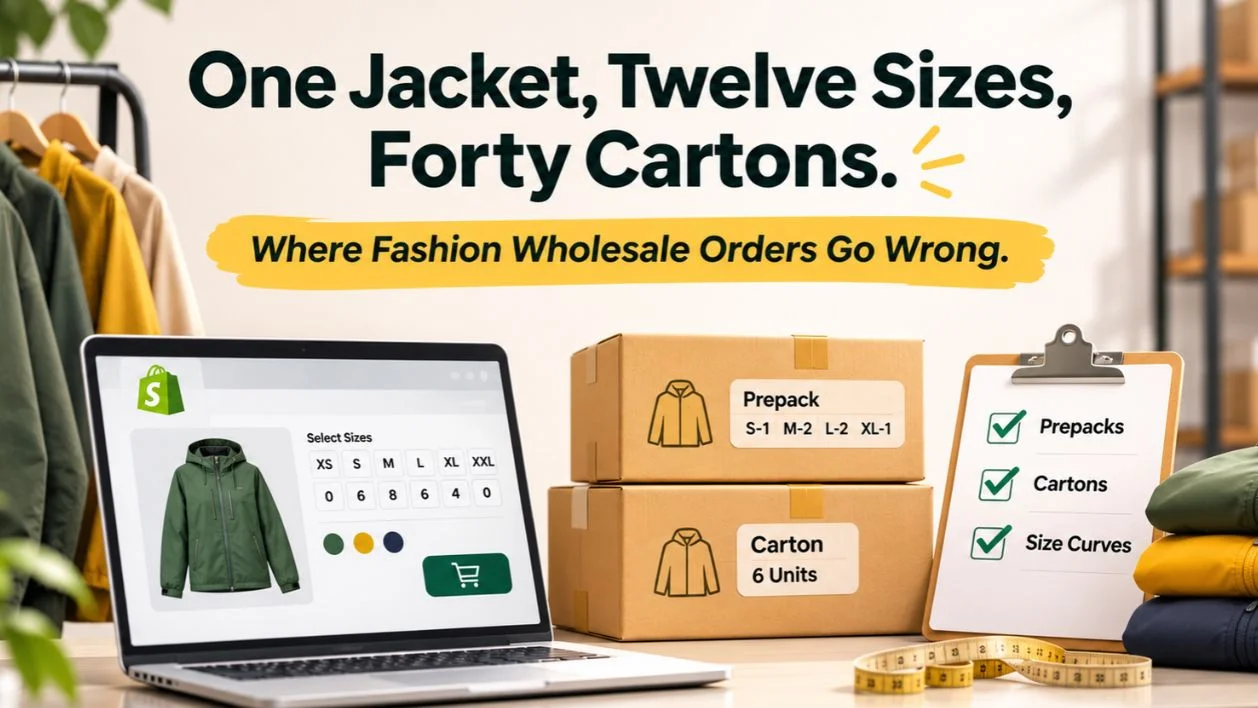
A boutique buyer orders a rain jacket in three colours across the size run. She clicks through, the order goes in, and everyone thinks the job is done. Then the warehouse looks at it. The brand ships that jacket in cartons of six, and in prepacks of one S, two M, two L and one XL for opening orders. The buyer's 17 units in an uneven size spread don't fit either. Someone emails her. She changes it, or doesn't. The order sits in "unfulfilled" for four days.
That gap between how buyers order and how stock physically moves is where most fashion wholesale orders go wrong. This post is about that gap: prepacks, cartons and the size curve. It walks through a real-shaped buyer scenario, maps where the order breaks, shows the operational cost behind each break, and ends with a checklist of decisions that remove most of the manual work.
If you're looking for how to set up a size and colour order form on Shopify, our guide to Shopify apparel wholesale ordering on the MultiVariants blog covers that, including the basic prepack arithmetic. This post picks up where that guide stops: what happens to the order after the buyer clicks, and why.
Key takeaways
Buyers think in size curves ("more M and L than XS"). Warehouses think in cartons and prepacks. Shopify's native quantity rules think in single variants. The order has to survive all three.
Shopify's minimum, maximum and increment rules apply to each variant on its own, and price breaks need the quantity on each variant (Shopify Help Center). There is no native prepack or size-ratio setting.
Selling prepacks as their own SKUs works at checkout but splits your stock into pack units and loose units, which then drift apart.
The cost shows up after checkout: edited orders, split cartons, short shipments, re-invoicing and slow confirmations.
Most of it is fixed by decisions, not code: sell mode per season, what counts toward a minimum, the carton rule, and what happens to odd quantities.
The buyer's side: how a size run is actually ordered
Start with how the buyer thinks, because everything else has to bend around it.
The size curve
Boutiques don't order equal amounts of each size. They order to a curve based on what sold last season: perhaps one XS, two S, three M, three L, two XL and one XXL. For a store with a younger customer, the curve shifts small. For workwear, it shifts large. The curve is the buyer's knowledge, and she expects the brand to respect it.
The opening order and the reorder
At the start of a season, buyers place opening orders, often from a line sheet or at a trade show, often months ahead of delivery. Brands commonly ask for prepacks or full cartons here, because it makes allocation and shipping simple. Mid-season, the same buyer reorders what sold: three M in black, two L in olive. That's open stock, and it's small. Our MultiVariants post on opening orders vs reorders covers why those two flows need different handling on the storefront.
The colourway decision
Buyers often decide colour first and sizes second. "I'll take the black and the olive, not the sand." Then they fill sizes within each colour. A minimum that ignores colour, or one that applies to each size, fights that decision.
The receiving dock
What arrives matters too. A boutique with a small stockroom wants cartons it can open and put straight onto the rail, ideally one colour per carton. A department store buyer may need cartons labelled by size and colour so they can be checked in quickly. If your cartons don't match how the buyer receives stock, the friction just moves from the order to the delivery.
The time budget
A wholesale buyer ordering for a small shop has dozens of brands to get through. If your order takes three times longer than the next brand's, she'll email you a spreadsheet instead, or skip the reorder.
Where the order breaks: the friction map
We mapped the path from "buyer opens the product" to "order is packed". The same six breaks come up again and again for fashion brands that sell in cartons or prepacks.

Break 1: The curve doesn't fit the carton
The brand packs cartons of six. The buyer's curve for one colour adds up to 12, which fits two cartons, but her curve for the other colour adds up to 9. That's one and a half cartons. Someone has to round it up, round it down, or ship a split carton. Each option changes the order the buyer placed, and each needs her agreement.
Shopify's native increment setting doesn't help here, because it counts each variant on its own. An increment of 6 on a jacket means six of every size, not six in total. Shopify's own help page uses a hat example: a buyer can't combine 5 grey and 5 blue hats to meet an increment of 10.
Break 2: The prepack and the curve disagree
A 1-2-2-1 prepack is a fixed curve. If the buyer's real curve is 1-2-3-2, the prepack either leaves her short on L or long on S. Many brands accept that as the price of prepacks, but the buyer should know it before ordering, not after.
Break 3: Prepacks and loose units share the same jackets
The common workaround is to sell each prepack as its own product or variant: "Rain jacket, black, Pack A (6 units)". It checks out cleanly. But now the same physical jackets exist twice in Shopify: as loose sizes and inside packs. If the warehouse breaks a pack to fill a reorder, the pack count is wrong. If it doesn't, loose sizes can sell out while packs sit full. Over a season, the two counts drift.
Break 4: Minimums that count the wrong thing
The brand wants 12 per style. Native rules make that 12 per size, which no boutique will buy. So the brand drops the native minimum to 1 and checks minimums by hand. Now every order needs a human to look at it.
Break 5: Price breaks that ignore the run
The sales rep promised 10% off from 48 units. The buyer orders 48 across eight sizes and two colours. Native volume pricing needs the quantity on each variant to qualify (Shopify Help Center), so no break applies. Either the buyer pays more than she was told, or someone re-invoices.
Break 6: Sold-out sizes inside a prepack
One size in a prepack runs out. A loose-size store just greys out that size. A prepack store either stops selling the whole pack, or keeps selling packs it can't fill. The second is worse: it turns into a short shipment and a credit note.
The operational effects: what each break costs
None of these breaks show up as an error message. They show up as work.

Break | What staff do | What the buyer sees |
|---|---|---|
Curve doesn't fit the carton | Round the order and email to confirm | A different order from the one she placed |
Prepack vs curve | Explain the ratio after ordering | Too many of one size, too few of another |
Prepack SKUs share stock | Move stock between pack and loose SKUs | Packs available while sizes are sold out, or the reverse |
Minimum per size | Approve exceptions by hand | "Why can't I order 2 of XS?" |
Price break per size | Refund or re-invoice the difference | A price that changes after ordering |
Sold-out size in a prepack | Short-ship and issue a credit | An incomplete delivery |
Slower confirmations
Each manual check adds a delay between the order and the confirmation. For an opening order placed months ahead, that may not matter. For a mid-season reorder of a style that's selling, every day the order sits is a day the shelf is empty.
Allocation errors
When cartons and prepacks are fixed by hand, allocations drift from what was ordered. The warehouse picks what the edited order says, not what the buyer remembers. That's how "I ordered three M" turns into a support ticket.
Stock you can't trust
Split stock between pack SKUs and loose SKUs is the slowest-acting problem. It doesn't break anything on day one. By the end of the season, the counts on Shopify and in the warehouse no longer agree, and your sell-through data is wrong for planning the next one.
Buyers who stop ordering online
The quietest cost is the buyer who goes back to email. She isn't complaining; she's just decided your store is more work than a spreadsheet. If your wholesale orders by email aren't falling after launching online ordering, this is usually why.
We don't have figures for how long any of this takes in your business, so measure it. Count last month's wholesale orders that were edited after checkout, and how long they waited.
Three ways brands sell sizes, and what each needs
The fix starts with naming how you sell each style, because each sell mode needs different rules.

Open stock
The buyer orders any quantity of any size. Rules are about the style or the colour: "12 per style", "at least 6 per colour". This is the most flexible for buyers and the simplest for stock, because every unit is a loose unit. What it needs from Shopify: a way to count across sizes. Native rules can't, so it needs an app or custom logic.
Cartons
The buyer orders in multiples of a carton size, usually on the style or colour total, not per size. "Any sizes, in multiples of 6." What it needs: a step on the total, and a clear message when the total is between cartons. Some brands also allow one mixed carton per colour as an exception.
Prepacks
The buyer orders packs with a fixed size ratio. What it needs: a pack that's sold as a unit, stock that stays honest between packs and loose units, and a plan for sold-out sizes. Shopify has no ratio setting, and neither do most quantity-rule apps, so prepacks are usually their own SKU or come from an ERP.
Many brands use prepacks or cartons for opening orders and open stock for reorders. That's fine, as long as each style knows which mode it's in at each point in the season.
A worked example: one rain jacket through a season
Here's a made-up brand to show how the breaks pile up. It sells a rain jacket in black, olive and sand, in XS to XXL. Opening orders come in a 1-2-2-1 prepack of S, M, L and XL, plus XS and XXL as loose units. Reorders are open stock in cartons of 6 per colour. The trade price drops 10% at 48 units of the style.
At the start of the season, the warehouse receives 1,200 jackets. It packs 120 prepacks (720 jackets) and keeps 480 loose. On Shopify, the brand creates three prepack variants, one per colour, with 40 each, and keeps the loose sizes as normal variants.
In February, a boutique orders 4 black prepacks, 3 olive prepacks and 2 loose XS in black. That's 44 units. The rep told her 10% off from 48, so she adds 4 loose XXL to reach 48. Native price breaks look at each variant, so none of the 48 qualify. The brand re-invoices by hand.
In April, the same boutique reorders: 3 M and 2 L in black, 4 M in olive. That's 5 black and 4 olive, and the carton rule is 6 per colour. Native increments would demand 6 of each size, so the brand turned them off. Staff email her to round up. She adds one black and two olive, and the order ships a week later than it could have.
In May, loose black M sells out. The warehouse opens two black prepacks to fill reorders, but nobody adjusts Shopify. Shopify still shows 30 black prepacks available. In June, a new stockist orders 4 black prepacks. The warehouse can only fill 2. She gets a short shipment and a credit note.
None of these was a system failure. Every rule was enforced by a person, and each person did something reasonable. The fix isn't working harder. It's deciding the rules up front, and putting them where the store can check them: carton steps on the colour total, tiers on the style total, and a written rule for breaking prepacks.
The prepack question in more detail
Prepacks deserve extra attention because they're where workarounds cause the most damage.
Option A: Prepack as its own SKU
Each prepack is a product or variant with its own stock count, physically packed in the warehouse. Simple at checkout, clear for picking. The cost is two stock pools for the same jackets. It works best when packs are built once at the start of the season and never broken.
Option B: Prepack as a bundle of loose units
The prepack is a bundle that draws its components from loose stock: one S, two M, two L, one XL. Stock stays in one pool, and a sold-out size makes the pack unavailable automatically. The cost is that the warehouse picks a pack from loose units every time, unless it also keeps pre-packed stock, which brings back the two-pool problem. Shopify's free Bundles app can make a fixed bundle like this; check how it fits your B2B catalogs and pricing before relying on it.
Option C: Prepack logic in the ERP
The ERP holds the pack definition and allocates sizes when the order arrives. Shopify sells "packs" as a unit, and the ERP turns them into sizes. It's the cleanest for stock and the heaviest to build. It usually means an agency and integration work.
There's no universal best choice. Pick the one that matches how your warehouse physically stores the jackets, and write down what happens when a size runs out.
What it looks like on Shopify today
Here's where each piece sits with Shopify's native B2B and the apps most fashion brands consider.
Native B2B (Basic and up): companies, catalogs, trade prices, a quick order list, per-variant minimums, maximums and increments, and up to 10 price breaks per product that apply to each variant.
MultiVariants (our app): a size and colour matrix on the product page (Standard plan, $12.99 a month), and minimums and maximums on the combined total across sizes, a minimum per option such as "at least 12 in red", limits on the number of variants, and step quantities (Professional plan, $29.99 a month). It doesn't create fixed-ratio prepacks.
DiscountRay (also ours): quantity tiers on the free plan, and B2B prices by customer group or tag on Growth ($14 a month), so a 48-unit tier can count the style total.

For a full decision by sell mode, see Native Shopify B2B or MultiVariants: which should handle wholesale size runs? If you're hiring help, our list of Shopify agencies for fashion wholesale names four with public wholesale projects.
The merchant checklist: decisions that fix most of it
Use this to fix an existing setup or before launching wholesale ordering. Write the answers down; they become your setup spec.
Name the sell mode for each style and season: open stock, cartons or prepacks.
Decide what counts toward a minimum: per style, per colour, or per size.
Set the carton rule: a step on the style total, on the colour total, or none.
Choose your prepack model: own SKU, bundle of loose units, or ERP.
Decide what counts toward a price break: almost always the style total.
Decide what happens to odd quantities: block, round up with a message, or allow and confirm.
Decide what happens when one size in a prepack sells out.
Write the message a buyer sees for each rule, in plain words.
Agree who can approve an exception, and how it's recorded.
Measure edited orders monthly, and aim for zero.

Messages buyers can act on
Every rule needs a message at the moment it's broken. A generic "quantity not allowed" sends buyers to email. A message that says what to do keeps them on the page. Some examples, which you'd write in your own voice:
"This style has a minimum of 12 in any sizes. You have 9. Add 3 more."
"We ship olive in cartons of 6. You have 4. Add 2 more, or remove 4."
"Order 48 or more of this style, in any sizes, for 10% off. You're at 41."
"Prepack A is unavailable because size M is sold out. You can order the other sizes as open stock."
Show the rule on the product page before the buyer starts, not only when she breaks it. "Minimum 12 per style, cartons of 6 per colour" next to the grid saves most of the errors.
What to tell your sales reps
Reps are often where the rules break first, because they make promises in person. Give them a one-page sheet that matches what the store enforces: the minimum per style, the carton rule, the prepack ratios, and exactly how tiers are counted. If a rep can promise "10% off from 48 in any sizes", the store has to honour it automatically. If it can't, the rep shouldn't promise it.
Also agree how reps place orders on a buyer's behalf. Orders created as drafts in Shopify admin don't go through the storefront, so storefront rules don't check them. Either reps order through the storefront logged in as the buyer, or they check the rules by hand and note it on the order.
A five-minute test on your own store
Log in as a test wholesale buyer and try these:
Order one style across four sizes to your size curve.
Order 7 units when your carton is 6.
Try to reach your first price break with mixed sizes.
Order a prepack, then check the loose-size stock for the same jacket.
Set one size to zero and try to order a prepack containing it.
Check the order in admin: is the price what the buyer saw?
If any of these needed a human to fix, you've found your friction.
Returns and claims
Prepacks and cartons also change how returns work. A boutique that returns two faulty jackets from a prepack is returning loose units, not a pack. If the pack was sold as its own SKU, there's no loose variant to refund against on that order, and staff improvise. Decide in advance:
Are faulty units from a prepack refunded at the pack's per-unit price or the loose trade price?
Do returned units go back into loose stock, or are they written off?
Can a buyer return a whole unopened prepack, and within what window?
How is a short shipment credited when a prepack couldn't be filled?
Put the answers in your wholesale terms, so buyers know before they order and your team doesn't have to decide case by case.
How to tell whether it's fixed
Once the rules are in place, track a few numbers every month for at least one season. You don't need a dashboard; a shared sheet is enough.
Edited orders: wholesale orders changed by staff after checkout. This is the main number, and it should fall towards zero.
Time to confirm: hours between the order and the confirmation email. Reorders should be confirmed the same day.
Short shipments: orders that left the warehouse with fewer units than ordered, usually because of prepack stock.
Re-invoices and credits: price corrections after the order, which point to tiers counting the wrong thing.
Email orders: wholesale orders that still arrive by email or spreadsheet from buyers who have an online account.
If edited orders fall but email orders don't, the rules work but the store is still too slow for buyers. Look at the order form, not the rules. If short shipments stay high, look at how prepacks and loose stock are adjusted when the warehouse breaks a pack.
When it's worth asking for help
If your rules are open stock with style or colour minimums and carton steps, an app usually covers it. If you sell prepacks across seasons, have an ERP that owns allocation, or need opening orders and reorders on different rules for different buyers, that's where an assessment or an agency pays off. Ask us for a size-run assessment and we'll walk through the checklist with you.
FAQ
What is a prepack in fashion wholesale?
Can Shopify sell prepacks natively?
Why does Shopify's increment setting not work for cartons?
What is a size curve?
Should I use prepacks or open stock?
How do I stop prepack and loose stock drifting apart?
Can price breaks count mixed sizes?

Anika Anamta Mehnaz
This article is written by Anika Anamta Mehnaz, a Content Writer and Content Marketing Strategist specializing in Shopify, eCommerce, and SaaS. With over four years of content writing experience, she creates SEO and AI search-optimized content that helps Shopify merchants make better business decisions through practical, research-backed insights. Her work covers Shopify apps, product variants, bundles, discounts, B2B commerce, and conversion-focused strategies. Outside of work, Anika enjoys watching anime, reading John Grisham novels, and discovering new ideas in digital marketing and e-commerce. If you enjoy discussing Shopify, content marketing, or online growth, feel free to connect with her. Twitter: https://x.com/mehnaz2201 Medium: https://medium.com/@mehnaz_78932
Keep reading
View all articles →
The Wholesale Size-Run Playbook: Stop Collecting Orders in Spreadsheets
November 11, 2026 • 17 min read

The Size-Run Problem: Shopify Agencies That Make Fashion Wholesale Orders Less Painful
November 11, 2026 • 18 min read

Shopify Wholesale Setup: The Full B2B Journey, From First Quote to Reorder (2026)
November 6, 2026 • 17 min read