On this page
- Key takeaways
- Why garages need a different kind of auto parts store
- How we chose these Shopify agencies for auto parts
- The five agencies at a glance
- Uncap: the strongest public B2B evidence
- Red Van: speed and simplicity in a migration
- Fyresite: fitment data as the core skill
- Cartmade: built for bodyshops
- magic42: a mixed B2B and B2C migration
- What none of the public case studies show
- Where apps can do part of the job
- Trade first or drivers first? A phased plan
- Red flags in automotive agency pitches
- The garage test: send this to every agency
- Questions to ask about fitment data
- How to compare proposals
- After you hire: the first 30 days
- FAQ
If you sell auto parts on Shopify to garages and workshops as well as to drivers, look at agencies that have shipped both vehicle fitment and trade ordering, not just a good-looking store. Five agencies have public automotive Shopify work worth reviewing: Uncap (Kooks Headers & Exhaust), Red Van (CarBahn), Fyresite (Corbeau USA and its Parts Intelligence system), Cartmade (CarPanels Direct) and magic42 (Roger Clark Motorsport). None of their public case studies shows a garage reordering by part number, so make that your first test.
This post is for automotive parts brands, distributors and aftermarket sellers on Shopify, or moving to it, that sell to trade buyers. It explains what each agency's published work proves, what it leaves out, and how to test any agency on the way garages really buy. We make MultiVariants, QuotWay and DiscountRay, which come up where an app can do part of the job. No agency paid to be included, and this is not a ranking.
Last checked: 12 November 2026, against the sources linked in this post.
Who this is for: Auto parts brands, distributors and aftermarket sellers on Shopify, or moving to it, that sell to garages and workshops.
Disclosure: eFoli makes MultiVariants, QuotWay and DiscountRay. No agency paid to be included and the list is not a ranking.
Key takeaways
Most "best automotive Shopify agency" lists judge agencies on fitment search for drivers. Garages buy differently: by part number, in quantity, again and again, with trade prices and often on account.
Five agencies have public automotive work on Shopify that we could check. Each proves something different, from B2B portals to fitment data to fast migrations.
Ask every agency to show a trade buyer finding a part by OE or supplier number, ordering ten of it with two other parts, and reordering next week. That's the job, and no public case study we found shows it end to end.
Fitment data is a project of its own. The Auto Care Association's ACES and PIES standards are the industry formats for fitment and product data (Auto Care Association).
Apps can cover parts of the trade side without a custom build: bulk ordering on one page, trade pricing by customer, and quotes for special-order parts.

Why garages need a different kind of auto parts store
A driver buying brake pads wants reassurance: "Will these fit my 2019 Golf?" A year, make and model finder, good photos and reviews do that job.
A garage buying brake pads already knows they fit. The technician has the car on the lift and a part number from the catalogue or the old part. What the garage needs is speed:
Search by part number, including OE numbers and the supplier's own numbers.
Order several parts in one go, often for two or three jobs at once.
See their own price, not retail with a discount code.
Reorder quickly, because the same filters, pads and fluids go out every week.
Pay on account, with an invoice that the office can match to the job.
A store designed only for drivers fails all five. Lifestyle photos, a vehicle selector on every page and a one-product-at-a-time cart turn a 30-second reorder into a 10-minute chore. The garage picks up the phone, or orders from a distributor whose site was built for them.
So when you hire an agency, check whether their automotive work served drivers, trade buyers or both.
How we chose these Shopify agencies for auto parts
We looked for agencies that meet all of these:
At least one public automotive project on Shopify, described on the agency's own site or in a Shopify case study.
A named client we could find and check.
Evidence of fitment, trade or B2B work, not just a theme build.
We read each case study and noted what it shows and what it doesn't. We didn't contact the agencies or their clients before writing, and we haven't worked with any of them. Results quoted are as published, and we've flagged where a source is unclear.
The five agencies at a glance
Agency | Automotive work we checked | What it proves | What it doesn't show |
|---|---|---|---|
Uncap | Kooks Headers & Exhaust, Shopify case study | B2C and B2B on one store, company portals, negotiated prices, ERP link | Part-number reorder flow for garages |
Red Van | CarBahn, Shopify case study | A 10-week migration with fitment, dealer pages and big speed gains | Trade ordering, which came later on Shopify Plus |
Fyresite | Corbeau USA, Chassis Unlimited, Parts Intelligence | Deep fitment data work, VIN capture, bulk ordering with fitment | Independent results for its fitment claims |
Cartmade | CarPanels Direct | A store for trade buyers and bodyshops with reg and VIN lookup | Any performance figures |
magic42 | Roger Clark Motorsport | Migration to Shopify with B2B and B2C, fitment guides, search | Trade-specific features in detail |
Uncap: the strongest public B2B evidence
Case study: Kooks Headers & Exhaust on Shopify
Kooks makes exhaust headers and systems and has been in business since 1962. According to the Shopify case study, its old custom site had limited search, poor performance and no way to sell wholesale online. Uncap, a Shopify Platinum Partner focused on B2B, moved it to Shopify with:
One store for both consumers and wholesale buyers
Company portals with negotiated pricing, streamlined reordering and account management
Vehicle fitment by year, make, model and engine, connected to the PDM Automotive product information system
A custom link to the Infor Visual ERP for real-time stock and order sync
The case study reports a 38% reduction in total cost of ownership. It gives the conversion rate gain as 22% in the main text and 9% in the summary box, so treat the exact figure with care.
What it proves: Uncap has built a B2B portal with negotiated prices and reordering for a parts manufacturer, connected to an ERP.
What to ask: How do dealers find parts on the portal, by part number or by vehicle? How many users can one dealer account have? Can a dealer see their own order history by job or vehicle?
Red Van: speed and simplicity in a migration
Case study: CarBahn on Shopify
CarBahn is a BMW performance tuning and parts company. It had three separate WooCommerce sites competing with each other and a nine-second load time. Red Van moved it to Shopify in ten weeks, merging the three sites into one domain with:
Vehicle fitment navigation by year, make and model
Collections by vehicle, from air filters to full exhausts
A store locator and dedicated pages for 81 dealers
Shop Pay
The Shopify case study reports that organic traffic and order count both tripled within 30 days of launch, average order value rose by more than $200, load time fell from 9 seconds to 1, and return and cancellation rates fell 43%. B2B came later, through Shopify Plus, after the relaunch.
What it proves: Red Van can run a fast, clean migration for a parts brand with dealers, and the fitment and speed work paid off in published numbers.
What to ask: What did the B2B phase include? Do dealers order online, and how do they find parts? What did the agency do to cut returns by 43%, and does that apply to trade orders too?
Fyresite: fitment data as the core skill
Work: Top Shopify automotive stores (Fyresite's own builds are marked) and Fyresite Parts Intelligence
Fyresite's article on Shopify automotive stores says it migrated Corbeau USA, a racing seat maker, from BigCommerce to Shopify Plus with a custom theme, and built its year, make and model seat-bracket finder with Shopify metafields. It also moved Chassis Unlimited from Magento to Shopify Plus. The same article is honest that one of the stores it lists isn't its build.
Its Parts Intelligence service describes:
Fitment checks at the SKU and variant level, including half-year fitment
Vehicle context carried through product pages, cart and checkout, with a saved "My Garage"
Optional 17-digit VIN capture passed to line items and fulfilment
Bulk ordering that keeps fitment context across multi-line orders, aimed at distributors and fleet buyers
Links to ERP and PIM systems and to Turn14, with a typical rollout of 7 to 16 weeks
The page names more clients, including Diesel Power Products and B&W Trailer Hitches. Its claims about fewer wrong orders and returns are the agency's own, with no independent data on the page.
What it proves: Fyresite treats fitment as a data problem, which is the right instinct for large catalogs, and it has thought about fleet and distributor ordering.
What to ask: Can a trade buyer skip the vehicle and search by part number? How is fitment data kept current when a supplier sends a new ACES file? What does the 7 to 16 weeks depend on?
Cartmade: built for bodyshops
Case study: CarPanels Direct
CarPanels Direct is a family-run UK store selling crash repair parts. Cartmade's case study says its customers are mainly trade buyers and bodyshops, plus individual drivers. The store has:
A vehicle selector on the homepage by make, model and year, or by registration or VIN
A "My Garage" feature that saves a vehicle for later visits
A catalog described as part-number driven, across 20+ part categories
Next-day dispatch and 30-day returns shown on every page
The case study gives a project length of one month and doesn't report sales or conversion figures.
What it proves: Cartmade has designed a Shopify parts store where trade buyers are the main audience, which is closer to the garage use case than most.
Worth knowing: Cartmade also publishes its own list of auto parts agencies, with itself first. That's common in agency marketing, but read it as a pitch.
What to ask: How do bodyshops order today: by registration, by part number or both? Do trade accounts see different prices? What happens when a bodyshop needs five panels for one job?
magic42: a mixed B2B and B2C migration
Case study: Roger Clark Motorsport
Roger Clark Motorsport sells specialist car parts to customers worldwide. magic42 moved it from a bespoke platform to Shopify, for both business and consumer sales. The build includes:
A homepage part finder with dropdowns by car model
Product categories and filters rebuilt for search
Ease-of-fitment ratings stored in Shopify metafields, with compatibility notes, specs and PDF fitting guides
Doofinder search with suggestions and synonyms, Klaviyo email and ShipperHQ shipping rates
The case study says online sales doubled year on year. It doesn't describe trade pricing or account features in detail.
What it proves: magic42 can handle a specialist parts catalog with fitting information that reduces wrong orders, on one store for trade and retail.
What to ask: What does the B2B side do differently from retail? How does search handle part numbers and their variations, such as numbers with and without dashes?
What none of the public case studies show
Across all five, a few garage needs are missing from what's published. That doesn't mean the agencies can't do them. It means you should ask them to show you:
Garage need | Why it matters | Ask the agency to show |
|---|---|---|
Search by OE and supplier part numbers | Technicians search by number, not by photo | A search for a number with and without dashes and spaces |
Multi-line quick order | One job needs several parts | Ten parts added to cart from one page |
Reorder by past order | The same consumables go out every week | A repeat of last week's order in under a minute |
Several users per garage | The owner, the parts manager and the technicians all order | User roles and spending limits on one account |
Prices by account | Trade prices differ by garage size and terms | Two trade accounts seeing different prices |
Special-order parts | Not every part is in stock or in the catalog | A request-a-quote path that becomes an order |
Core charges and returns | Many parts carry a deposit for the old unit | How a core charge appears and is refunded |
Where apps can do part of the job
Not every trade feature needs a custom build. Shopify's native B2B already includes companies, location-level permissions, catalogs with trade prices, payment terms, PO numbers, a quick order list and easy reorder in customer accounts, on Basic plans and above (Shopify Help Center). Non-Plus plans are limited to 3 active catalog assignments per B2B market.
Apps can fill specific gaps:
Ordering many parts on one page. MultiVariants shows variants in a list, grid or table with quantity boxes and adds them to cart in one click. Its Professional plan ($29.99 a month) adds minimum and maximum quantities and step quantities, useful for parts sold in boxes, such as filters in tens.
Trade prices by garage. DiscountRay sets B2B prices by customer tag or group on Growth ($14 a month) and by company or customer list on Pro ($29 a month).
Special-order parts. QuotWay adds a request-a-quote button and form, lets you counter with a price and turns an accepted quote into a Shopify draft order. Its free plan covers 10 quotes a month.
An agency that suggests one of these instead of a custom build for a simple need is usually saving you money, not cutting corners. An agency that wants to custom-build everything should explain why.
For a closer look at the trade-buying side, our MultiVariants posts on B2B self-service ordering on Shopify and common Shopify B2B ordering mistakes cover what business buyers expect from a store.

Trade first or drivers first? A phased plan
Most parts sellers can't build everything at once. The order you choose should follow where your revenue comes from today.
If most revenue comes from | Phase 1 | Phase 2 | Phase 3 |
|---|---|---|---|
Garages and trade accounts | Trade accounts, prices and part-number search | Quick order and reorder | Driver fitment search and content |
Drivers buying online | Fitment search and product pages | Trade sign-up and trade prices | Bulk ordering and account features |
Both, roughly equally | Shared catalog and clean part data | Trade accounts with quick order | Fitment search for drivers |
Whichever order you choose, clean part data comes first. Both audiences depend on it: drivers need fitment to be right, and garages need part numbers to be searchable. A beautiful fitment finder on top of messy data produces confident wrong answers, which is worse than no finder at all.
A useful habit in phase 1 is to ask your counter staff or phone team for the twenty searches they handle most. Those are the searches your site has to answer first, and they're usually part numbers, not vehicles.
Red flags in automotive agency pitches
"Fitment is included." Fitment data is rarely a line item you can include without knowing your data. Ask what's included, in hours and in records.
No mention of trade buyers. If you sell to garages and the pitch only talks about drivers, the agency is designing for the wrong customer.
Results with no source. "We grew a parts brand 300%" means nothing without a named client and a link.
Custom code for things Shopify already does. Quick order lists, company accounts and payment terms are native features. Building them again adds cost and upkeep.
No plan for data updates. A launch with perfect data and no update process starts going out of date the next month.
One person holds all the knowledge. Ask who else on the team knows your build, and what documentation you'll get.
The garage test: send this to every agency
Ask each agency to walk you through this scenario on a demo or a past build. It takes 20 minutes and tells you more than any portfolio.
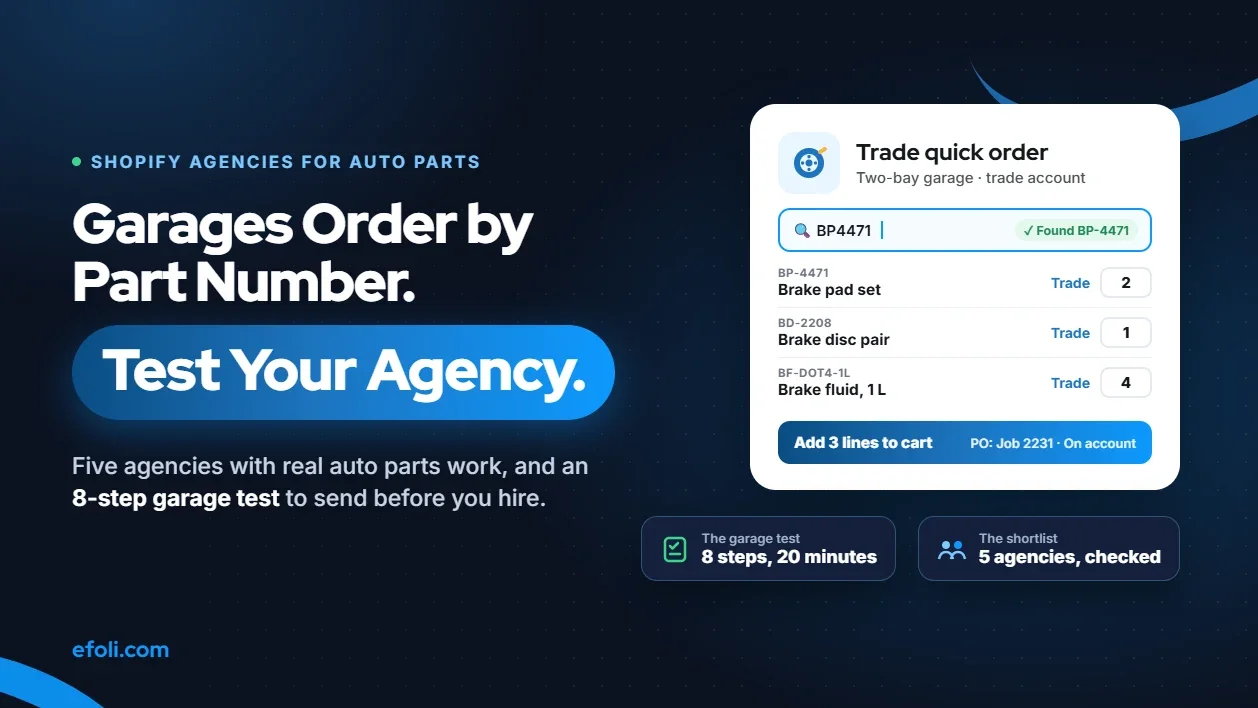
A technician at a two-bay garage logs in on a phone.
They search for a brake pad set by its OE number, typed without dashes.
They add 2 sets, plus 1 brake disc pair and 4 litres of brake fluid, from one page.
They see their garage's trade price, not retail.
They check out on account with a job reference in the PO field.
A week later, the parts manager reorders the same items from order history.
A part they need isn't in the catalog. They request a quote and get a price by message.
The owner logs in separately and sees every order from both staff members.
Score each step: works today, works with an app, needs custom work, or not possible. The pattern of answers tells you whether the agency understands trade buying.

Questions to ask about fitment data
Fitment is where auto parts projects run over budget. Ask these before you sign anything:
Where does fitment data come from? A supplier ACES file, a data provider, your own spreadsheets or a mix.
Who cleans it? Raw fitment data often has duplicates and gaps. Someone has to own the clean-up.
How is it stored in Shopify? Metafields, metaobjects or an external service. Each has trade-offs for speed and upkeep.
What happens when a supplier sends an update? Monthly updates are common. A process that needs a developer each time gets expensive.
Can trade buyers skip fitment? They often know the part number already. Forcing a vehicle selector on them slows them down.
How does it affect speed? Large fitment tables can slow a store. Ask for real page speed figures from a live build.
The Auto Care Association's standards are a useful shared language here. ACES is the industry standard for "management and communication of product fitment data", and PIES is the standard for product information. An agency that talks fluently about both, and about what happens when the data is messy, has done this before.
How to compare proposals
When the proposals arrive, put them side by side:
Look for | Good sign | Warning sign |
|---|---|---|
Trade buying | They describe the garage flow without being asked | Only fitment search for drivers |
Data | A separate data phase with an owner | Fitment "included" with no detail |
Apps vs custom | Apps for simple needs, custom where justified | Everything custom |
Results | Published, with sources | Vague "increased conversions" |
Handover | Documentation and training for your team | Only the agency can change things |
Timeline | Phased, with trade features dated | One big launch with everything |
Ask for references from a client that sells to trade, not just to drivers, and call them. Ask what they would do differently. Ask, too, how the agency handled the first big data update after launch, because that's the moment most parts stores find out whether the build can be maintained without the agency.
If you're moving from another platform, our post on when to replatform your ecommerce store covers the warning signs and the cost of switching. For a shortlist built the same way for another industry, see our post on Shopify agencies for fashion wholesale.
After you hire: the first 30 days
The first month sets the tone for the whole project. A few things to agree in writing early:
A data audit before design. The agency reviews a sample of your part data, fitment and part numbers, and reports what's missing or inconsistent. Design waits until this is done.
Three real trade buyers as testers. Pick a large garage, a small one and a bodyshop. Show them early wireframes of search and quick order, not the finished homepage.
A list of the top 200 parts by trade volume. These get tested first, because they're most of what garages order.
A decision on part-number formats. Agree how numbers with dashes, spaces and supplier prefixes are stored and searched.
A written list of what's native, what's an app and what's custom. It makes later costs predictable.
By day 30 you should be able to watch one of your garage testers search for a real part number and add it to a cart on a test store. If that hasn't happened, ask why.
FAQ
What should a Shopify agency for auto parts be able to do?
Can Shopify handle B2B ordering for garages?
What are ACES and PIES?
Do I need Shopify Plus for an auto parts store?
How long does an auto parts Shopify build take?
Should I choose an agency from a "best agencies" list?
How do garages search for parts on a website?

Anika Anamta Mehnaz
This article is written by Anika Anamta Mehnaz, a Content Writer and Content Marketing Strategist specializing in Shopify, eCommerce, and SaaS. With over four years of content writing experience, she creates SEO and AI search-optimized content that helps Shopify merchants make better business decisions through practical, research-backed insights. Her work covers Shopify apps, product variants, bundles, discounts, B2B commerce, and conversion-focused strategies. Outside of work, Anika enjoys watching anime, reading John Grisham novels, and discovering new ideas in digital marketing and e-commerce. If you enjoy discussing Shopify, content marketing, or online growth, feel free to connect with her. Twitter: https://x.com/mehnaz2201 Medium: https://medium.com/@mehnaz_78932
Keep reading
View all articles →
The Salon Orders 60 Bottles. Why Is It Seeing Retail Pricing?
November 12, 2026 • 17 min read
Build Accessory Bundles That Help Buyers, Not Just Order Values
November 12, 2026 • 17 min read
OrderRules or Native Shopify Inventory: What Actually Limits Bakery Orders?
November 12, 2026 • 17 min read