On this page
- Shopify Personalized Discounts: What Counts as Personalization?
- Why Segmented Offers Protect Margin Better Than a Storewide Sale
- Which Customer Segments Are Worth Building for BFCM?
- First-Time Visitors Who Haven't Purchased
- Returning or Repeat Customers
- High-Value or VIP Customers
- Geographic or Market Segments
- What to Offer Each Segment Instead of a Blanket Discount
- Setting This Up on Shopify
- Two Risks Personalization Creates
- Price-Visibility Complaints
- Stacking Conflicts
- Common Mistakes to Avoid
- Conclusion
- Frequently Asked Questions
Imagine reviewing your Black Friday Cyber Monday results and finding that your storewide 25% sale attracted plenty of orders. Then you notice that loyal customers who usually buy at full price received 25% off, even though some would have purchased anyway.
Meanwhile, first-time shoppers who needed reassurance or a specific incentive saw exactly the same offer. The offer made no distinction between ready buyers and hesitant ones.
That is where Shopify personalized discounts can help. Alongside setting a safe discount ceiling for each product, deciding who should receive an incentive gives you another way to protect margins while encouraging purchases that might not otherwise happen. The aim is not to make every offer complicated. It is to spend your promotional budget where it has a clear purpose.
Here is a practical framework for choosing three or four BFCM customer segments, matching each one to an appropriate offer, and avoiding two easily overlooked problems: visible price differences and overlapping discounts.
Shopify personalized discounts help merchants create targeted BFCM offers based on customer purchase history, loyalty, location, and cart conditions. Instead of offering the same storewide discount to everyone, merchants can create separate incentives for first-time buyers, repeat customers, VIPs, and specific markets. Shopify's native segmentation and discount tools support many basic offers, while apps like DiscountRay provide more advanced personalization options. The key is to choose a few meaningful segments, match each with a relevant incentive, and test discount eligibility and stacking before BFCM.
TL;DR
Prioritize 3–4 customer segments: Focus on first-time buyers, repeat customers, VIPs, and geographic markets instead of creating too many BFCM campaigns.
Protect profit margins: Use targeted incentives where they may influence purchasing decisions rather than discounting every order unnecessarily.
Match offers to customer needs: Consider first-order discounts for new buyers, early access for repeat customers, and exclusive rewards for VIPs.
Start with Shopify's native tools: Shopify Customer Segmentation and discount eligibility settings can handle many basic personalized offers without an additional app.
Use advanced personalization when necessary: DiscountRay's Pro plan supports customer-specific targeting and conditions involving country, cart value, cart items, and order history.
Test before launching: Check customer eligibility, price visibility, overlapping segments, and discount stacking to prevent unexpected discounts and customer confusion.
Shopify Personalized Discounts: What Counts as Personalization?
A personalized discount on Shopify is an offer whose eligibility or value depends on a customer's identity, characteristics, purchase history, location, or cart, rather than being offered on the same terms to every shopper.
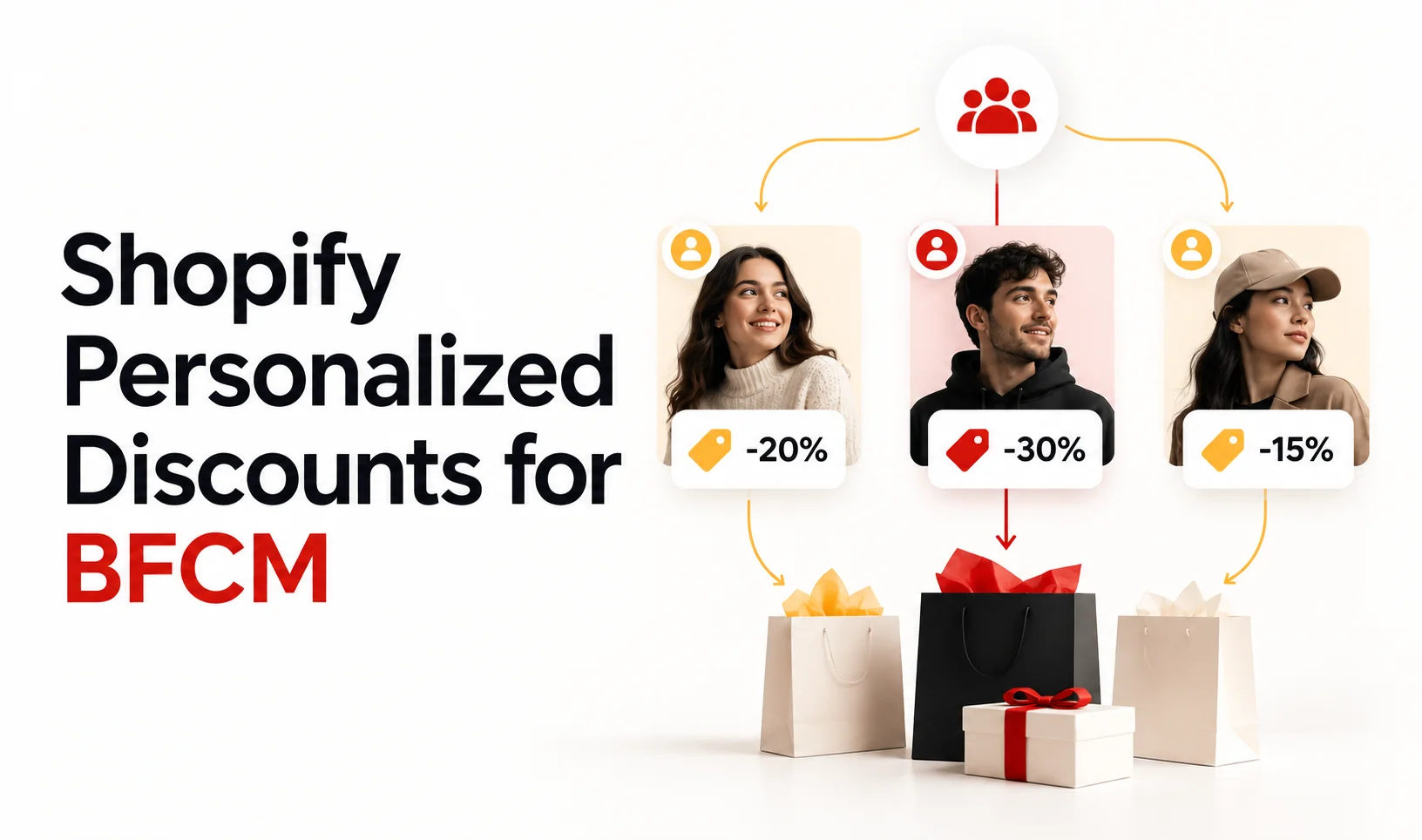
A storewide 20% discount treats a first-time buyer and a long-standing VIP alike. A targeted offer might instead give eligible new buyers 10% off selected products, invite repeat customers to shop early, or provide a gift once a VIP customer's cart reaches a defined threshold.
Personalization does not always mean changing a percentage. Early access, a carefully chosen product offer, or free shipping for a specific market can also make a promotion more relevant.
There is one important distinction: a visitor is not necessarily an identifiable customer. Shopify can apply customer-segment eligibility when it can recognize the customer, but an anonymous visitor browsing a product page cannot automatically be treated as a known first-time customer. That matters when planning what shoppers will see before checkout.
Why Segmented Offers Protect Margin Better Than a Storewide Sale
A blanket promotion is easy to communicate, but its cost is not limited to the customers it convinces to place an order. You also give the discount to eligible shoppers who were already likely to buy. Their orders may increase your sales total while contributing less profit than they otherwise would have.
Segmentation asks a more useful question: What does this specific customer need to move forward?
Someone considering a first order might respond to a small, clearly explained welcome incentive. Someone who has purchased from you three times may value early access to a popular product more than another percentage off. A high-spending customer might welcome priority access or a useful gift, while a market with unusually high shipping costs might respond to a shipping-focused offer.
None of these outcomes is guaranteed. Personalization lets you test whether an incentive changes buying behavior rather than discounting every order by default.
First, establish what each product can afford. Building a discount ceiling for each product helps prevent any segment-specific offer from becoming unprofitable before you even consider who qualifies. Then look at past orders, repeat-purchase patterns, average order value, and regional shipping economics to choose where extra incentives make sense.
Treat the margin benefit as a hypothesis to validate. Compare redemption, conversion, order contribution, and repeat purchases against your usual baseline, rather than assuming a narrower audience automatically produces better results.
Which Customer Segments Are Worth Building for BFCM?
You probably do not need ten separate BFCM campaigns. Three or four useful customer segments are easier to manage and test.
Start with the data your store already has. If geography barely affects costs or demand, skip that segment. Prioritize the problems you need to solve.
Segment | Signal to use | Typical BFCM offer |
First-time prospects | Known contacts with zero orders; separate path for anonymous shoppers | Modest first-order incentive on selected products |
Repeat customers | Previous order count and last purchase date | Early access or a relevant repeat-purchase offer |
VIP customers | Total spend, order frequency, or an established VIP tag | Exclusive access or gift at a qualified threshold |
Geographic markets | Customer location, market, and shipping economics | Market-specific shipping or selective product offer |
First-Time Visitors Who Haven't Purchased
Signal: A known customer or subscriber has not yet placed an order, or a shopper is new to your store and has not been identified.
Shopify can segment known customer records with zero orders, but it cannot recognize an anonymous browser as a specific customer. For anonymous visitors, consider a public first-order campaign with suitable restrictions.
Offer: Test a modest introductory discount on products with room in the margin, or a first-order shipping incentive if delivery costs are a common objection. A focused offer is easier to evaluate.
BFCM caution: Existing sale prices may already be attractive enough. Avoid layering a welcome offer onto the main promotion simply because a buyer is new, and test whether shoppers can claim the incentive more than once using different contact details.
Returning or Repeat Customers
Signal: Prior completed orders, purchase frequency, or the date of the last purchase. A returning website visitor who has never ordered is not the same as a repeat purchaser.
This group already knows something about your products and service. Rather than using a larger discount automatically, consider whether they would respond to a head start on limited inventory or a special offer on a product category they previously purchased.
Offer: Early BFCM access, a limited repeat-purchase incentive, or a curated product offer for customers with relevant buying history. Keep the message tied to something they have a reason to want.
BFCM caution: Do not treat everyone with one previous order as equally loyal. Someone who bought one two years ago may need a different message from someone who ordered last month. Avoid a loyalty reward that is worse than the public sale.
High-Value or VIP Customers
Signal: High lifetime spend, frequent purchases, or a carefully maintained VIP customer tag. Define VIP using your store's numbers instead of borrowing a universal dollar threshold.
Your strongest customers can be the most expensive group to over-discount. They may already plan to shop with you, so a large blanket percentage could reward orders that would have happened anyway.
Offer: First access to popular stock, a meaningful gift above a qualifying cart value, or a limited offer on a specific category. These avoid discounting every item.
BFCM caution: Make the reward genuinely distinct and disclose any threshold. An exclusive offer that disappears unexpectedly at checkout can do more damage to trust than no exclusive offer at all.
Geographic or Market Segments
Signal: Shipping destination, customer location, or the Shopify market in which a purchase takes place, together with local shipping costs and product demand.
Not every region should receive the same incentive. Delivery expenses, product availability, currency conversions, and buying patterns differ. A discount that works profitably in one market may not work in another.
Offer: A location-specific shipping promotion where the economics allow it, or an offer restricted to relevant products and markets. Use real operating differences, not stereotypes about a region.
BFCM caution: Test destination eligibility and local-currency presentation. Fixed-amount discounts convert from your store currency, affecting the amount displayed abroad.
What to Offer Each Segment Instead of a Blanket Discount
Once you have your audiences, resist the temptation to give each segment a different percentage just to make the campaign look personalized. The incentive should solve a recognizable problem.
For new buyers, a smaller first-order percentage on selected products may reduce hesitation without giving up the full 25% you were considering storewide. Keep it tied to the items that can support the discount. If your general BFCM sale already provides a strong price reduction, you might not need an additional welcome offer at all.
For repeat purchasers, consider access before the public sale begins. That offers a real benefit if desirable products are likely to run short. Another option is an offer on a product family related to their earlier purchase, provided you have enough purchase history to make the recommendation relevant.
For VIP customers, consider a free gift after a sensible spending threshold instead of a deep order-wide reduction. Count the gift's cost, shipping, and fulfillment in your promotion budget. Shopify's native Buy X Get Y discounts can handle eligible free-item offers, but shoppers must add the qualifying gift item to their cart themselves. Do not promise automatic gift insertion unless your actual setup supports it.
For geographic audiences, start with the operational pain point. A market-specific shipping incentive may be more useful than 10% off products in a region where delivery cost is the main obstacle. Conversely, where shipping is already affordable, selective product pricing might be the better test.
These are starting points, not rules every store must follow. Use a simple comparison: What would this segment receive without the special offer, what changes with it, and is that change worth its cost?
Setting This Up on Shopify
Begin with Shopify's own customer and discount tools before installing anything new. In the admin, you can create rule-based customer segments using attributes such as order count, amount spent, and location. Shopify updates segment membership as customers meet or stop meeting the rules. You can then use native discount eligibility controls for specific customers, customer segments, or markets, including on supported automatic discounts.
When you don't need an app: If you simply want an eligible customer segment to receive a fixed discount on selected products, a collection, or an order, native Shopify discount tools may be enough. You can also use customer segments for targeted communications. Building the segment itself does not require a separate paid segmentation app, although ordinary store and marketing costs still apply.
Before setting rules, clarify when Shopify can identify the buyer. Shopify's discount management documentation describes zero-order segments identified at checkout, while its discount-code FAQ warns that entirely new customers without an existing profile may not qualify for segment-specific offers. For a first-order campaign, test the exact new-customer checkout flow instead of relying on one interpretation. Do not promise an anonymous shopper a customer-specific price on the product page.
When you need an app: Native automatic discounts generally appear in the cart and at checkout, not as automatically crossed-out customer-specific product prices. If you need personalized price messaging on product pages, or an offer governed by combined customer, country, and cart-value conditions, you may need a compatible discount app or custom development. Shopify distinguishes discount savings from crossed-out product-page sale prices.
One option is DiscountRay B2B Custom Pricing, which supports offers targeted by customer, tags, groups, customer lists, country, cart value, cart items, and order history. Its storefront features include discount tables and promotional badges, but verify the exact customer-visible display and checkout behavior in your theme before launch.
Create a personalized discount with DiscountRay. You can preview the discount in the dashboard.

This is what your customers will see

Plan limits matter. As listed on the Shopify App Store in October 2026, DiscountRay's free Starter plan supports quantity and tiered discounts for all customers, not customer-specific personalization. Growth costs $14/month and includes B2B pricing by groups and tags. Pro costs $29/month and includes personalized customer discounts, targeting by country and cart value or items, order-history rules, and free gifts. For the combined personalization discussed here, Pro is the relevant plan.
Build this work into your broader BFCM offer and operational planning so timing, inventory, campaign messaging, and fulfillment stay aligned. Run test orders for each audience, including a customer who should not qualify.
Two Risks Personalization Creates
Personalization can be useful, but it also introduces two problems that a single public offer may not create to the same extent.
Price-Visibility Complaints
Two shoppers can compare screenshots, share a link, or discuss a promotion. If one sees a much better price without understanding why, the other may feel penalized for being a regular customer. Even a legitimate targeted campaign can appear unfair if the benefit is explained poorly.
Use straightforward eligibility language, such as “member offer,” “first-order discount,” or “early access for returning customers,” when those descriptions are accurate. State the qualifying conditions and expiration. Avoid claiming an offer is exclusive if the same or a better discount is widely available elsewhere on your store.
Check emails, product pages, cart messages, and checkout together. If customers see a full price until checkout, do not suggest that a personalized price has already been applied. If they need to sign in or identify themselves, tell them before they reach the final payment step.
Stacking Conflicts
A targeted discount may overlap with a sitewide automatic sale, a welcome code, free shipping, or another customer-group offer. Depending on your settings and eligibility, Shopify may combine discounts, select an eligible combination, or reject incompatible codes. Not every discount type can stack in every situation, as Shopify's discount-combination rules explain.
Before BFCM, create a worst-case test cart for each important customer segment. Apply every code or automatic offer the buyer could realistically qualify for and compare the actual checkout total with your intended minimum margin. Also test someone who belongs to two segments.
The point is not to memorize every Shopify combination rule. It is to make your discount eligibility and combination policy deliberate, so a targeted incentive cannot quietly add to a public sale beyond your budget.
Common Mistakes to Avoid
The biggest mistake is creating segments without changing the customer experience. If new buyers, repeat purchasers, and VIPs all receive the same 20% offer and the same message, the extra setup has not earned its place.
Other common problems are easy to prevent:
Building too many campaigns. Four well-managed offers with clear owners and end dates are more useful than a dozen promotions no one can troubleshoot during BFCM.
Ignoring overlap. A VIP might also qualify as a returning buyer or for a geographic promotion. Decide which benefit takes priority, and test the intended combination.
Using weak or misleading signals. Someone who viewed your site twice is not necessarily a loyal customer; someone who bought a year ago is not necessarily ready to buy again.
Skipping the control group or baseline. A segment that redeems many codes is not automatically a successful segment if most of those customers would have purchased without the extra discount.
Keep a campaign record of the audience, offer, dates, expected cost, and test result so you can troubleshoot quickly.
Conclusion
Shopify personalized discounts work best when each audience has a reason to receive a different offer. Start with three or four segments you can identify reliably: new prospects, repeat purchasers, VIPs, and geographic markets where relevant. Match the incentive to the customer's need, not to an arbitrary discount ladder, and keep every offer inside your margin limits.
Before BFCM goes live, test what each customer actually sees and pays. A narrower promotion is only better if the eligibility is clear, the discount doesn't stack beyond your plan, and the results justify its cost.
Frequently Asked Questions
What is a personalized discount on Shopify?
Is Shopify customer segmentation free to use?
How do I give different BFCM discounts to different customers?
Can I combine a segmented discount with a storewide BFCM sale?
Do I need an app to personalize Shopify discounts?

Syeda Rehnoma Tanzom
This article is written by Syeda Rehnoma Tanzom, an SEO content writer with 3+ years of experience specializing in eCommerce content. What makes the work here a little different? A close collaboration with support teams to understand what merchants are actually going through, their frustrations, their questions, and their wins. The goal is simple: write content that speaks to real problems, not just search engines. When not buried in keywords and content briefs, you'll find her nose-deep in a good book, binge-watching true crime documentaries or psychological thrillers, and occasionally switching gears with a feel-good rom-com.
Keep reading
View all articles →
How to Build Shopify BFCM Wholesale Strategy: Survive Bulk Order Spike
October 19, 2026 • 14 min read
20+ Best Shopify Apps for BFCM 2026 to Build a Smarter Black Friday Tech Stack
October 12, 2026 • 191 min read
How to Build a Shopify BFCM Discount Strategy to Protect Profit Margin
October 7, 2026 • 14 min read