"Send Us a Drawing" Shouldn't Be the Whole RFQ: Where Industrial Parts Quotes Break on Shopify
Why 'send us a drawing' breaks industrial parts quotes on Shopify, the six points where requests stall, what it costs, and the checklist that fixes it.
On this page
- Key takeaways
- The buyer's side of the story
- Three people, three different questions
- The friction map
- 1. The form asks for a message, not a specification
- 2. Files go missing or arrive in the wrong place
- 3. The revision gets lost
- 4. Certificates and inspection come up after the price
- 5. The quote leaves the store
- 6. Nobody follows up
- 7. Confidential and controlled parts get no special path
- What it costs: the operational effects
- Catalog parts and custom parts aren't the same problem
- What a better quote request looks like
- The quote side
- Where QuotWay fits
- What to send back in the first hour
- Freight, lead times and capacity
- The merchant checklist
- A worked example: one quarter of quotes
- A note on what we can't promise
- FAQ
Short answer: Industrial parts quotes break on Shopify when the store collects a message instead of a specification. The buyer has a drawing, a revision, a material, a finish, a quantity, certificates and a deadline. A "Contact us" form with one text box captures none of that in a usable way, so the quote turns into an email thread. The fix is a quote request that collects the specification as structured fields and attachments, keeps every revision of the quote, and converts the accepted quote straight into a Shopify draft order.
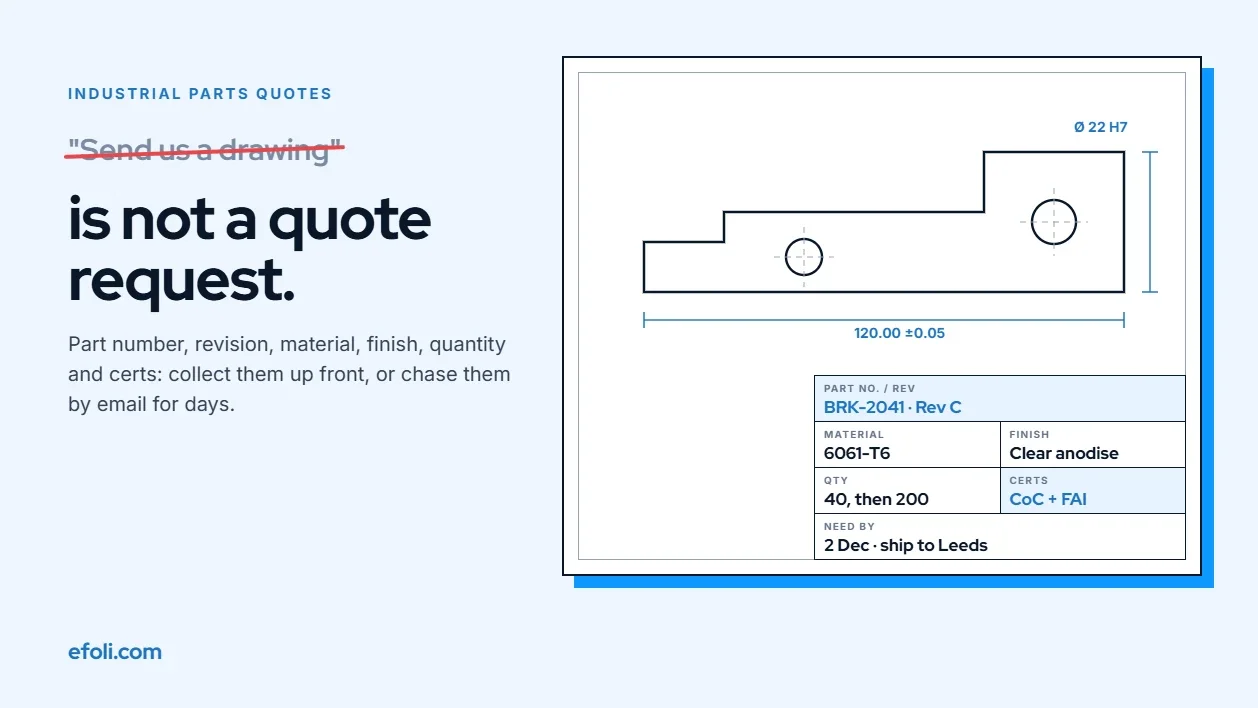
Here's an email that arrives at a lot of parts suppliers every week.
Hi, please quote the attached. 40 off, rev C. Need certs. Can you do by end of month? Thanks, Dan
Attached: a PDF drawing. Not attached: the 3D model, which Dan forgot. Also not mentioned: the finish (the drawing says "anodise", but which type?), whether "40 off" is a one-time order or the first of four, or whether "certs" means a certificate of conformance, material certificates, or both.
Your estimator replies with five questions. Dan answers three of them two days later, from his phone. Meanwhile, a competitor with a better quote form has already sent a price.
This post is for industrial parts suppliers and machine shops that sell on Shopify, and for the agencies that build their stores. It walks through what the buyer goes through, where the friction sits, what it costs your team, and the checklist that fixes it.
Key takeaways
An industrial quote request is a specification, not a message. Collect it as structured fields and files.
The drawing is the contract. Capture the revision with it, and never let a quote drift away from the revision it priced.
Speed matters. A survey cited by Paperless Parts, using Thomasnet data, found that 53% of industrial buyers expected to be contacted within 24 hours of submitting an RFQ.
Certificates, inspection reports and export controls change the price. Ask about them up front, not after the quote.
Keep standard catalog parts as normal products with quantity rules, and quote only what genuinely needs a quote.
A quote that ends as a Shopify draft order removes the re-keying step where errors creep in.
The buyer's side of the story
Industrial buyers aren't browsing. They have a part that needs making or replacing, and usually a deadline someone else set. The person filling in your form might be a procurement officer, a design engineer or a maintenance planner. They have different questions, but they share one expectation: they want to send the job once and get a price back without a long conversation.
Look at what the big online manufacturing platforms ask for. Xometry's production order RFQ asks for CAD files and drawings, quantities for each part, processes and materials, certification and inspection needs, ITAR or EAR restrictions, delivery dates and ship-to locations, and technical and sales contacts. Fictiv's help pages say a drawing should call out critical dimensions, tapped holes, tolerances and finishing information, and that requests for certificates of conformance, first article inspections, CMM reports or material certifications need a drawing attached.
That's the bar buyers are used to. Now compare it with the typical Shopify parts store: a product page with "Contact us for pricing", a form with name, email and message, and maybe a file upload that only takes one file.
The buyer isn't being difficult when they send a vague email. They're filling in the form you gave them.
Three people, three different questions
The person behind the request shapes what they care about, and a good form serves all three:
The design engineer cares about the drawing being read correctly. Their worry is that you'll miss a tolerance or a note in the title block. They want to see the revision on your quote and know an engineer looked at it.
The procurement officer cares about price, lead time and paperwork. Their worry is approval. They need a quote document with a reference number, a validity date and terms their finance team will accept.
The maintenance planner cares about the date. A line is down or a planned shutdown is coming. Their worry is that you'll say yes and deliver late.
A single message box asks all three to write their worries in free text. Most won't. They'll send the drawing and hope, and you'll find out what mattered to them only when something goes wrong.
The friction map
Here's where an industrial quote request goes wrong, step by step.

1. The form asks for a message, not a specification
A single text box invites a single sentence. "Please quote the attached" is the most common one. Every missing detail becomes a question your estimator has to ask.
The fields that matter for machined or fabricated parts are well known:
Part number and drawing revision
Quantity, and whether it's a one-off or a repeat
Material and grade
Finish or coating
Tolerances that matter, if not on the drawing
Certificates and inspection needs
Required date and delivery location
Export control status, if relevant
Our QuotWay team's guide to request a quote form fields covers how to choose fields without making the form so long nobody finishes it. For industrial parts, the trick is conditional fields: ask about anodising type only if the buyer picks "anodised".
2. Files go missing or arrive in the wrong place
Drawings are the heart of the request, and they're where most forms are weakest.
The form takes one file, but the buyer has a PDF drawing and a 3D model.
The file size limit is lower than a real model. A detailed assembly model can easily run to tens of megabytes.
Files land in a shared inbox, separate from the request, and nobody can tell which drawing belongs to which quote.
Buyers with sensitive or export-controlled parts don't want to email drawings at all. The Paperless Parts article notes that ITAR customers often send encrypted ZIP files instead.
The practical answer is usually two layers. Accept the PDF drawing directly in the quote request, because that's what an estimator reads. For large models, accept a link to the buyer's own secure file share, and put that link on the quote record.
3. The revision gets lost
A drawing called "bracket.pdf" says nothing. A drawing called "BRK-2041 rev C" says everything. If the buyer updates the drawing to rev D halfway through the conversation, your quote has to say which revision it priced.
This is the costliest mistake on the whole list, because it doesn't show up until parts are made. A quote priced on rev C and a part made to rev D, or worse, the other way round, means scrap, rework and an awkward call.
Make the revision a required field. Print it on the quote. And when the buyer sends a new revision, create a new version of the quote rather than editing the old one. Our QuotWay team explains why in its post on immutable quote versions: when each round is saved, nobody can overwrite what was agreed.
4. Certificates and inspection come up after the price
"Need certs" can mean a lot of things: a certificate of conformance, material certificates from the mill, a first article inspection report, CMM data. Each takes time, and some need a drawing to inspect against. If the quote is priced without them and the buyer asks afterwards, you either absorb the cost or re-quote, and both feel bad.
Ask the question in the form, with checkboxes. A buyer who ticks "first article inspection" has told you something about their industry and their expectations before you've spent a minute on the quote.
5. The quote leaves the store
Many suppliers price in a spreadsheet or an ERP, then email a PDF. The buyer prints it, gets approval, raises a purchase order and emails it back. Someone in your office then types the order into Shopify by hand.
Every re-keying step is a chance to get a quantity, price or revision wrong. It also means your store has no record of the quote at all. You can't see how many quotes became orders, which part types win, or which customers never reply.
6. Nobody follows up
Quotes go quiet. The buyer is waiting for budget approval, or they're comparing three suppliers, or they forgot. Without a quote record that has a status and an expiry date, nobody knows which quotes to chase.
Our post on how to follow up on a B2B quote gives a timing guide. For industrial parts, a quote also needs a validity period, because material prices move. The QuotWay guide on how long a B2B quote should be valid covers that.
7. Confidential and controlled parts get no special path
Some parts can't be handled casually. A defence or aerospace customer may be working with drawings covered by export controls, which is why Xometry's RFQ asks buyers to state ITAR or EAR restrictions up front. Even ordinary customers often want an NDA before sharing a new design.
If your form has no way to flag this, two things happen. Cautious buyers don't send the drawing at all and go to a supplier who looks set up for it. Or they send it the same way as everything else, into a shared inbox, which is the last place it should be. Add a simple question, "Is this part export controlled or covered by an NDA?", and route those requests to a named person with a secure way to receive files.
What it costs: the operational effects
It's easy to treat this as a customer experience problem. It's also an operations problem, and the costs add up quietly.

Estimator time goes on admin. Every missing field is an email, a wait and a follow-up. Your most skilled people spend their day chasing finish specs instead of pricing parts.
Quotes get slower, and slow quotes lose. If more than half of buyers expect contact within a day, a request that sits in a shared inbox over a weekend may already be lost.
Wrong parts get made. Revision mix-ups, missing finish details and assumed tolerances become scrap and rework. Those costs rarely get traced back to the quote form, but that's where they started.
Sales can't see the pipeline. With quotes in inboxes and spreadsheets, nobody can answer simple questions. How many quotes went out last month? What share became orders? Which customers ask for prices and never buy?
Repeat orders take as long as new ones. When a customer orders the same part again in six months, someone has to find the last quote, check the revision and re-price it. A quote record on the store makes that a two-minute job.
Catalog parts and custom parts aren't the same problem
Not everything you sell needs a quote. Many industrial suppliers sell two kinds of product:
Catalog parts. Standard fasteners, fittings, bushings and consumables with fixed prices, often sold in boxes or packs.
Custom parts. Made to the buyer's drawing, priced per job.
Mixing the two is a common mistake. If every product says "request a quote", buyers wait days for the price of a box of standard screws. If custom parts have a fake fixed price, you either lose money or reject orders.
Keep catalog parts as normal Shopify products with clear prices, minimums and pack quantities. Apps such as MultiVariants let buyers order several sizes from one table and enforce minimums and steps, so a box of 100 can't be ordered as 37. Our MultiVariants team's guide to quantity increment models explains how to set steps for packs and cartons.
Then reserve the quote request for parts that genuinely need one. Your estimators will thank you.
Watch for mixed requests too. A buyer often needs a custom bracket and the standard bolts that hold it on. If they can add the catalog bolts to the same quote as the custom part, you get one order, one delivery and one invoice instead of two half-orders. Check that your quote setup lets buyers add catalog products to a quote alongside a custom line.
If your catalog side is closer to parts lookup than manufacturing, our eFoli post on Shopify agencies for auto parts covers ordering by part number, which has a lot in common with industrial reordering.
What a better quote request looks like
Here's how the same request could arrive if the form did its job.

Field | Dan's answer |
|---|---|
Part number and revision | BRK-2041 rev C |
Drawing | BRK-2041-C.pdf (attached) |
3D model | Link to buyer's file share |
Quantity | 40, then about 40 a quarter |
Material | 6061-T6 aluminium |
Finish | Clear anodise |
Certificates | Certificate of conformance, material certs |
Inspection | First article inspection |
Required by | 28 November |
Delivery | Plant 2, Leeds |
Export controlled? | No |
Your estimator can price this in one pass. No questions, no waiting. And because "about 40 a quarter" is on the record, the quote can offer a repeat price straight away.
The quote side
Once the request is in, the quote itself needs to:
Show the part, revision, quantity, price, lead time and validity date.
Allow price breaks, such as 40, 100 and 250, so the buyer can see the value of a bigger order.
Keep each version when the buyer counters or sends a new revision.
Convert into an order without anyone re-typing it.
On Shopify, the natural home for an accepted quote is a draft order. Draft orders support custom line items, so a one-off part doesn't need a product page, and you can send the buyer an invoice from the admin.
Where QuotWay fits
QuotWay is a quote and negotiation app for Shopify, built by our team. For industrial parts, these parts of the App Store listing are the most relevant:
Structured requests. Custom form fields and full targeting from the Starter plan ($29 a month at the time of writing), and conditional form logic on Professional ($79 a month).
Attachments. Buyer attachments on Starter are listed as 3 files of up to 5 MB each. That's enough for PDF drawings. Large 3D models are better shared as a link, as above. Enterprise lists higher attachment limits without stating figures.
Negotiation that keeps history. Counter-offers are saved round by round as locked versions.
Approvals. Approval workflows on Professional, so a large or unusual quote can go to a manager before it's sent.
Partial acceptance. On Professional, a buyer can accept some lines and not others, which suits multi-part RFQs where one part goes elsewhere.
Quote to order. Accepted lines convert to a native Shopify draft order with prices locked.
B2B accounts. Enterprise ($199 a month) adds Shopify B2B companies, locations and payment terms.
There's also a free plan with 10 quotes a month, which is enough to test the flow with a few real customers before committing.

QuotWay won't price the part for you. Your estimator still decides the price. What it changes is everything around the price: what arrives, where it's kept, how versions are tracked and how the accepted quote becomes an order.
If your products are made to order but aren't industrial, the QuotWay guide to quoting custom and made-to-order products covers the general case, and our eFoli post on furniture quote requests shows the same problem in a very different industry.
What to send back in the first hour
You can't always price a part in an hour. You can always reply. A good first response does three things: confirms what arrived, says who's looking at it and gives a date.
Thanks, we've received your quote request QR-1182 for BRK-2041 rev C, 40 pieces, with one drawing attached. Sarah in our estimating team will review it and send a price by Thursday. If the 3D model is available, add it at the link in this email and we'll use it.
That message costs nothing, sets the expectation and catches the most common gap, the missing model, while the buyer still has the files open. Most quote apps can send a confirmation like this automatically. The human part is the date, so make sure someone owns it.
Freight, lead times and capacity
Two things often get left off industrial quotes and cause trouble later.
Freight. A crate of steel parts doesn't ship like a parcel. Either quote freight as its own line or state clearly that it's excluded. Our QuotWay team covers the options in shipping and freight on B2B quotes.
Lead time. A quote that promises three weeks has to match what the shop floor can deliver. If you also sell made-to-order products online with fixed prices, lead times and production caps should be enforced on the store. Our OrderRules team's guide to made-to-order lead times and production caps explains how.
The merchant checklist
Use this to audit your current quote process. If you answer "no" to more than three, the quote form is costing you work and orders.

Does the form ask for part number and revision as separate, required fields?
Can buyers attach a PDF drawing to the request itself?
Is there a way to share large CAD files, such as a link field?
Does the form ask about material, finish, certificates and inspection?
Does it ask whether the order is one-off or repeat?
Does it ask about export controls if you make controlled parts?
Does the buyer get a confirmation with a reference number?
Does your team get notified within minutes, not at the next inbox check?
Does every quote show the revision it priced and a validity date?
Is each counter-offer or revision saved as a new version?
Does an accepted quote become a Shopify order without re-typing?
Can you see how many quotes went out, and how many became orders, this month?
A worked example: one quarter of quotes
This is a made-up but typical case. A small CNC shop on Shopify sells a catalog of standard spacers and bushings, and quotes custom parts to drawing.
Before the change, quote requests came through a contact form and by email. The owner estimated that most requests needed at least one round of questions before they could be priced, usually about material, finish or quantity, and that repeat orders took as long to price as new ones because the old quote had to be dug out of someone's inbox.
They made four changes:
Catalog parts got fixed prices, pack quantities and minimums, and lost their "request a quote" buttons.
Custom parts got a structured quote request with part number, revision, material, finish, certificates and a PDF drawing upload, plus a link field for models.
Every quote was created as a versioned record with a 30-day validity date.
Accepted quotes were converted to draft orders instead of being typed in.
The result they cared about most wasn't a conversion number. It was that the estimator stopped spending mornings on email. Repeat orders became a matter of opening the last quote, checking the revision and sending a new version. That's the kind of change you can see in a week.
A note on what we can't promise
Better quote capture doesn't guarantee more orders. It removes reasons to lose them. If your prices or lead times aren't competitive, a better form will just help you lose faster. But for most suppliers we talk to, the bottleneck isn't the price. It's the three days of emails before anyone can produce one.
If you're planning a bigger move into online B2B, our eFoli guide to Shopify wholesale setup maps the whole journey, from first quote to reorder.
FAQ
Can Shopify handle custom industrial parts quotes?
What should an industrial RFQ form ask for?
How do I accept CAD files on a Shopify quote form?
Why does the drawing revision matter so much?
How fast should I respond to an industrial RFQ?
Should standard parts have a "request a quote" button?
How does a quote become an order on Shopify?
Do I need Shopify Plus for B2B quotes?
What's the difference between an RFQ and a quote?

Anika Anamta Mehnaz
This article is written by Anika Anamta Mehnaz, a Content Writer and Content Marketing Strategist specializing in Shopify, eCommerce, and SaaS. With over four years of content writing experience, she creates SEO and AI search-optimized content that helps Shopify merchants make better business decisions through practical, research-backed insights. Her work covers Shopify apps, product variants, bundles, discounts, B2B commerce, and conversion-focused strategies. Outside of work, Anika enjoys watching anime, reading John Grisham novels, and discovering new ideas in digital marketing and e-commerce. If you enjoy discussing Shopify, content marketing, or online growth, feel free to connect with her. Twitter: https://x.com/mehnaz2201 Medium: https://medium.com/@mehnaz_78932
Keep reading
View all articles →
The Customer Bought the Tent. Who Remembered the Sleeping Bag?
November 13, 2026 • 18 min read
The Embedded Commerce Playbook for Brands With Reseller Websites
November 13, 2026 • 17 min read
The Roses Are Gone. The Orders Keep Coming. Why Florists Oversell on Shopify
November 13, 2026 • 18 min read