Shopify BFCM Bundle Ideas to Increase Average Order Value in 2026
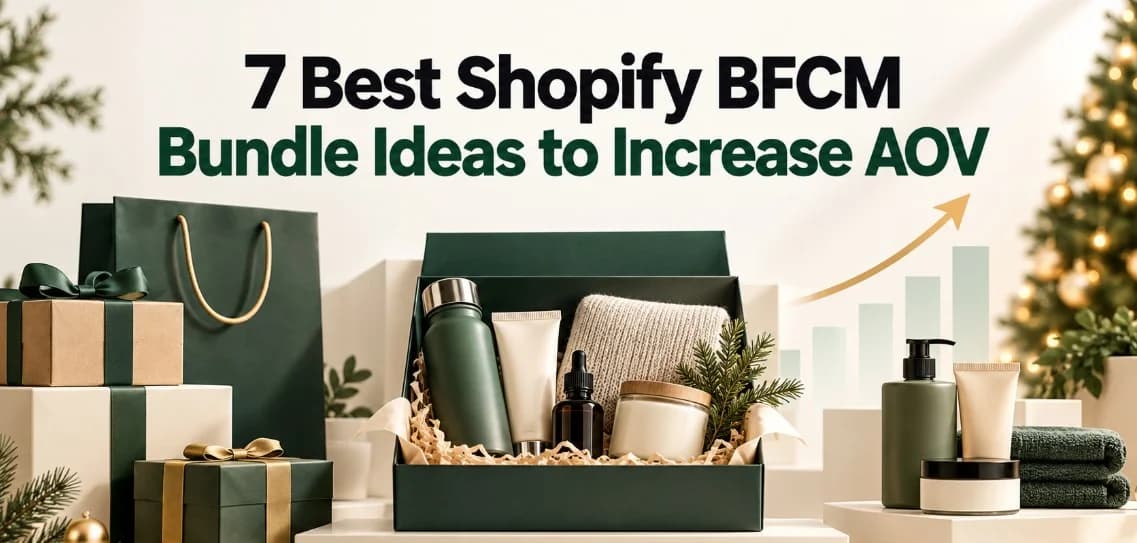
Use Shopify BFCM bundles to increase the value of each order without defaulting to a bigger sitewide discount. Compare seven bundle strategies, learn where each fits, and see how to price, test, and measure them before BFCM.
On this page
- What Are Shopify BFCM Bundles?
- Why Use Bundles Instead of Simply Increasing the BFCM Discount?
- Check Your Current AOV Before Creating a BFCM Bundle
- 7 Shopify BFCM Bundle Ideas
- 1. Create a Complementary Product Bundle
- 2. Let Customers Build Their Own BFCM Box
- 3. Use a Mix-and-Match Bundle for Variety
- 4. Offer Volume Bundles for Products Customers Stock Up On
- 5. Add a Cross-Sell Bundle Around the Main Product
- 6. Create Good-Better-Best Bundle Tiers
- 7. Create a Limited BFCM or Holiday Bundle
- Holiday Coffee Tasting Collection
- Which BFCM Bundle Type Should You Choose?
- How to Price Shopify BFCM Bundles Without Eroding Your Margin
- Does Every BFCM Bundle Need a Discount?
- How to Create BFCM Bundles on Shopify
- Where PushBundle Fits
- Test Your BFCM Bundle Before Customers See It
- How to Measure Whether Your BFCM Bundle Increased AOV
- Shopify BFCM Bundles Should Make the Purchase More Valuable, Not Just Bigger
- FAQs
BFCM shoppers may be prepared to spend more, but that does not mean they will spend without thinking about value.
Shopify's 2025 Global Holiday Retail Report found that shoppers' planned Black Friday Cyber Monday spending increased from $155 in 2024 to $192 in 2025. At the same time, 51% planned to set clear spending caps, while 23% expected to follow stricter budgets than the year before. The research surveyed 18,000 shoppers and 7,500 businesses across nine countries.
That combination matters for Shopify merchants planning BFCM 2026.
Customers may be willing to spend more per order, but the additional products still need to feel worthwhile.
Shopify BFCM bundles can give customers a clear reason to buy more products, more units, or a more complete set while allowing the merchant to decide what the larger purchase needs to look like.
Shopify itself lists increasing average order value, providing customer value through curation, clearing inventory, and improving product visibility among the potential benefits of product bundles.
The important part is designing the bundle around customer behavior and margin rather than putting several products together and calling it a BFCM deal.
Quick Note: Shopify merchants can increase BFCM AOV with complementary product bundles, build-your-own boxes, mix-and-match bundles, volume bundles, cross-sells, tiered bundle sizes, and seasonal sets. The right format depends on how customers already buy, your normal order value, available inventory, and the margin you can afford to exchange for a larger order.
What Are Shopify BFCM Bundles?
A Shopify BFCM bundle combines multiple products, variants, or quantities into one offer for the Black Friday Cyber Monday period.
That could mean a predetermined skincare set, a six-flavor snack box customers build themselves, a three-pack of the same product, or a main product bundled with useful accessories.
The customer gets a simpler or more valuable purchasing option. The merchant gets an opportunity to increase the number of products or units included in the order.
A bundle also does not automatically require a large discount.
Value can come from curation, convenience, customization, exclusive combinations, free shipping, a gift, or a modest price advantage.
The purpose is simple:
Make the larger purchase more useful or attractive than buying one item alone.
Bundles should still be only one part of your wider holiday plan. If you are working through offers, inventory, storefront preparation, fulfillment, testing, B2B operations, and post-sale retention together, eFoli's complete Shopify BFCM guide provides the wider roadmap. See eFoli’s Shopify BFCM Guide
Why Use Bundles Instead of Simply Increasing the BFCM Discount?
Imagine one product normally sells for $40.
A 25% storewide promotion reduces it to $30 whether the shopper buys one product or several.
Now imagine three complementary products normally cost $120 together, and you offer the set for $108.
The customer receives value, but the incentive only applies when the shopper commits to the larger $108 purchase.
That is one of the strategic differences between broad discounting and bundling.
With a bundle, you can connect the incentive to:
More products purchased, more units purchased, or a higher-value combination.
This does not automatically make bundles more profitable. The merchant still has to account for product cost, fulfillment, packaging, payment fees, shipping subsidies, advertising, and returns.
But it changes the starting question from:
How large should our BFCM discount be?
to:
What larger purchase would justify giving this incentive?
That is a much more useful question when the goal is increasing AOV without giving away unnecessary margin.
Shopify also recommends bundling as one method of increasing order value because multiple related products can be sold as one useful package.
Check Your Current AOV Before Creating a BFCM Bundle
You need to know what customers normally spend before deciding what a meaningful larger order looks like.
Shopify calculates average order value using gross sales after discounts divided by the number of orders, excluding post-order adjustments such as exchanges or edits. Merchants can track AOV over time through Shopify Analytics.
Suppose your usual AOV is $52.
A $55 bundle probably does not create much movement.
A well-designed $75 or $80 bundle could create a more meaningful increase if the additional products naturally belong in the purchase and the economics remain healthy.
Before deciding the bundle price, answer three questions:
What does the customer normally spend?
What additional products or quantities would genuinely improve the purchase?
How much margin remains after the bundle incentive and additional costs?
Only then should you decide the bundle format.
7 Shopify BFCM Bundle Ideas
1. Create a Complementary Product Bundle
Start with products that customers already have a reason to use together.
A skincare merchant might combine a cleanser, serum, and moisturizer.
A coffee store could combine coffee, filters, and a storage container.
A hair-care merchant could combine shampoo, conditioner, and treatment.
The advantage is that you are not trying to manufacture demand for unrelated products. You are making a complete solution easier to buy.
For BFCM, the customer could receive a modest bundle saving, exclusive packaging, a gift, or another benefit for purchasing the full set.
The AOV opportunity comes from moving a shopper from buying one hero product to purchasing several relevant products at once.
Avoid using the bundle as a dumping ground for slow-moving items that do not fit the customer's original need. The complete set should make sense without requiring a lengthy explanation.
2. Let Customers Build Their Own BFCM Box
A build-your-own box gives the merchant control over the structure while giving customers control over what goes inside.
Imagine a snack company offering 15 flavors.
Instead of deciding which six flavors every shopper receives, the merchant can let customers choose their own.
The same model can work for tea, coffee, candles, beauty products, sauces, pet treats, stationery, confectionery, accessories, and many other categories.
You could offer different box sizes such as:
Small box: choose 4
Standard box: choose 8
Large box: choose 12
Now the shopper is making two decisions at once:
What do I want?
and
How much do I want?
That creates a natural path toward a larger basket without requiring the customer to accept products they do not want.
3. Use a Mix-and-Match Bundle for Variety
Mix-and-match works well when customers want several items but care strongly about the combination.
Consider a store selling protein bars in eight flavors.
A fixed six-pack may include flavors some customers dislike.
A mix-and-match bundle can instead say:
Choose any 6 flavors to complete your BFCM pack.
This combines customer choice with a required bundle quantity.
The same idea works for lipstick shades, candle scents, coffee roasts, beverages, bakery items, apparel variants, and similar product ranges.
Shopify defines a mix-and-match bundle as one composed by the customer from interchangeable products or variants. Shopify's free first-party Bundles app supports fixed bundles and multipacks; merchants who need mix-and-match functionality can use a compatible third-party bundle app, or build a custom solution using the Bundles APIs on eligible Shopify Plus stores.
The AOV opportunity comes from turning several separate purchasing decisions into one clear requirement:
Complete the pack.
4. Offer Volume Bundles for Products Customers Stock Up On
Sometimes the bundle does not need different products at all.
It can simply encourage customers to buy more units of something they already use.
For example:
Option | Regular value | Illustrative BFCM offer |
1 unit | $25 | $25 |
3 units | $75 | $69 |
6 units | $150 | $129 |
These numbers are examples, not recommended BFCM discounts.
The important principle is that the stronger benefit becomes available only when the shopper commits to a larger quantity.
Volume bundles are particularly relevant for products that customers regularly consume, replace, share, or stock up on, such as coffee, skincare basics, food, pet supplies, cleaning products, socks, craft supplies, and some B2B consumables.
This also aligns with broader BFCM behavior. Shopify has previously found that holiday shoppers use seasonal discounts to stock up on everyday products, reinforcing why quantity-based offers can fit some categories particularly well.
5. Add a Cross-Sell Bundle Around the Main Product
Sometimes the biggest AOV opportunity is not another version of the main product.
It is the thing the customer is likely to need next.
Someone buying a coffee brewer may need filters.
Someone buying shoes may need care products.
Someone buying a camera may need storage or accessories.
Someone buying a gift may want premium packaging.
Instead of presenting those products as unrelated recommendations, create a logical combination around the main purchase.
A merchant might position it as:
Complete your setup
or:
Add the essentials
The best cross-sell bundle reduces thinking for the customer.
It should answer:
If I'm already buying this product, what else will genuinely help me use it?
Avoid filling the recommendation with unrelated products simply because you want a larger cart.
6. Create Good-Better-Best Bundle Tiers
Not every shopper will want the same bundle size.
A tiered approach lets customers decide how far they want to go.
For example:
Bundle | Example structure | Purpose |
Starter | 3 items | Lower entry point |
Complete | 5 items | Main BFCM offer |
Premium | 8 items + benefit | Higher-value option |
This creates an AOV ladder instead of one fixed purchasing decision.
A shopper who does not want the premium set can still buy the starter version. Someone who was already willing to spend more has a clear reason to consider the next level.
The tiers need meaningful differences, though.
Do not create three nearly identical options separated only by arbitrary pricing.
Moving up should offer something customers can understand: additional useful products, stronger value, free shipping, a gift, premium packaging, or another relevant benefit.
7. Create a Limited BFCM or Holiday Bundle
Seasonality can also create a reason to bundle products that already exist in your catalog.
Examples might include:
BFCM Starter Kit
Holiday Hosting Pack
Winter Skincare Set
Year-End Office Supply Box
Holiday Coffee Tasting Collection
You do not necessarily need new products.
You are changing how the existing products are merchandised for the season.
A curated seasonal bundle gives shoppers a faster way to understand how several products belong together and can create urgency without permanently reducing the price of the entire catalog.
The seasonal theme should still have a purpose.
Adding “BFCM” to the name of three unrelated products does not create a strong bundle.
Which BFCM Bundle Type Should You Choose?
Use customer behavior rather than the bundle app's feature list as the starting point.
Customer behavior | Bundle to consider | Why |
Customers buy related items separately | Complementary bundle | Makes the complete solution easier to buy |
Customers want control over every item | Build-your-own box | Adds personalization |
Customers want variety | Mix-and-match | Combines choice with a larger order |
Customers naturally stock up | Volume bundle | Links the incentive to quantity |
Customers often need an accessory | Cross-sell bundle | Adds a logical next product |
Customers have different budgets | Tiered bundles | Creates several AOV levels |
Products fit a seasonal use case | Holiday bundle | Adds timely merchandising context |
A useful rule is:
Choose the bundle structure that makes the larger purchase feel natural to the customer.
Do not choose it simply because the format looks impressive.
How to Price Shopify BFCM Bundles Without Eroding Your Margin
A higher AOV is not automatically a better order.
Consider three products priced individually at:
Product A: $30
Product B: $24
Product C: $16
Together, they normally sell for $70.
Assume their combined product cost is $29.
If you offer the bundle for $63, the customer saves $7.
That leaves $34 before accounting for payment processing, shipping, packaging, fulfillment, advertising, returns, and other variable costs.
Whether $63 is a healthy bundle price depends on those remaining expenses.
This is why the success metric cannot simply be:
Did AOV increase?
Instead, compare the additional order value with the additional discount, product cost, shipping, and fulfillment cost required to create it.
That principle also runs through eFoli's broader BFCM planning framework: decide what your economics can support before choosing the promotion format.
Does Every BFCM Bundle Need a Discount?
No.
Bundles can provide value through:
Curation, convenience, choice, exclusive combinations, packaging, or access.
A merchant could therefore use a bundle with no direct price reduction.
Another merchant could offer a modest bundle saving.
Another could keep product pricing unchanged and add free shipping or a gift after the customer reaches a certain bundle value.
This distinction is increasingly relevant when shoppers are budget-conscious but still looking for strong value. Shopify's holiday research specifically recommends value-focused promotions such as discounts, gifts with purchase, shipping incentives, and bundled products.
The objective is not to make every bundle cheaper.
It is to make the complete offer feel worth buying.
How to Create BFCM Bundles on Shopify
Shopify requires a bundles app to create product bundles.
Its free first-party Shopify Bundles app is available across Shopify plans and supports fixed product bundles and multipacks.
For mix-and-match bundles, Shopify currently directs merchants toward compatible third-party bundle apps, while eligible Plus merchants can also build custom bundle functionality using Shopify's Bundles APIs.
That means the right implementation depends heavily on the campaign.
If you only need a simple predetermined bundle, Shopify's native option may already solve the problem.
If the BFCM idea requires shoppers to build their own box, mix items from several products or variants, use more complex quantity rules, or create other configurable bundle experiences, a third-party BFCM bundle app may be more appropriate.
Where PushBundle Fits

One option is PushBundle.
Its current Shopify App Store listing includes build-a-box, mix-and-match, volume discount, and cross-sell bundles, as well as quantity breaks, customer eligibility, free-gift and free-shipping rewards, scheduling, and several pricing options depending on the plan.
That makes PushBundle relevant when, for example, you want customers to build their own BFCM box, choose from several eligible products or variants, unlock different bundle sizes, or attach a cross-sell offer to the main purchase.
Product Page with PushBundle

The app should not determine your BFCM strategy, though.
Start with:
the customer behavior you want,
the products involved, and
the margin available.
Then choose the simplest tool that can execute it.
If you are also deciding which other tools belong in your campaign stack, eFoli's Best Shopify Apps for BFCM 2026 guide compares tools by campaign stage and also shows where Shopify's native functionality may already be enough.
Test Your BFCM Bundle Before Customers See It
Do not judge readiness from the app admin alone.
Place realistic test orders.
Check product selection, variant selection, quantity requirements, bundle pricing, discounts, inventory, mobile usability, cart presentation, checkout totals, shipping, and interactions with any other active promotions.
Inventory deserves particular attention.
Shopify calculates bundle availability from the inventory of the components inside that bundle. The component with the lowest available inventory can determine how many complete bundles remain sellable.
For example, imagine a bundle needs:
one cleanser,
one serum, and
one moisturizer.
You might have 200 cleansers and 180 moisturizers, but only 15 serums.
The complete bundle cannot behave as though you have 180 available sets.
That is exactly the kind of issue you want to discover before BFCM traffic arrives.
How to Measure Whether Your BFCM Bundle Increased AOV
Start with the baseline you recorded before the campaign.
Then compare your BFCM bundle performance using more than one metric.
AOV matters, but also look at bundle orders, units per order, bundle adoption, conversion rate, discount cost, gross margin per order, and inventory sell-through.
Shopify's Bundles app now includes bundle-performance metrics such as bundle total sales, bundle orders, top bundles by sales, and most-ordered bundles, while Shopify Analytics provides broader reporting for sales and AOV.
Suppose your normal AOV is $54.
During BFCM, it rises to $71.
That $17 increase looks encouraging.
But imagine that generating it required $15 in extra product cost and discounting.
Compare that with another bundle where AOV also reaches $71 but the additional variable cost is $7.
The revenue result is similar.
The economics are not.
So the real goal is:
Increase useful order value, not simply the number shown in your AOV report.
Shopify BFCM Bundles Should Make the Purchase More Valuable, Not Just Bigger
The easiest way to make a BFCM offer look stronger is often to increase the discount.
Bundles give merchants another option.
They can help customers complete a routine, buy complementary products, choose their favorite variants, stock up, build a custom box, or reach a higher-value package without applying the same discount to every single order.
Start with how your customers already shop.
Check your normal AOV.
Understand your margin.
Choose products or quantities that genuinely belong together.
Then decide whether the right format is fixed, customizable, mix-and-match, volume-based, cross-sold, tiered, or seasonal.
The strongest Shopify BFCM bundles are not necessarily the ones offering the biggest percentage off.
They are the ones where customers can clearly see the value in buying more—and where the larger order still makes financial sense for the merchant.
FAQs
What are the best Shopify BFCM bundle ideas?
Can Shopify bundles increase average order value?
Does every Black Friday bundle need a discount?
Can Shopify create mix-and-match bundles?
What is the difference between a mix-and-match bundle and a build-your-own box?
How should I price a BFCM bundle?
When should Shopify merchants create their BFCM bundles?

Anika Anamta Mehnaz
This article is written by Anika Anamta Mehnaz, a Content Writer and Content Marketing Strategist specializing in Shopify, eCommerce, and SaaS. With over four years of content writing experience, she creates SEO and AI search-optimized content that helps Shopify merchants make better business decisions through practical, research-backed insights. Her work covers Shopify apps, product variants, bundles, discounts, B2B commerce, and conversion-focused strategies. Outside of work, Anika enjoys watching anime, reading John Grisham novels, and discovering new ideas in digital marketing and e-commerce. If you enjoy discussing Shopify, content marketing, or online growth, feel free to connect with her. Twitter: https://x.com/mehnaz2201 Medium: https://medium.com/@mehnaz_78932
Keep reading
View all articles →
How to Build Shopify BFCM Wholesale Strategy: Survive Bulk Order Spike
October 19, 2026 • 14 min read
20+ Best Shopify Apps for BFCM 2026 to Build a Smarter Black Friday Tech Stack
October 12, 2026 • 186 min read
How to Build a Shopify BFCM Discount Strategy to Protect Profit Margin
October 7, 2026 • 14 min read