On this page
- Key takeaways
- Step 1: Write the requirements for both steps
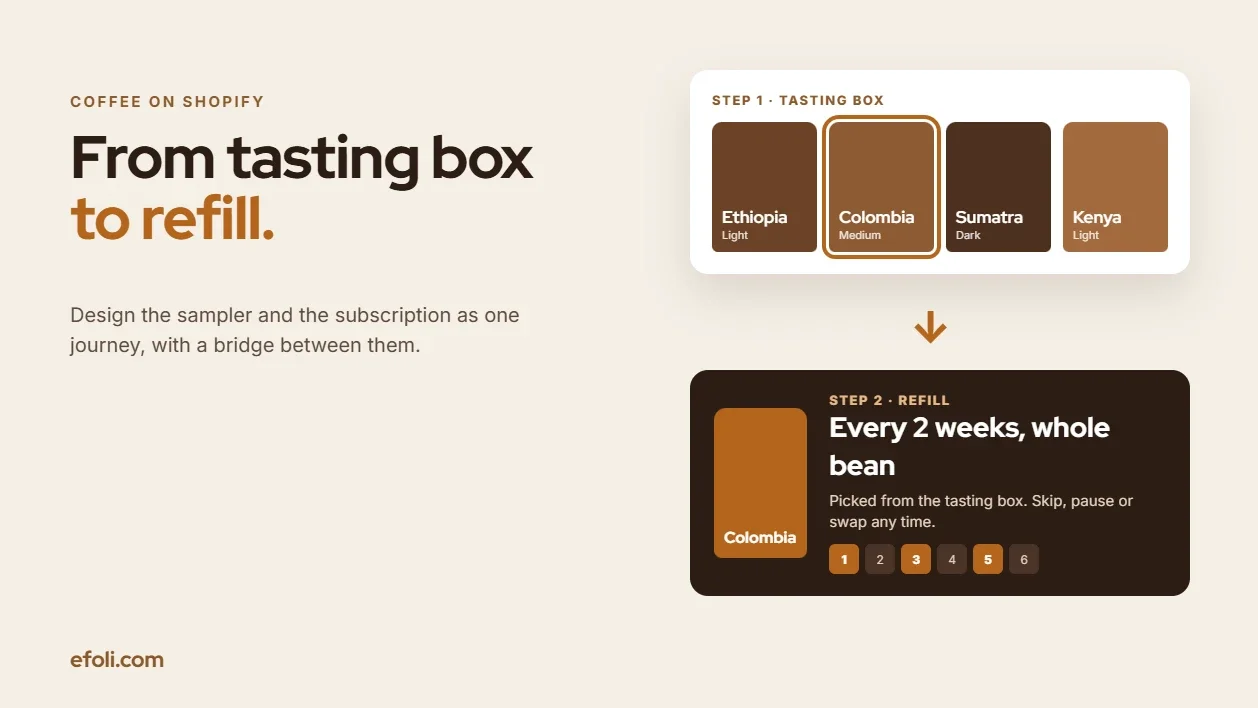
- The tasting box: help someone choose
- The refill: keep the right coffee arriving
- The bridge: make the next step obvious
- Questions to answer before building
- Step 2: Check compatibility before choosing tools
- What Shopify's native tools cover
- Where a bundle app fits
- Where discounts fit
- Step 3: Set up the tasting box
- Decide fixed or mix-and-match
- Make the coffees comparable
- Plan around roast dates
- Step 4: Set up the refill
- Ask how they brew, not which grind
- Set the default frequency from consumption
- Offer bag sizes that fit the frequency
- Make changes easy
- Define "roaster's choice"
- Step 5: Build the bridge
- In the box
- In email
- In the account
- The bridge offer
- Step 6: Know the edge cases
- A subscribed coffee sells out
- The sampler includes a coffee that isn't available for subscription
- A grind change between renewals
- Renewals on non-roasting days
- Wholesale and café buyers
- Step 7: Test the whole journey
- Step 8: Hand over a runbook
- What to measure after launch
- Worked example: a six-coffee roaster
- Further reading
- Mistakes that break the journey
- Final Thoughts
- FAQ
Short answer: A coffee sampler and a coffee subscription are two different products, and they need a deliberate bridge between them. Treat the tasting box as step one: a small, fixed or mix-and-match set that helps a new customer find the coffee they like, shipped close to its roast date. Treat the refill as step two: a subscription built around the bag the customer chose, with grind, bag size and frequency set from how they actually drink coffee. Then connect the two with a clear next action, such as a code or credit that only works on the first subscription order, and a follow-up timed to when the sampler runs out. On Shopify, check compatibility before you build anything. Shopify's own Bundles app doesn't work with subscriptions, so a sampler that should renew needs a bundle app that supports selling plans, such as Push Bundle's Mix & Match subscriptions, paired with a subscription app. Test roast dates, grind changes, swaps, skips and the discount on renewal before launch, and hand the roastery team a short runbook so the journey keeps working after the agency leaves.
A small roaster sells six single-origin coffees. A new customer lands on the site from a friend's recommendation, reads six tasting notes that all mention chocolate somewhere, and can't decide. So she buys the tasting box: four 50 g bags. She likes the second one, from Huila, a lot. Two weeks later she's out of coffee and back at the supermarket, because nothing told her what to do next.
The roaster got a stranger to try its coffee and like it. Then the store let the moment pass.
This playbook is for coffee roasters and the Shopify agencies that build their stores. It covers how to set requirements for a sampler-to-subscription journey, how to set it up on Shopify, which edge cases break it, how to test it, and what to hand over when the build is done.
Key takeaways
A tasting box and a subscription are separate products with separate jobs. Design them as two steps with a bridge between them.
Freshness shapes the whole journey. The Specialty Coffee Association describes whole bean coffee as reasonably fresh within about three weeks of roasting.
Shopify's Bundles app isn't compatible with subscriptions, so a renewing sampler needs a bundle app and a subscription app that work together.
Ask customers how they brew, not which grind they want, and let them change it later.
Set the default frequency from how much coffee the household drinks, not from what's easiest to fulfil.
Put the bridge offer on the first subscription order only, and test that it doesn't repeat on every renewal by accident.
Test the journey end to end: sampler order, follow-up, first refill, a grind change, a swap, a skip and a renewal.
Step 1: Write the requirements for both steps
Write down what each step is for. Many coffee stores blur the two, and end up with a sampler that tries to be a subscription.
The tasting box: help someone choose
The tasting box exists to answer one question: which coffee do I like? Its requirements follow from that.
Small portions. Enough for a few cups of each coffee, not a week's supply.
Real choices. Coffees that taste different enough to compare. Four coffees that all taste of chocolate and caramel don't help anyone choose.
Clear tasting notes. Written so a new customer can link what they taste to what they read.
A way to record a favourite. A card in the box, an email asking which one they liked, or a short form.
Roast-date awareness. The box should ship close to roasting, so the comparison is fair.
The refill: keep the right coffee arriving
The refill exists to make the coffee the customer likes turn up before they run out. Its requirements are different.
The chosen coffee, or a roaster's choice for customers who want variety.
The right bag size for the household.
The right grind for their brewing method.
A frequency that matches how much they drink.
Easy changes: skip, pause, swap coffees, change grind or bag size.
The bridge: make the next step obvious
The bridge is the part most stores forget. It's whatever moves the customer from the tasting box to the refill.
A next action in the box and in the follow-up emails, such as "Tell us your favourite and we'll send a full bag."
An incentive on the first subscription order, such as a code that credits part of the sampler price. Decide whether you want this at all. Many roasters prefer to keep the sampler price honest and avoid discounting.
A follow-up timed to when the sampler runs out, not to when it was delivered.
Questions to answer before building
Agree the answers to these with the roastery before you open the admin:
Is the tasting box fixed, or can customers choose which coffees go in it?
Can the tasting box itself be a subscription, for example a monthly discovery box?
Which coffees are available for refills, and are any seasonal?
Which bag sizes and grinds will you offer?
When do you roast, and how often?
Will there be a bridge offer? If so, what is it worth, and how long does it last?
What happens when a subscribed coffee sells out?
Who answers subscription questions, and what can they change for a customer?

Step 2: Check compatibility before choosing tools
Coffee journeys combine bundles, subscriptions and discounts, and those three don't always work together on Shopify, so check them before setup.
What Shopify's native tools cover
Shopify's free Bundles app creates fixed bundles and multipacks. For a simple, fixed tasting box that customers buy once, it can be enough. But Shopify's bundles eligibility and considerations page is clear on two limits that matter here:
Bundles don't work with purchase options such as subscriptions or pre-orders, and they aren't compatible with the Shopify Subscriptions app.
The Bundles app doesn't support mix-and-match bundles, where customers choose what goes in the box.
So if the tasting box is a one-off fixed set, native bundles may do the job. If customers choose their coffees, or if the box should renew as a discovery subscription, you need something else.
The free Shopify Subscriptions app sells subscriptions that renew weekly, monthly or yearly, with subscribe-and-save, fixed or custom pricing. Its listing says customers can cancel, skip and pause. It doesn't list product swaps, so check whether it meets your requirements before you commit to it, or compare it with other subscription apps on the App Store.
Where a bundle app fits
Push Bundle, a Shopify mix and match bundle app, offers fixed, mix-and-match and build-a-box bundles. Mix & Match and the multi-step builder are on its Growth plan, $14 a month with a 14-day trial. The Push Bundle team explains how Mix & Match bundles can be sold as subscriptions: shoppers choose One-time or Subscribe when they add the box to the cart, and the bundle price applies to the first order and every renewal. It needs a subscription app that manages selling plans for every product in the bundle, and the bundle editor flags any product that isn't yet in a selling plan.
That gives you two practical patterns:
One-off tasting box, then a single-coffee subscription. The tasting box is a fixed or mix-and-match bundle bought once. The refill is a normal subscription product. This is the simplest pattern and the easiest to support.
Discovery subscription. The tasting box itself renews, for example four different coffees every month. This needs a bundle that supports subscriptions and a subscription app that manages its products' selling plans.
Whichever you choose, the rule from the brief applies: prove that the bundle and the subscription app work together on a development store before promising it to the roaster.
Where discounts fit
There are three discount jobs in a coffee journey, and each needs a different tool.
Subscribe-and-save is usually set in the subscription app as part of the selling plan.
The bridge offer on the first subscription order can be a Shopify discount code. Shopify's discount settings let you limit a code to subscription purchases and choose how many recurring payments it applies to, such as the first payment only.
Multi-bag pricing for one-off orders, such as "two bags save 10%", can use a tiered discount app. DiscountRay, a Shopify tiered discount app, offers quantity discounts and tiered pricing on its free Starter plan, and bulk and personalized codes on its Growth plan, $14 a month with a 14-day trial at the time of writing.
Before you combine them, decide which offers can stack. A subscribe-and-save price, a bridge code and a tiered discount on the same order can add up to more than the roaster intended. The DiscountRay team's guide to subscription discounts covers the wider options.
Step 3: Set up the tasting box
With the requirements agreed and compatibility checked, build the tasting box first.
Decide fixed or mix-and-match
A fixed tasting box is easier to roast for and easier to explain: "Our four signature coffees." A mix-and-match box lets customers choose, for example, any four of six coffees. Choice is useful when the range is wide, but it adds work in roasting and packing.
If you choose mix-and-match, set a fixed number of slots, such as exactly four bags, and limit each coffee to one per box so the box stays a comparison rather than a smaller version of a normal order.
Make the coffees comparable
Tasting notes do more work in a sampler than anywhere else. Write them in a consistent structure:
Origin and process, in one line.
Roast level, using the same scale for every coffee.
Three tasting notes, ordered from strongest to weakest.
"Try this if you like…", comparing it to something familiar.
Best brewing methods.
Print the same notes on a card in the box, numbered to match the bags. Ask the customer to tick the one they liked best.
Plan around roast dates
The SCA's Coffee Decoded column on fresh coffee says roasted coffee releases carbon dioxide quickly for about the first 20 days after roasting, and that whole bean coffee can reasonably be considered fresh within about three weeks of roasting. Ground coffee loses that freshness much faster, within about an hour of grinding. Most roasters also rest coffee for a few days after roasting before shipping it.
For the tasting box, that means:
Roast all four coffees in the same window, so customers compare like with like.
Ship within a set number of days after roasting, and say so on the product page.
Print the roast date on each bag.
Time the follow-up to when the coffee will run out, not when it arrives.
Step 4: Set up the refill
The refill is where the customer stays, so most of the detail goes here.
Ask how they brew, not which grind
Most customers don't know which grind setting they need, but they know whether they use a cafetière, a pour-over, an espresso machine or a moka pot. Ask for the brewing method and map it to a grind behind the scenes. Offer whole bean as its own choice. Store the answer as a variant or a line item property, so the roaster sees it on every order.
Set the default frequency from consumption
Ask two simple questions, such as cups per day and people in the household, and suggest a frequency. Show the maths: "Two people, two cups a day each, about 15 g a cup: a 250 g bag lasts about four days." The numbers are illustrative, so use your own grams per cup.
Offer only the intervals that match your bag sizes and roast schedule.
Offer bag sizes that fit the frequency
A household that runs out of a 250 g bag in four days would be better served by a 1 kg bag every two weeks than four small bags. Offer bag sizes that make the frequency sensible, and suggest the larger bag when the maths points to it. Freshness matters here: a bag that takes six weeks to finish will be well past the SCA's three-week freshness window by the end.
Make changes easy
Customers change their minds about coffee. They want to try the new seasonal lot, switch to decaf for a while, or change grind after buying a grinder. Decide which changes customers can make themselves and which need customer service:
Self-serve: skip, pause, change frequency, change grind.
Self-serve or service: swap to another coffee, change bag size.
Service only: anything that changes the price significantly.
Check what your subscription app's customer portal supports, and write the rest into the customer service runbook.
Define "roaster's choice"
If you offer a different coffee each cycle, define which coffees can be sent, how dislikes are recorded and whether decaf is ever included.
Step 5: Build the bridge
The bridge connects the two steps. It doesn't need to be complicated, but it does need to exist.
In the box
A printed card with three things: the tasting notes, a place to tick the favourite, and a short URL or QR code that leads to a page where the customer can subscribe to that coffee. If you use a bridge offer, print it on the card with its expiry date.
In email
A short sequence works well:
Shipping email: what's in the box and when it was roasted.
Tasting email, a few days after delivery: how to taste side by side, and a link to pick a favourite.
Running-out email, timed to the box's size: "You're probably on your last bag. Want a full bag of your favourite?"
Reminder before the offer expires, if you use one.
In the account
Save the favourite as a customer tag or metafield, such as "favourite coffee: Huila", to personalise the running-out email.
The bridge offer
If you use one, keep it simple and limited:
Value: a fixed amount off the first subscription order, often related to the sampler price.
Scope: subscription purchases only.
Duration: first payment only, unless you deliberately want more.
Expiry: a few weeks after delivery.
One per customer.
Test that the code applies only to the first subscription order. A bridge offer that quietly repeats on every renewal is one of the easiest ways to give away margin without noticing.
Step 6: Know the edge cases
These are the situations that break coffee journeys most often. Each one needs a decision before launch.
A subscribed coffee sells out
When a seasonal lot runs out, choose one: swap to a named similar coffee and tell them before it ships, switch to roaster's choice for one cycle, or pause the subscription and ask. Write the rule down, because customer service will be asked about it every season.
The sampler includes a coffee that isn't available for subscription
Small lots and competition coffees often appear in tasting boxes but aren't available as refills. Either keep them out of the sampler or say clearly that they're limited, so a customer doesn't pick a favourite they can't subscribe to.
A grind change between renewals
The customer buys a grinder and wants whole beans from now on. Test that the change carries over to the next renewal and appears on the packing slip.
Renewals on non-roasting days
Decide whether renewals ship from stock or wait for the next roast, and tell customers which.
Wholesale and café buyers
Cafés and offices buy differently: larger bags, fixed weekly deliveries, invoice terms. Keep them on a separate path rather than squeezing them into the consumer subscription. The OrderRules team's guide to Shopify for coffee roasters covers order cutoffs and roast-day planning if you need to control when orders arrive.
Step 7: Test the whole journey
Test the journey as a customer would experience it, from first click to third renewal. Use a development store or a test mode in your subscription app.
# | Test | Expected result |
|---|---|---|
1 | Buy a fixed tasting box | One order; four bags on the packing slip |
2 | Build a mix-and-match tasting box | Exactly four coffees; no duplicates if not allowed |
3 | Try to add a sold-out coffee to the box | Coffee disabled or hidden |
4 | Subscribe to a coffee with the bridge code | Code applies to the first order only |
5 | Check the second renewal | Bridge code not applied; subscribe-and-save price kept |
6 | Change grind in the customer portal | Next renewal shows the new grind |
7 | Skip one delivery | Next order date moves one interval |
8 | Swap to another coffee | Next renewal ships the new coffee at the correct price |
9 | Subscribe to a renewing discovery box | Bundle price applies to every renewal |
10 | Combine a sitewide sale with a subscription | Only the agreed discounts apply |
11 | Simulate a failed payment | Retry and customer notification work as set |
12 | Check emails | Roast date, coffee, grind and next date all correct |

Record each result with a screenshot or order number, and fix failures before launch.
Step 8: Hand over a runbook
When the build is finished, the roastery team runs the journey. A short runbook keeps it working.
For the roastery:
Roast schedule and how it maps to renewals.
How to read grind and coffee choices on orders.
What to do when a subscribed coffee runs low.
For customer service:
What customers can change themselves, and where.
How to swap a coffee, change bag size or apply a goodwill credit.
How the bridge offer works, and what to say when it has expired.
How to handle a failed payment or a delayed renewal.
For marketing:
The email sequence, and the timing of each email.
How to change the tasting box line-up each season.
Which discounts can combine with subscriptions.
For the store owner: which app runs which part of the journey, and what to retest after any app or theme update.
What to measure after launch
Agree a few measures before launch so the roaster can tell whether the journey works. Keep them simple and look at them monthly.
Sampler-to-subscription rate: the share of tasting box customers who start a subscription within a set period, such as 45 days.
Favourite chosen: how many tasting box customers tell you which coffee they liked.
Time to first refill: days between sampler delivery and the first subscription order.
Early changes: how many subscribers change grind or coffee in the first two cycles. A lot of early changes suggests the first choice wasn't easy enough.
Skips and cancellations by reason, if your app collects them.
Compare them to your own previous months rather than to benchmarks you can't verify, and change one thing at a time.
Worked example: a six-coffee roaster
Here's how a fictional roaster, Hillside Roasting Co., might apply this playbook. The details are illustrative.
The range: six single-origin coffees and one house blend, roasted on Monday and Thursday.
Step one, the tasting box: a mix-and-match box of any four coffees in 50 g bags, built with a bundle app. Each box ships within four days of roasting, with a numbered tasting card and a QR code.
Step two, the refill: a subscription for any single coffee or the house blend, in 250 g or 1 kg bags, every one, two or four weeks. Customers choose their brewing method, and the store maps it to a grind.
The bridge: a code worth part of the tasting box price, valid for subscription purchases, first payment only, for 30 days after delivery. A running-out email goes out ten days after the box is delivered, with the customer's favourite pre-selected if they told the roaster which one it was.
The edge cases decided in advance: sold-out coffees are swapped for a named alternative with an email two days before roasting. Renewals ship from the next roast day. Café customers use a separate wholesale path.
The tests: twelve tests on a development store, including a renewal with the bridge code that showed the code repeating on the second order. The code's recurring payment setting was changed to first payment only before launch.
Further reading
The Push Bundle team's guide to coffee and tea bundles is a useful companion when choosing bundle formats, and Anika's guide to running a subscription box business on Shopify covers the operational side of recurring boxes. If you're also selling coffee through recipe content or partner blogs, Anika's post on selling recipe ingredients online shows how to sell products from editorial pages. eFoli's guide to fragrance discovery sets covers the same sample-first thinking in a different category.
Mistakes that break the journey
Treating the sampler as a small subscription. It has a different job. Design it to help someone choose.
Using Shopify Bundles for a renewing box. Native bundles don't work with subscriptions.
Promising compatibility before testing it. Bundle apps and subscription apps need to be tested together.
Asking for grind instead of brewing method. Customers know how they brew.
Default frequencies that don't match consumption. Coffee that runs out early sends customers back to the supermarket. Coffee that piles up goes stale.
A bridge offer that repeats on every renewal. Limit it to the first payment and test it.
No plan for sold-out coffees. Every seasonal lot ends.
Follow-ups timed to delivery instead of consumption. The best moment to offer a refill is when the sampler is nearly finished.
Final Thoughts
A tasting box gets a new customer to try your coffee. A subscription keeps the coffee they like arriving. Design them as two steps, build a clear bridge between them, and check that your bundle app, subscription app and discounts work together before you promise anything. Plan around roast dates, ask how customers brew, set frequencies from consumption, and test every change a subscriber can make. Then the customer who loved the Huila gets a full bag of it, instead of a supermarket blend.
FAQ
How do I turn coffee sampler buyers into subscribers on Shopify?
Can Shopify Bundles be sold as a subscription?
How long does roasted coffee stay fresh?
Should a coffee subscription ask for grind size?
How do I stop a subscription discount from applying to every renewal?
What should happen when a subscribed coffee sells out?

Anika Anamta Mehnaz
This article is written by Anika Anamta Mehnaz, a Content Writer and Content Marketing Strategist specializing in Shopify, eCommerce, and SaaS. With over four years of content writing experience, she creates SEO and AI search-optimized content that helps Shopify merchants make better business decisions through practical, research-backed insights. Her work covers Shopify apps, product variants, bundles, discounts, B2B commerce, and conversion-focused strategies. Outside of work, Anika enjoys watching anime, reading John Grisham novels, and discovering new ideas in digital marketing and e-commerce. If you enjoy discussing Shopify, content marketing, or online growth, feel free to connect with her. Twitter: https://x.com/mehnaz2201 Medium: https://medium.com/@mehnaz_78932
Keep reading
View all articles →
Same Headphones, Three Reseller Tiers: Why One Price Makes No Sense
November 20, 2026 • 17 min read
Shopify Subscriptions, Bundle Apps and Custom Code: Check Compatibility First
November 20, 2026 • 17 min read
MultiVariants vs Custom Quick-Order Forms for Repeat Distributor Orders
November 20, 2026 • 17 min read