On this page
- Key takeaways
- How electronics resellers actually buy
- Three resellers, three buying patterns
- Why electronics is different from other wholesale
- The friction map: where a single trade price fails
- "Trade price" without context
- No volume ladder
- One discount across very different products
- Packs that don't match the buyer
- The secret tier
- No answer at launch time
- What single-price trade pricing costs the distributor
- Signs your trade pricing is costing you orders
- Pricing fairly between resellers
- What a better reseller pricing setup looks like
- Define the tiers in plain language
- Set discounts by category, not storewide
- Know the limits of native B2B catalogs
- Show the next tier on the product page
- Match pack sizes to the buyer
- Put launch and clearance rules in writing
- Roll the tiers out to existing buyers
- Make terms and returns visible
- Worked example: Voltline Distribution
- Before
- What changed
- What happened
- Habits that keep electronics trade pricing broken
- Merchant checklist: electronics reseller pricing
- Final Thoughts
- FAQ
Short answer: Electronics reseller pricing on Shopify goes wrong when one wholesale price is shown to a repair shop buying four units, an independent retailer buying forty and a regional reseller buying four hundred. Each buyer has different volumes, margins and expectations, and electronics margins are thin enough that a single trade discount is either too generous for small buyers or too weak for large ones. To fix it, define reseller tiers by clear criteria, set discounts by category rather than one storewide percentage, match pack sizes to how each tier buys, show each buyer their own price before the cart, and keep pricing consistent within each tier. In the US, price differences between competing resellers can raise legal questions, so tie tiers to volume or cost and take advice.
Marcus runs a phone and laptop repair shop in a mid-sized town. Alongside repairs, he sells a small range of accessories at the counter: chargers, cables, cases and a couple of models of wireless headphones. He buys most of them from Voltline Distribution, a fictional electronics wholesaler that sells on Shopify.
On a Tuesday morning, Marcus signs in to Voltline's trade store to order four pairs of the headphones that sold out last week. The trade price is $42 a pair. He checks out and thinks nothing of it.
Two weeks later, a supplier rep from another distributor visits the shop. Over coffee, the rep mentions that a big-box electronics chain two towns over sells the same headphones at $49 retail. Marcus sells them at $59. He goes back to Voltline's site to see if there's a better price for more units. There's no volume tier, no pack price and nothing on the product page except "$42 trade."
He calls Voltline. The account manager says larger resellers "get a different price," but can't say what it would take for Marcus to get it. Marcus orders the next batch from the other distributor.
This article is for electronics wholesalers and distributors selling to resellers on Shopify. It follows Marcus's order from the buyer's side, maps where single-price trade pricing breaks, shows what it costs the distributor and ends with a checklist.
Key takeaways
Electronics resellers buy at very different volumes. One trade price can't fit a repair shop, an independent store and a regional chain.
Margins differ by category. A flat trade discount across headphones, cables and laptops will be wrong for most of them.
Define tiers by criteria buyers can understand, such as annual spend or order volume.
Show each buyer their own price before the cart, and show what it would take to reach the next tier.
Match pack sizes to how each tier buys.
In the US, the FTC explains that price differences are generally lawful when they reflect cost differences, such as volume, but differences between competing resellers can raise questions. Get advice on your tier structure.
How electronics resellers actually buy
Three resellers, three buying patterns
Voltline sells to three broad groups. Each one buys the same headphones in a very different way.
Reseller type | Typical order | What they care about | How they compare prices |
|---|---|---|---|
Repair shops | 2 to 10 units, often | Availability, small packs, quick delivery | Against other distributors and online retail |
Independent retailers | 20 to 100 units, monthly | Margin, display stock, price protection | Against retail chains and marketplaces |
Regional resellers and e-tailers | 100+ units, by pallet or carton | Cost per unit, terms, allocation of new models | Against direct brand accounts |
Marcus doesn't expect the same price as a regional reseller. But he does expect to know what price he gets, why, and how to get a better one.
Why electronics is different from other wholesale
Most wholesale categories share the same problem: different customers buy different volumes. Electronics has a few extra pressures.
Margins are thin and vary by category. Cables and cases can carry healthy margins. Branded headphones, speakers and devices often carry much less. A 20% trade discount might work on cables and lose money on headphones.
Prices move fast. A new model can make last season's stock worth less overnight. Resellers who bought at the old price want to know whether they'll get price protection, a credit or a promotion to clear stock.
Brands set advertised price policies. Many electronics brands have policies on the minimum price resellers can advertise. The FTC's guidance on manufacturer-imposed requirements explains that, since 2007, US federal law looks at minimum resale price arrangements under a "rule of reason," and that a manufacturer can usually adopt a policy on its own and refuse to deal with resellers that don't follow it. It also notes that some state laws treat minimum resale price agreements more strictly. Resellers care about these policies because they shape the margin between their cost and the price they can show.
Retail is a visible benchmark. Unlike many trade goods, consumer electronics are sold online at public prices. If a reseller's trade price is close to retail, they notice immediately.
Warranty and returns matter. Dead-on-arrival units, warranty claims and serial number tracking are part of every electronics order. Large resellers often negotiate return terms. Small ones rarely know what theirs are.
The friction map: where a single trade price fails

Moment | What the reseller expects | What the store shows | What happens |
|---|---|---|---|
Signing in | "My account, my price" | One trade price for everyone | Buyer doesn't know if it's competitive |
Product page | Price by volume, pack options | One price per unit | No reason to buy more |
Comparing categories | Different margins per category | Same discount on everything | Some products look overpriced |
Ordering a pack | Carton or inner pack price | Single units only | Buyer splits the order elsewhere |
Reaching a threshold | "Spend X to get Y" | Nothing | No incentive to consolidate orders |
New model launch | Price protection or clearance terms | Nothing on the site | Buyer stops ordering ahead of launches |
Checkout | Terms, PO number | Card payment | Larger buyers call instead |
Reordering | Same price as last time, or better | Price changed without notice | Trust drops |
"Trade price" without context
Marcus saw $42. He didn't know whether that was the best price, a starter price or the same price everyone gets. A price without context makes the buyer compare it with whatever they can find, usually retail.
No volume ladder
Marcus might have bought eight pairs instead of four, or twelve if there were a carton price. The store gave him no reason to. Volume tiers aren't only a discount. They show the buyer how the relationship can grow.
One discount across very different products
Voltline's trade discount was a flat percentage off retail. That made cables look like a great deal and headphones look expensive next to retail chains. Buyers cherry-picked the cables and bought headphones elsewhere.
Packs that don't match the buyer
Headphones ship from the brand in inner packs and cartons. Voltline sold them as single units only. Larger buyers wanted carton pricing. Smaller buyers would have bought a 4-pack at a slightly better price. Neither option existed.
The secret tier
Larger resellers did get better prices, negotiated by account managers and kept in a spreadsheet. Marcus had no idea how to qualify. Hidden tiers make smaller buyers feel they're paying a penalty, and they make the distributor's pricing hard to manage.
No answer at launch time
When a new headphone model launched, Voltline had no clear policy on the old model. Resellers stopped buying a few weeks before launch, then waited for clearance pricing. Stock sat in the warehouse.
What single-price trade pricing costs the distributor
Lost orders from small buyers. Marcus didn't stop buying headphones. He stopped buying them from Voltline. Small buyers add up, and repair shops order often.
Margin leaks in the wrong places. A flat discount gives away margin on high-margin products and doesn't compete on low-margin ones. The distributor ends up both too cheap and too expensive at once.
Account manager time. Every price question goes to a person. Every custom price lives in a spreadsheet. As the customer list grows, that becomes a full-time job and a source of errors.
Inconsistent pricing. When prices are negotiated one by one, two similar buyers can end up with very different prices. That's a trust problem, and in the US it can also be a legal one.
Slower stock turns at launch time. Without a clear price protection or clearance policy, resellers delay orders before new models arrive. The distributor carries the risk.
Signs your trade pricing is costing you orders
You don't need a pricing audit to spot the problem. Look at your own order data for these patterns:
Buyers only order the high-margin lines from you. If resellers buy cables and cases from you but headphones elsewhere, your category discounts are uneven.
Order sizes cluster just below where a better price would make sense. That often means there's no volume step to reach.
Orders drop a few weeks before every new model. Buyers are waiting for clearance because they don't know your policy.
The custom price spreadsheet keeps growing. Every row is a negotiation that the store couldn't handle.
Account managers spend more time quoting than selling. Price questions are taking up time that should go to growing accounts.
Small buyers order once and disappear. They tried you, compared, and moved on.
Any two of these together usually mean the pricing structure, not the price level, is the issue.
Pricing fairly between resellers
Tiered pricing is common in wholesale. But in the US, the Robinson-Patman Act limits some price differences between competing buyers. The FTC's price discrimination guidance explains that price differences are generally lawful when they reflect real cost differences, such as those from volume, or when they're offered to meet a competitor's price. The concern is when favoured buyers get a price advantage over competing buyers for goods of like grade and quality, and that harms competition.
This isn't legal advice, and the rules differ by country. But it points to a practical design principle: base tiers on things you can explain, such as volume, order size or cost to serve, and apply them consistently to every buyer who qualifies. Published, criteria-based tiers are easier to explain to a buyer and easier to defend than a spreadsheet of one-off deals. If you're unsure, talk to a lawyer before launching.
What a better reseller pricing setup looks like
Define the tiers in plain language
Start with three or four tiers, each defined by something measurable:
Tier | Who qualifies | Example criteria |
|---|---|---|
Trade | Any approved reseller | Approved trade account |
Trade Plus | Regular buyers | Annual spend above a set level |
Partner | Larger resellers | Higher annual spend, or carton-level ordering |
Key account | Strategic resellers | Contract with agreed terms |
Publish the criteria to trade customers. Marcus should be able to see what it takes to move from Trade to Trade Plus.
Set discounts by category, not storewide
Give each category its own discount for each tier, based on its margin.

For Voltline, that meant cables and cases had larger tier discounts, branded headphones and speakers had smaller ones, and devices had the smallest. Every tier still got a better price than the one below, in every category.
DiscountRay can apply discounts to collections, products or variants, and target them to customer tags or groups on its Growth plan, or to companies and customer lists on its Pro plan. You can set category discounts for each reseller tier, so a Trade Plus buyer sees one discount on cables and another on headphones without a custom price list.

Know the limits of native B2B catalogs
Shopify B2B catalogs can hold fixed prices or percentage adjustments, plus volume pricing and quantity rules. On non-Plus plans, Shopify's B2B plan features say you can have up to three active catalog assignments across active B2B markets, and catalogs assigned directly to a company or location are Plus only.
If you have three tiers and few exceptions, native catalogs may be enough. If you have four tiers, key accounts with their own prices and category-level discounts that change with promotions, you'll either need Plus or a pricing app. Anika's guide to distributor pricing on Shopify covers the broader options, and her post on Shopify wholesale pricing problems explains the common traps.
Show the next tier on the product page
A tier table on the product page shows each buyer their price and what more volume would cost. For example:
Quantity | Trade price per unit |
|---|---|
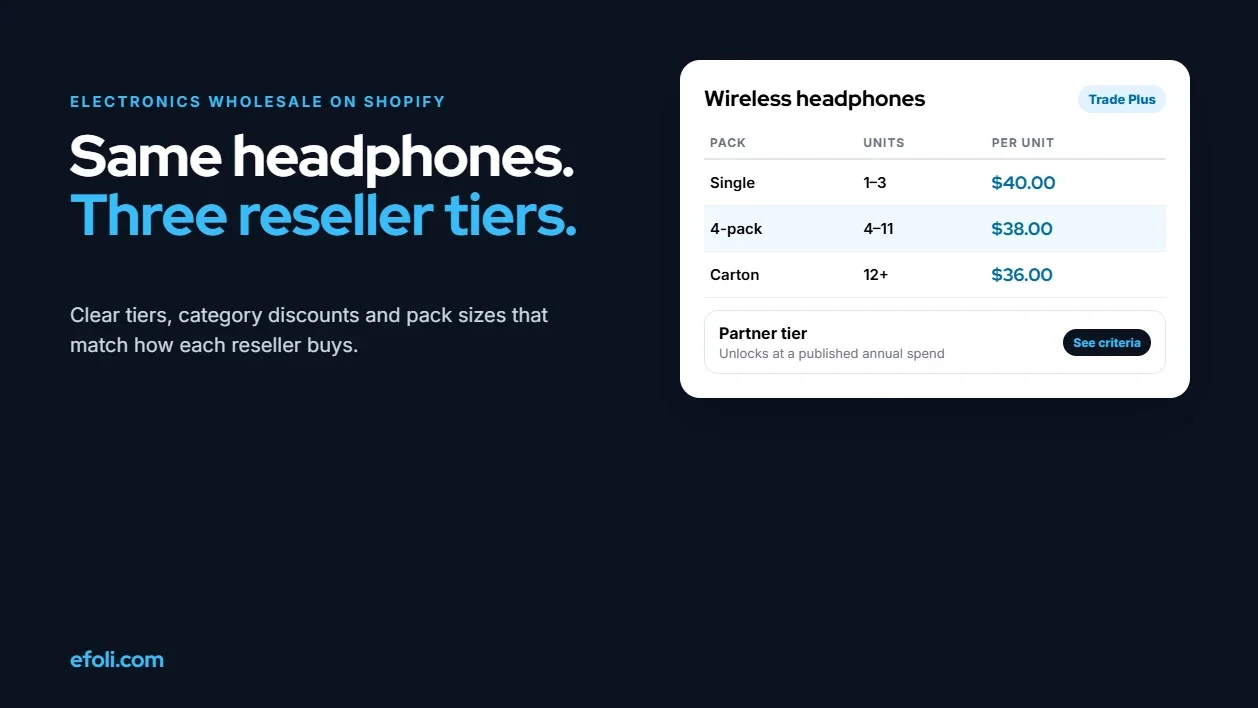
1 to 3 | $42 |
4 to 11 | $40 |
12+ (carton) | $38 |
This is separate from the account tier. A Trade buyer and a Partner buyer can both see a volume ladder, starting from their own tier price. That gives Marcus a reason to buy a carton and gives larger buyers a clear cost per unit.
Match pack sizes to the buyer
Sell packs that reflect how electronics are actually shipped and bought: singles, inner packs and cartons. MultiVariants can show pack quantities as selectable options on the product page and enforce order steps or minimums on its Professional plan. You can add pack-size quantity options so a repair shop can pick a 4-pack and a reseller can pick a carton without separate products.

Make sure inventory is counted correctly. If packs are quantity steps rather than separate products, one carton of 12 should reduce stock by 12 units.
Put launch and clearance rules in writing
Publish a short policy for model changes:
How much notice resellers get of a new model.
Whether there's price protection on recent orders of the old model, and for how long.
When clearance pricing starts and who gets it first.
How returns of unopened old stock are handled, if at all.
Then show the relevant line on product pages for models nearing replacement. Resellers will order closer to launch if they know what happens next.
Roll the tiers out to existing buyers
Changing trade pricing for existing customers needs care. A buyer who has paid $42 for a year and suddenly sees $43 will call, even if their total bill goes down.
Assign tiers from real data. Use the last 12 months of spend or order volume to place each buyer, then review the edge cases by hand.
Avoid surprise increases. If a buyer's price would rise, consider keeping their current price for a set period, then moving them to their tier.
Explain the change. Send each buyer a short note with their tier, what it gives them and what it would take to move up.
Brief the account managers first. They'll get the questions. Give them the criteria and a script.
Review after one quarter. Check who moved tiers, who stopped buying and whether any category margins need adjusting.
Make terms and returns visible
Larger resellers expect payment terms, PO numbers and defined return rules for dead-on-arrival units. Shopify B2B supports payment terms and PO numbers on all B2B plans. Write the warranty and DOA process into the trade account page and the order confirmation, so buyers don't have to call to find out.
It also helps to be clear about who handles warranty claims: the distributor, the brand or the reseller. Repair shops like Marcus's often deal with the end customer first, so they need to know whether to send a faulty unit back to you or direct the customer to the brand. A short flowchart on the trade account page saves dozens of phone calls a month, and it makes smaller resellers feel they're getting the same support as larger ones.
If key accounts have contract prices, Syeda's guide to contract-based discounts explains how to manage them without hiding them from everyone else.
Worked example: Voltline Distribution
Voltline is a composite example, not a real company.
Before
One trade price, set as a flat percentage off retail.
Key accounts priced in a spreadsheet by account managers.
Products sold as single units only.
No published tier criteria.
No policy on model changes.
What changed
Four tiers, with criteria published on the trade account page.
Discounts set per category for each tier, using customer tags and collection-level discounts.
A volume table on each product page, starting from the buyer's tier price.
Singles, 4-packs and cartons available on headphones and speakers, with stock deducted per unit.
A one-page model change policy, linked from affected product pages.
Key account contracts recorded in the pricing app rather than a spreadsheet.
What happened
Voltline's results won't apply to every distributor, and this is an illustration rather than a benchmark. But the direction was clear. Repair shops started buying 4-packs. Several independent retailers asked what they needed to reach Trade Plus, which gave account managers a reason to call. Headphone orders became less seasonal around launches, because buyers knew the clearance policy. And the pricing spreadsheet shrank to a short list of contract accounts.
Marcus, in this story, gets a Trade price on singles, a better price on a 4-pack, and a clear target for Trade Plus. He doesn't need the regional reseller's price. He needs a fair price, visible to him, and a reason to keep buying from the same distributor.
Habits that keep electronics trade pricing broken
One discount for everything. Margins differ too much across categories. Set discounts per category.
Secret tiers. If buyers can't see how to qualify, they assume they're overpaying.
Volume pricing without packs. A price for 12 units means little if the buyer can't order a carton in one step.
Ignoring retail. Your buyers can see retail prices. Check your trade prices against them regularly.
No launch plan. Without price protection or clearance rules, resellers stop ordering ahead of every new model.
Inconsistent exceptions. Every one-off deal makes the next buyer's price harder to explain, and in the US, can raise questions under price discrimination law.
Merchant checklist: electronics reseller pricing

Tiers
Three or four tiers defined by measurable criteria.
Criteria published to trade customers.
Tiers applied consistently to every qualifying buyer.
Tier structure reviewed with legal advice where needed.
Pricing
Discounts set per category for each tier.
Each tier gets a better price than the one below, in every category.
Trade prices checked against public retail prices.
Volume table shown on product pages.
Contract prices recorded in one system, not a spreadsheet.
Packs and inventory
Singles, inner packs and cartons available where relevant.
Pack orders deduct stock per unit.
Minimums and order steps match how products ship.
Policies
Model change and price protection policy published.
DOA and warranty process published.
Payment terms and PO numbers available to qualifying tiers.
Review
Tier movement reviewed quarterly.
Category margins reviewed when brand prices change.
Buyer feedback collected from each tier.
For more on electronics, Anika's post on electronics accessory bundles on Shopify covers attach-rate offers for retail buyers, and her guide on how to sell gadgets online looks at selling electronics through content and other websites.
Final Thoughts
Marcus didn't leave over $2 a pair. He left because the store gave him one price, no context and no way to earn a better one. Electronics resellers buy at very different volumes, across categories with very different margins. Give them clear tiers, category-level discounts, pack sizes that match how they buy and policies they can read. Then the price stops being the reason they leave.
FAQ
How do I set up reseller pricing tiers on Shopify?
Can Shopify show different prices to different resellers?
Should electronics trade discounts be the same across all products?
Is it legal to charge different resellers different prices?
How do I sell electronics in packs and cartons on Shopify?
What should a price protection policy include?

Anika Anamta Mehnaz
This article is written by Anika Anamta Mehnaz, a Content Writer and Content Marketing Strategist specializing in Shopify, eCommerce, and SaaS. With over four years of content writing experience, she creates SEO and AI search-optimized content that helps Shopify merchants make better business decisions through practical, research-backed insights. Her work covers Shopify apps, product variants, bundles, discounts, B2B commerce, and conversion-focused strategies. Outside of work, Anika enjoys watching anime, reading John Grisham novels, and discovering new ideas in digital marketing and e-commerce. If you enjoy discussing Shopify, content marketing, or online growth, feel free to connect with her. Twitter: https://x.com/mehnaz2201 Medium: https://medium.com/@mehnaz_78932
Keep reading
View all articles →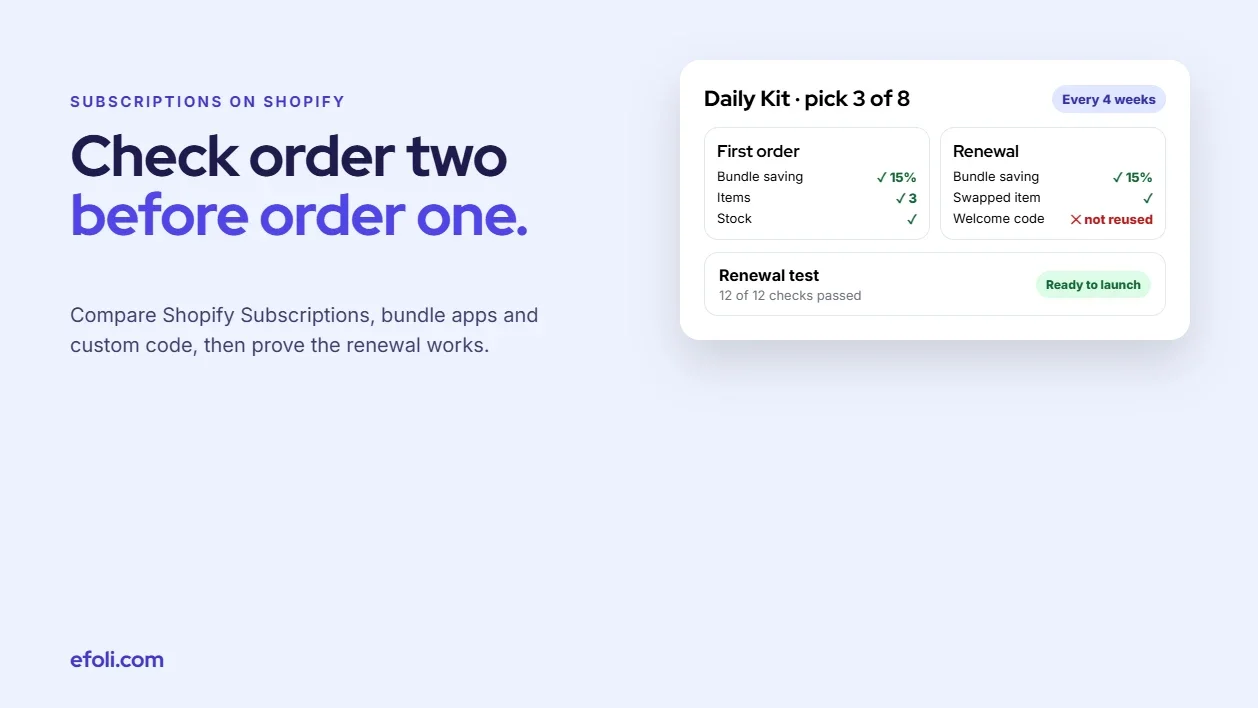
Shopify Subscriptions, Bundle Apps and Custom Code: Check Compatibility First
November 20, 2026 • 17 min read
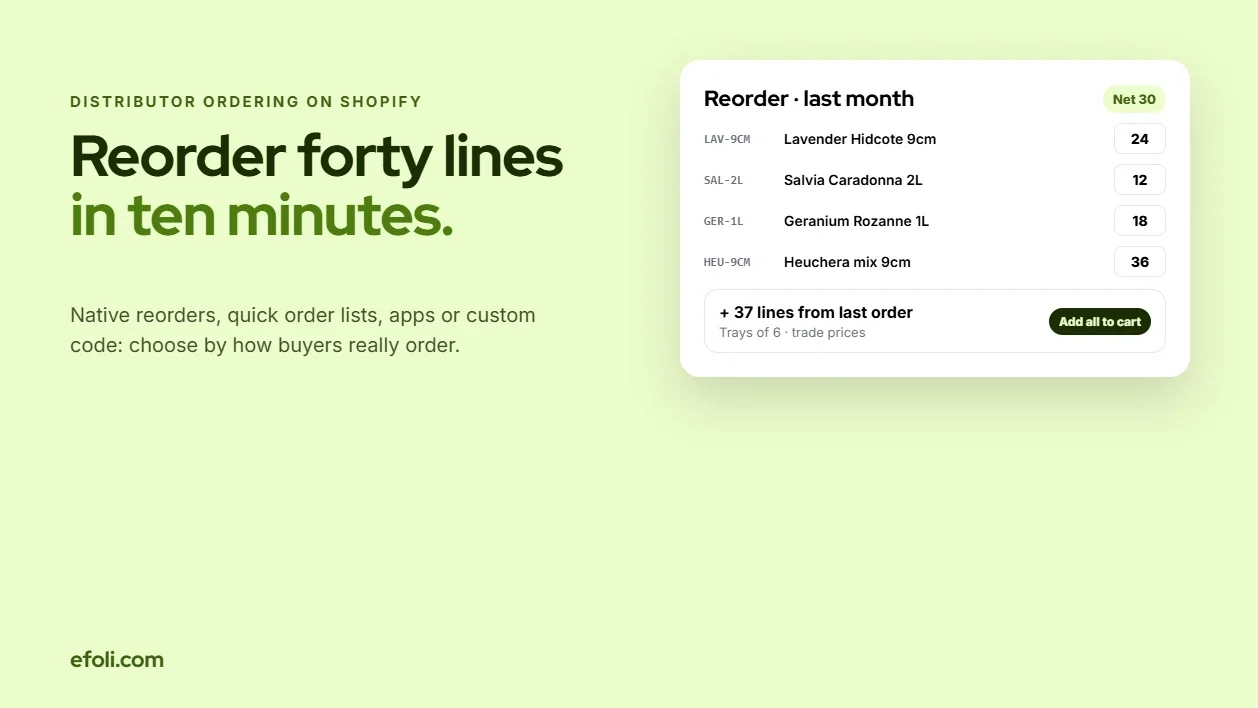
MultiVariants vs Custom Quick-Order Forms for Repeat Distributor Orders
November 20, 2026 • 17 min read
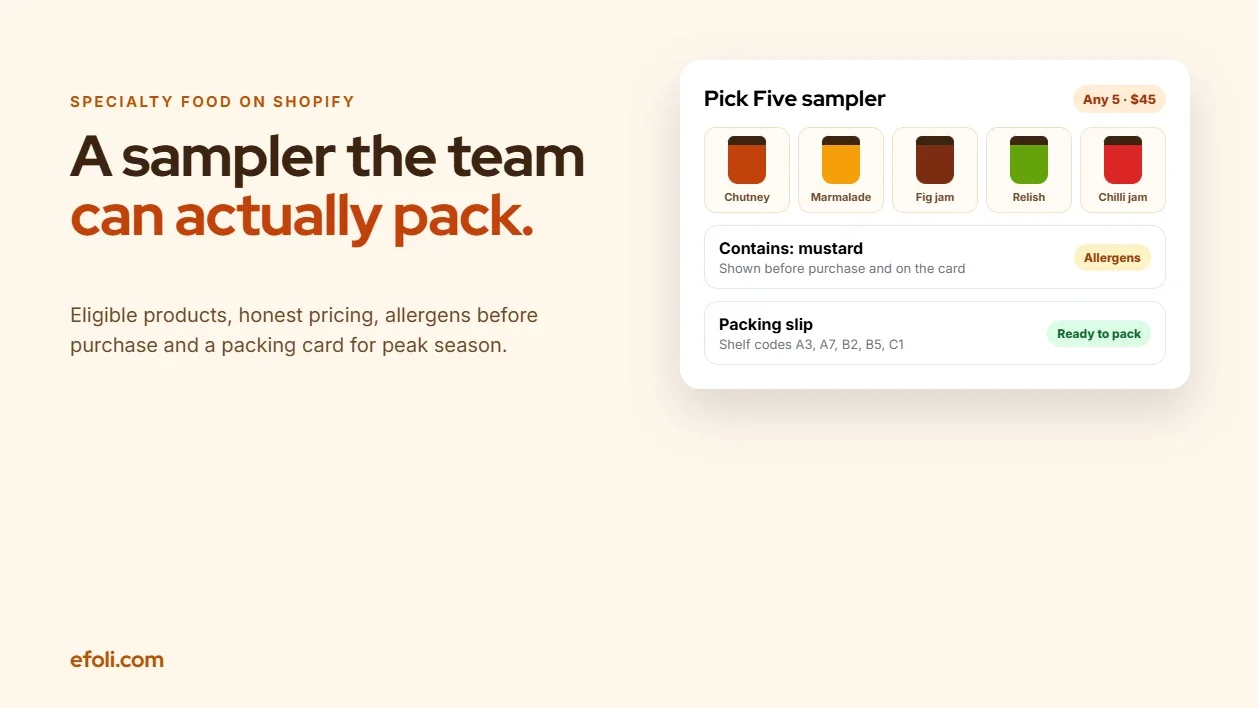
Design a Specialty Food Sampler That the Merchant Can Actually Fulfil
November 20, 2026 • 17 min read