On this page
- Key takeaways
- Part 1: What the merchant needs to decide first
- Run a workshop with the person who packs the boxes
- Choose the sampler type
- Agree the eligible product list
- Price the sampler from the bottom up
- Decide the inventory method
- Decide what happens when something runs out
- Plan the gift version from the start
- Part 2: Configuring the sampler on Shopify
- Choose the bundle approach
- Set the choice rules
- Show allergens before purchase
- Handle best-before dates
- Add volume offers carefully
- Decide where the sampler appears
- Write the product page for the shopper, not the brand
- Part 3: Where samplers break
- A curated item runs out in peak season
- Packing errors in pick-your-own boxes
- The box doesn't fit the selection
- Gift orders with allergen concerns
- Mixed orders
- Damaged jars and returns
- Seasonal changes
- Shipping heat and cold
- Part 4: QA before launch
- Part 5: Handing it over
- The packing card
- The seasonal update routine
- Who owns what after launch
- The metrics to watch
- Worked example: Hollow Lane Pantry
- Before
- After
- What changed
- Common mistakes in sampler builds
- Specialty food sampler checklist
- Final Thoughts
- FAQ
Short answer: A specialty food sampler box on Shopify works when it's designed around what the kitchen and the packing bench can deliver, not just what looks good on the product page. Agree a fixed list of eligible products, a price that covers the box and packing, rules for allergens and shelf life, and a clear inventory method before you configure anything. Then build the sampler with a bundle app, show allergen information before purchase, test the stock deductions and the substitutions, and hand the merchant a packing guide. Most sampler problems appear in the first busy week, not on the product page.
Specialty food founders love samplers. A box of five small jars introduces new customers to the range, makes a natural gift, and turns a single-product shopper into someone who knows the whole shelf.
They're also one of the easiest products to get wrong. A sampler touches pricing, inventory, allergens, shelf life, packing and gifting all at once. When an agency builds it as "a bundle with five jars," the merchant often ends up with a beautiful product page that the packing team dreads.
This playbook is for Shopify agencies, freelancers and in-house teams building samplers for specialty food brands. It follows a fictional preserves brand, Hollow Lane Pantry, from the first workshop to the handover, and it focuses on the parts that make or break fulfilment.
Key takeaways
Start with the packing bench. Ask what the team can pack quickly and correctly at peak, then design the sampler around that.
Decide between a curated sampler, a pick-your-own sampler, or both. Each needs a different setup.
Limit pick-your-own choices to products that are in stock, fit the box and share similar shelf life.
Show allergen information before purchase. In the UK, distance sellers must provide it before the sale and at delivery.
Test inventory deductions, substitutions and out-of-stock behaviour before launch.
Hand over a packing card, a substitution policy and a seasonal update routine.
Part 1: What the merchant needs to decide first
Run a workshop with the person who packs the boxes
The founder will explain the brand. The person who packs the orders will explain the sampler. Get both in the room. For Hollow Lane Pantry, the founder wanted shoppers to choose any five products from the range of 30. The packer pointed out that the honey jars were taller than the box, the crackers were fragile and the seasonal chutneys sold out every November.
That conversation changed the design before any work started. Ask the packer:
Which products fit in the sampler box, and in what sizes?
Which products are fragile, heavy, or need extra padding?
Which products sell out or change by season?
How long does it take to pack a sampler now?
What goes wrong most often?
Choose the sampler type
There are three common sampler models. Agree which one you're building.
Sampler type | How it works | Best for | Watch out for |
|---|---|---|---|
Curated | The brand picks the products | Gifts, new customers, simple packing | Stock-outs of one item stop the whole box |
Pick your own | The shopper chooses from a list | Repeat buyers, foodies, upsells | Packing errors, slow picking, odd combinations |
Curated with swaps | A set box with limited swaps | Allergies and preferences | Rules can get complicated |
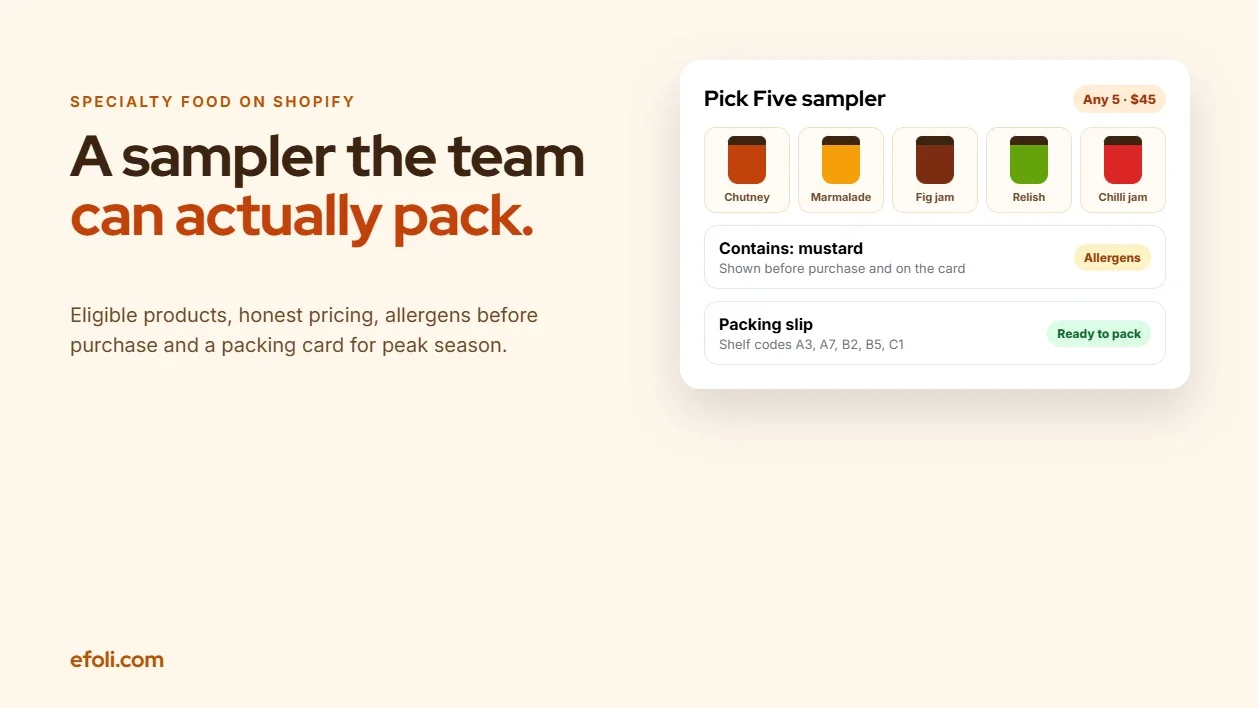
Hollow Lane chose two. A curated "Pantry Favourites" sampler for gifting and new customers, and a "Pick Five" sampler for repeat buyers. The curated box would be the default on the home page.
Agree the eligible product list
For a pick-your-own sampler, list the products that can go in it. A product should be eligible only if:
It's available in the sampler size.
It fits the box with the other items.
It has a shelf life long enough for the shipping time and the customer's use.
It's packed the same way as the others, for example ambient, not chilled.
The packing team can find and pick it quickly.
Hollow Lane's eligible list came down to 18 products from 30. The honey jars went into a separate gift set. The chilled items were left out.
Price the sampler from the bottom up
A sampler price should cover more than the products. Work it out from the ingredients of the order:

Cost line | Example questions |
|---|---|
Products | Cost of each item in the sampler size |
Box and padding | Box, crinkle paper, dividers, tape |
Inserts | Tasting card, recipe card, allergen card |
Labour | Packing time per sampler |
Payment fees | Percentage of the sale |
Shipping subsidy | If shipping is free or discounted |
Margin | The brand's target margin |
For a pick-your-own sampler, use the most expensive likely combination when checking margin, or set the price at a level where the most expensive combination still works. If some products are much more expensive, either leave them out of the sampler or charge a small upgrade fee.
Decide the inventory method
This decision matters more than it sounds. Agree how stock is counted:
Component stock. The sampler takes stock from each product in it. This is accurate but means a sampler can sell out because one item is low.
Separate sampler stock. The brand pre-packs a number of samplers and tracks them as one product. This is simple but only works for curated samplers.
Mixed. Curated samplers are pre-packed. Pick-your-own samplers take stock from components.
Hollow Lane used pre-packed stock for the curated sampler during peak season and component stock for Pick Five. Document how your bundle app deducts stock, because apps handle this differently.
Decide what happens when something runs out
Write a substitution rule before launch. For example:
Curated sampler: if an item runs out, swap it for a named alternative of similar value, and update the product page within a day.
Pick your own: out-of-stock items disappear from the choice list automatically.
Gift orders: never substitute without a note on the packing slip.
Plan the gift version from the start
Samplers are bought as gifts more often than most products, so the gift flow belongs in the first workshop, not a later phase. Agree:
Whether the sampler can ship to a different address from the buyer's.
Whether prices are hidden on the packing slip for gift orders.
How the gift message is captured and printed.
Whether a gift sampler gets different packaging, such as a sleeve or ribbon.
What happens if the recipient has an allergy the buyer didn't know about.
Hollow Lane decided that gift samplers would ship without prices, with the message printed on a card rather than the slip, and with the allergen card always included. That decision shaped the packing slip template and the checkout fields.
Part 2: Configuring the sampler on Shopify
Choose the bundle approach
Shopify offers bundles natively through the Shopify Bundles app, but that app handles fixed bundles and multipacks rather than mix and match, according to Shopify's bundle considerations. For a curated sampler, a fixed bundle may be enough. For a pick-your-own sampler, you'll need a third-party bundle app or a custom build.
PushBundle supports both. You can build a curated sampler as a fixed bundle and a pick-your-own sampler with mix and match, where shoppers choose from a set list of up to 128 products. The build-your-own-box flow supports a set bundle price, so "Pick any five for $45" works without a price per item. The guided setup walks through choosing products, setting the price and placing the bundle on the store. Merchants can build a pick-your-own food sampler in the editor without a developer.

If you want a step-by-step walkthrough, Touhid's guide on how to let shoppers build their own box covers the setup in detail.
Set the choice rules
For a pick-your-own sampler, set:
The number of items, such as exactly five.
Whether shoppers can choose the same product more than once.
The eligible product list.
What happens when an item is out of stock.
For Hollow Lane, shoppers could pick any five, with a maximum of two of the same product. That kept boxes varied without blocking shoppers who loved one chutney.
Show allergens before purchase
Food brands need clear allergen information. In the US, the FDA identifies nine major food allergens: milk, eggs, fish, crustacean shellfish, tree nuts, peanuts, wheat, soybeans and sesame. Sesame was added by the FASTER Act and became the ninth major allergen from 1 January 2023.
In the UK, the Food Standards Agency's allergen technical guidance says businesses selling prepacked food through distance selling, including online, must make mandatory allergen information available before the purchase is completed and at the moment of delivery.
For a sampler, that means:
Each product in the choice list should link to, or show, its ingredients with allergens emphasised.
The curated sampler page should list every item's allergens together.
The packed sampler should include each product's own label, and ideally a card listing all items.
Store allergen data as product metafields so it can be shown in the bundle, on product pages and in filters. Hollow Lane added "Contains" and "May contain" fields to each product and showed them under each choice in the sampler.
Handle best-before dates
The USDA's Food Safety and Inspection Service notes that except for infant formula, product dating isn't required by federal regulations in the US, although some states have their own rules. Many specialty brands use best-before dates anyway, and customers expect them.
For samplers, agree a minimum remaining shelf life at packing, such as "at least three months," and add it to the packing guide. This matters most for gifts, which may sit unopened for weeks.
Add volume offers carefully
Samplers often sell well as gifts in multiples. If the brand wants "Buy two samplers, save 10%," a quantity discount can handle it. DiscountRay's free Starter plan supports tiered discounts and a pricing table on the product page. You can add a multi-sampler tier discount so the saving is shown before the shopper adds to cart.
Check how the discount interacts with the bundle price. A sampler that's already priced as a bundle may not have room for a second discount. Run the margin numbers again with the discount applied.
Decide where the sampler appears
A sampler only works if new customers see it at the right moment. Common placements:
Home page: the curated sampler as "New here? Start with this."
Product pages: a small note on each eligible product, such as "Try it in our Pick Five sampler."
Cart: a sampler suggestion for first-time shoppers with a single item.
Gift guide: the sampler at the top of the gifting collection.
Content: recipe posts and pairing guides that link to the sampler.
Don't add the sampler everywhere at once. Pick two placements, measure, then add more.
Write the product page for the shopper, not the brand
A sampler page should answer:
What's in it, or what can I choose?
How much is each item?
Who is it for?
Does it contain anything I can't eat?
How long will it keep?
Can I send it as a gift?
Hollow Lane's page included a "What's in the box" section, sizes in grams, a tasting order, allergen notes, a "best within" guide and a gift message option. Anika's post on fragrance discovery sets on Shopify has a useful approach to sampler messaging that carries over well to food.
Part 3: Where samplers break
A curated item runs out in peak season
The most common problem. One item in the curated sampler sells out, and either the whole sampler stops selling or orders arrive that can't be packed. Agree the substitution rule, set up stock alerts and keep a named backup product.
Packing errors in pick-your-own boxes
A packer looking at a list of five products from 18 can easily pick the wrong one. Make the packing slip clear: product name, size and a short code. Group items on the slip in shelf order. Hollow Lane added shelf codes to every product so packing slips read like a pick list.
The box doesn't fit the selection
If shoppers can choose any five, someone will choose five of the heaviest or tallest items. Either keep those products out of the sampler or test the worst-case combination in the actual box.
Gift orders with allergen concerns
A gift buyer might choose items for someone else without checking allergens. Add a reminder near the gift option and include an allergen card in every sampler.
Mixed orders
Some customers will buy a sampler and two full-size jars in the same order. Make sure the packing slip separates the sampler contents from the other items, so the packer doesn't put a full-size jar in the sampler box or leave a sampler item loose.
Damaged jars and returns
Food can't usually be returned for resale, so damaged or wrong items are normally replaced or refunded. Agree with the merchant whether a broken jar means replacing one item or the whole sampler, who approves it, and how the replacement is recorded so stock stays accurate. For a pick-your-own sampler, the support team needs to see exactly what the customer chose.
Seasonal changes
If the sampler changes by season, plan who updates the product list, images, description and allergen card. A sampler showing last season's chutney is a fast way to get a complaint.
Shipping heat and cold
Ambient products can still suffer in heat. Glass jars can crack in cold. Agree shipping rules for extreme weather and whether the brand pauses certain items or regions.
Part 4: QA before launch

Run these tests on a development store or a password-protected store with real products.
Test | What to check |
|---|---|
Buy a curated sampler | Correct price, all items on the packing slip |
Buy a pick-your-own sampler | Choices appear clearly on the order and packing slip |
Choose an out-of-stock item | Item is unavailable or hidden |
Choose more than the limit of one product | Blocked with a clear message |
Buy two samplers with a tier discount | Discount applied once, margin still positive |
Check stock after a sampler order | Each component reduced correctly |
Cancel a sampler order | Stock returned as expected |
Gift order with message | Message appears on the packing slip |
View allergens before purchase | Every eligible product shows allergens |
Mobile purchase | Choices, prices and allergens readable |
Pack the worst-case combination | Fits the box safely |
Then pack ten samplers with real orders, timed. If the packing takes much longer than planned, simplify the choice list or improve the slip before launch.
Hollow Lane's first timed run showed the Pick Five samplers took nearly twice as long to pack as the curated ones. The fix was simple: shelf codes on the slip and a sampler-only shelf with the 18 eligible products.
Part 5: Handing it over
The packing card
Give the merchant a one-page packing card:
Box size, padding and insert order.
Minimum best-before at packing.
Substitution rules.
What to do with a gift message.
Who to tell when an item runs out.
The seasonal update routine
Write a short routine for changing the sampler:
Update eligible products in the bundle app.
Update the curated sampler contents and images.
Update the allergen card and the product page.
Test one order.
Brief the packing team.
Who owns what after launch
Task | Owner | How often |
|---|---|---|
Update eligible products | Merchandising | Each season |
Check stock of sampler items | Operations | Weekly, daily at peak |
Update allergen card | Product or compliance | Whenever a recipe changes |
Review sampler margin | Founder or finance | Quarterly |
Fix bundle or theme issues | Agency or developer | As needed |
The metrics to watch
Agree what to measure in the first two months:
Sampler orders and the share of new customers.
How often sampler buyers go on to buy a full-size product.
Packing errors and complaints.
Stock-outs that affected samplers.
If samplers lead to full-size orders, the brand might add a follow-up email or a "loved your sampler?" offer. That's a good second phase, not a launch requirement.
Worked example: Hollow Lane Pantry
This example is a composite of patterns common in specialty food brands. Hollow Lane Pantry isn't a real business.
Before
Hollow Lane sold a "Taster Box" that was a single product with a description listing five items. The packer chose the five items based on what was in stock. Customers sometimes got different items from those described. The box had no allergen card. In November, two items ran out and the team switched the box to "unavailable" for a week.
After
A curated "Pantry Favourites" sampler, pre-packed in the run-up to the holidays, with a named substitute for each item.
A "Pick Five" sampler built with PushBundle, from 18 eligible products, with a maximum of two of any one product.
Allergen metafields on every product, shown in the sampler choices.
A printed allergen card in every box.
A tier discount for buying two or more samplers.
A packing card, shelf codes and a seasonal update routine.
What changed
The team no longer had to describe a box that didn't match what was packed. Out-of-stock items disappeared from the Pick Five choices. The curated sampler stayed available through November because substitutes were agreed in advance. Packing got faster once the slip matched the shelves. None of these results is guaranteed for every brand, but each one came from a decision made before setup, not after launch.
Common mistakes in sampler builds
Building the page before the packing plan. A sampler that looks great but takes ten minutes to pack will be quietly hidden by the merchant within a month.
Letting shoppers choose from the whole range. More choice feels generous, but it slows packing, strains the box size and makes margin hard to predict. A shorter list of products that suit sampling works better.
Treating allergens as a description line. "Contains nuts" in a paragraph is easy to miss. Show allergens with each choice and on a card in the box.
Forgetting the second discount. A bundle price plus a site-wide promo code can push a sampler below cost. Decide which discounts can combine with the sampler.
Skipping the timed pack. Ten real samplers packed against a stopwatch will tell you more than any product page review.
No owner after launch. Samplers change with the seasons. If nobody owns the update, the sampler goes stale while the rest of the store moves on.
Specialty food sampler checklist
Before setup
Workshop with the founder and the packer.
Sampler type chosen.
Eligible product list agreed.
Price built from product, packing, labour and margin.
Inventory method agreed.
Substitution rule written.
Setup
Bundle app configured for each sampler type.
Choice rules set.
Allergen metafields added and shown before purchase.
Minimum shelf life at packing agreed.
Volume offer checked against margin.
Product page answers the shopper's questions.
QA
Test matrix completed.
Stock deductions and cancellations tested.
Worst-case combination packed.
Ten samplers packed and timed.
Handoff
Packing card delivered.
Seasonal update routine delivered.
Metrics agreed.
For related reading, Anika's guide to the coffee sampler subscription on Shopify covers samplers sold on a recurring basis, and her post on how to sell recipe ingredients online shows how food brands can sell from content outside their store.
Final Thoughts
A sampler is a small product with a long list of decisions behind it. Start at the packing bench, agree the product list, price and inventory rules, show allergens before purchase, and test the worst-case box. Do that, and the sampler becomes what the founder hoped: an easy way for new customers to discover the range, without a packing team that dreads every order.
FAQ
How do I create a food sampler box on Shopify?
Can Shopify Bundles handle a pick-your-own sampler?
How should I show allergens for a food sampler?
How do I price a sampler box?
What happens when an item in a sampler sells out?
Are best-before dates required on food in the US?

Anika Anamta Mehnaz
This article is written by Anika Anamta Mehnaz, a Content Writer and Content Marketing Strategist specializing in Shopify, eCommerce, and SaaS. With over four years of content writing experience, she creates SEO and AI search-optimized content that helps Shopify merchants make better business decisions through practical, research-backed insights. Her work covers Shopify apps, product variants, bundles, discounts, B2B commerce, and conversion-focused strategies. Outside of work, Anika enjoys watching anime, reading John Grisham novels, and discovering new ideas in digital marketing and e-commerce. If you enjoy discussing Shopify, content marketing, or online growth, feel free to connect with her. Twitter: https://x.com/mehnaz2201 Medium: https://medium.com/@mehnaz_78932
Keep reading
View all articles →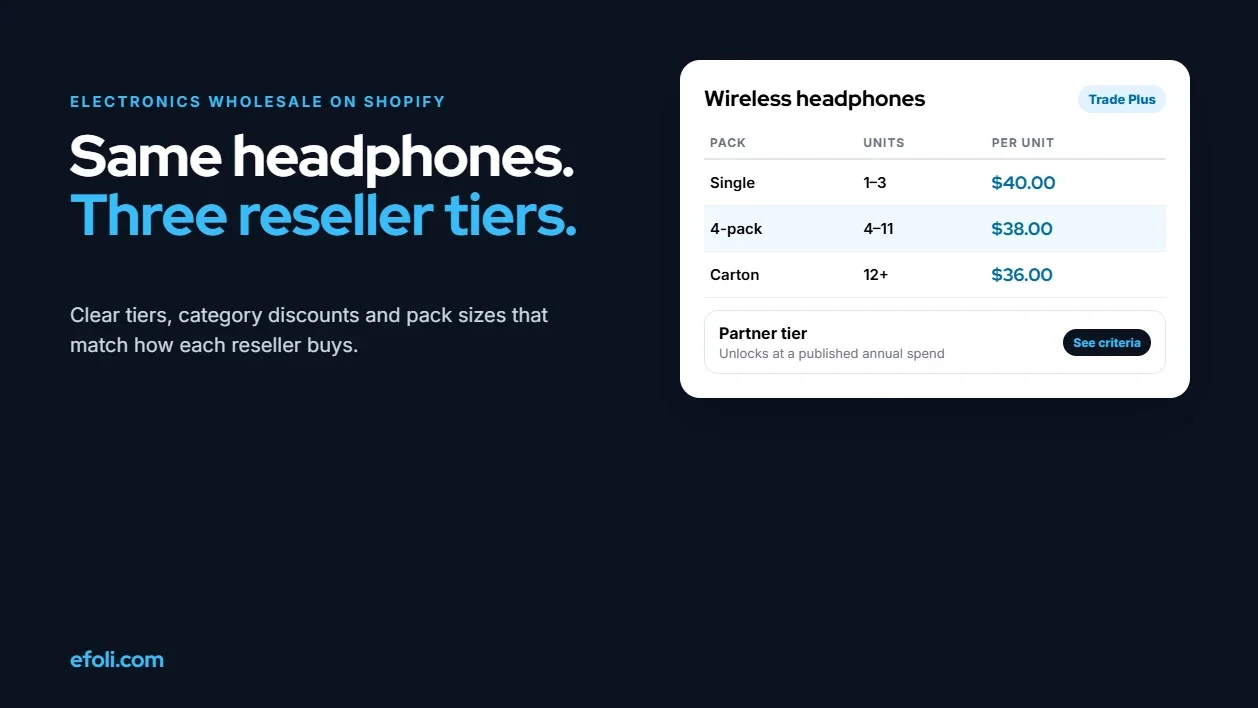
Same Headphones, Three Reseller Tiers: Why One Price Makes No Sense
November 20, 2026 • 17 min read
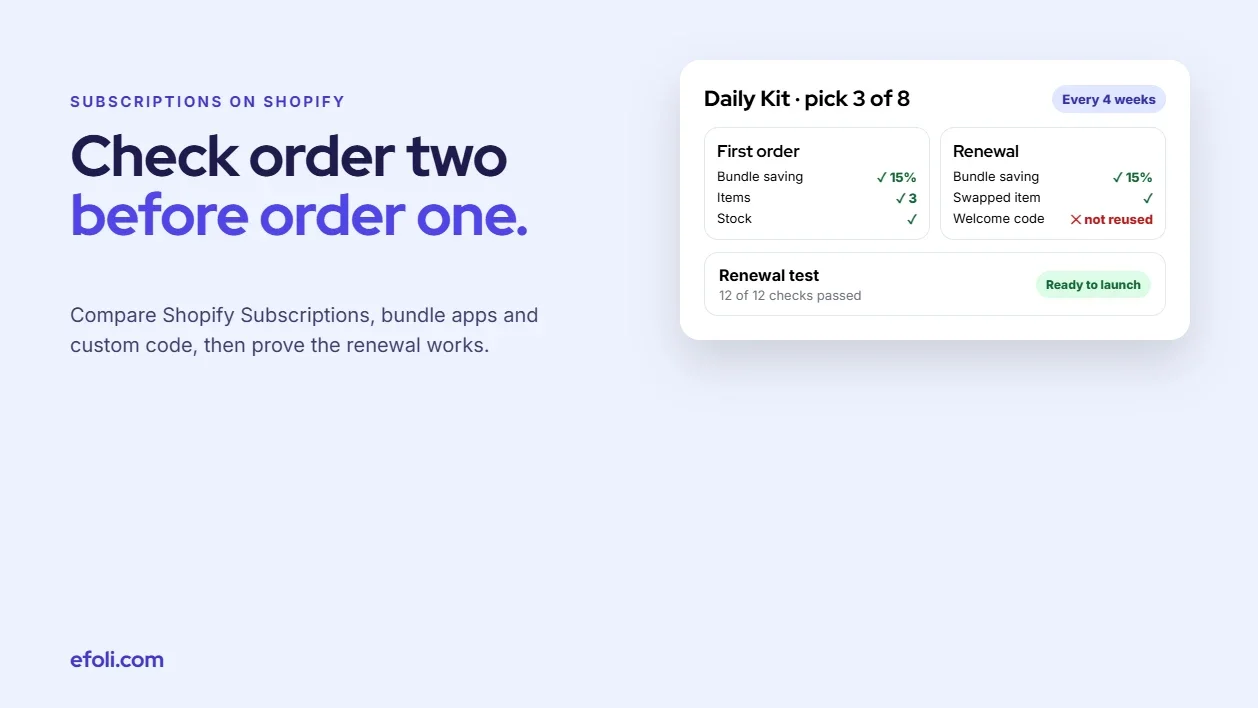
Shopify Subscriptions, Bundle Apps and Custom Code: Check Compatibility First
November 20, 2026 • 17 min read
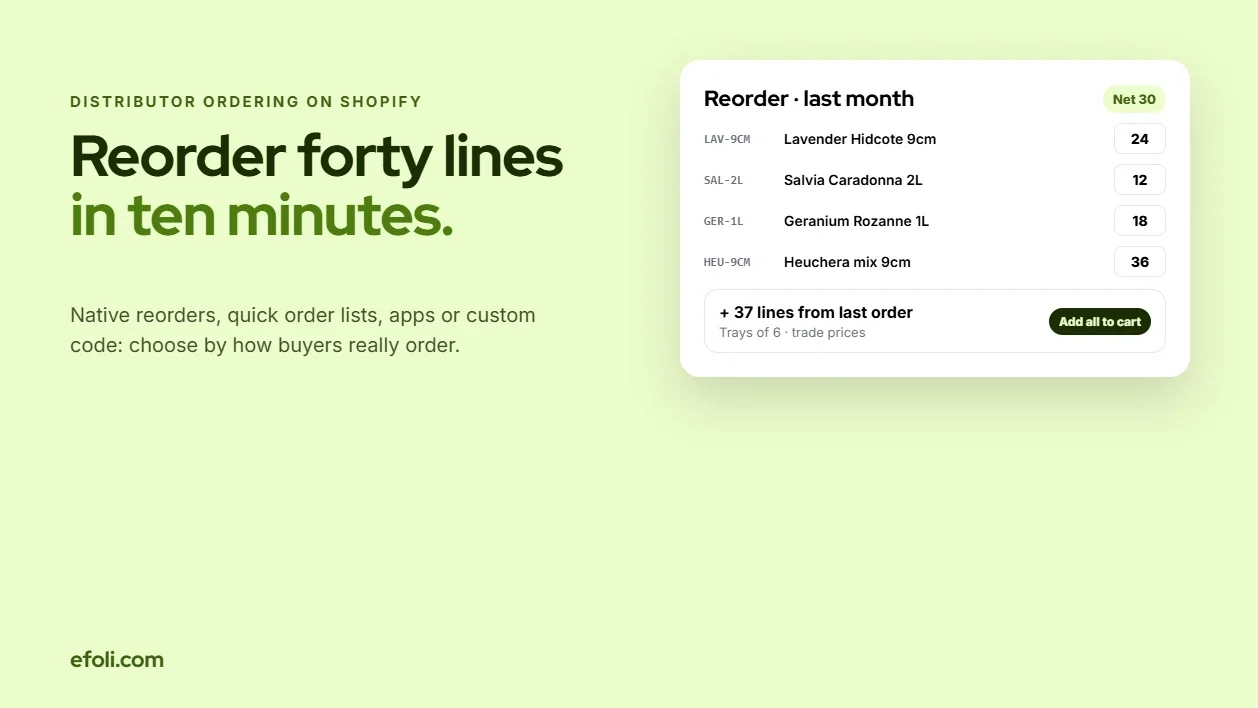
MultiVariants vs Custom Quick-Order Forms for Repeat Distributor Orders
November 20, 2026 • 17 min read