How to Optimize Your Shopify Store for ChatGPT, Gemini, and AI Shopping
AI tools are becoming part of how customers discover, compare, and research products. Learn how Shopify merchants can prepare product pages, structured data, store content, reviews, and brand information for ChatGPT, Gemini, and the growing AI shopping ecosystem.
On this page
- What Is Shopify AI Shopping?
- How ChatGPT, Gemini, and AI Systems Discover Products
- 1. Improve Your Shopify Product Data First
- 2. Write Product Titles That Explain What You Sell
- 3. Write Product Descriptions Around Customer Questions
- 4. Make Important Product Facts Easy to Find
- 5. Keep Price, Inventory, and Variant Information Accurate
- 6. Use Structured Data Correctly
- 7. Optimize Images for Product Understanding
- 8. Build Helpful Collection Pages
- 9. Create Content That Answers Pre-Purchase Questions
- 10. Optimize for Questions, Not Just Keywords
- 11. Strengthen Your Brand Entity Across the Web
- 12. Earn Real Reviews and Customer Evidence
- 13. Make Shipping, Returns, and Policies Easy to Understand
- 14. Improve Your About Page
- 15. Build E-E-A-T Signals Into Your Content
- 16. Do Not Abandon Traditional Shopify SEO
- 17. Build Strong Internal Linking Between Related Topics
- 18. Make Your Store Technically Accessible to Crawlers
- 19. Monitor AI Referral Traffic
- 20. Test How AI Systems Currently Understand Your Brand
- Shopify AI Shopping Optimization Checklist
- SEO vs GEO for Shopify
- What Shopify Merchants Should Avoid
- The Bigger Shift: Optimize Information, Not Just Pages
- Prepare Your Shopify Store for AI Discovery Before It Becomes the Default
- FAQs
For years, ecommerce discovery followed a familiar path. A customer searched Google, opened several product pages, compared options, and eventually chose what to buy. AI shopping is changing that journey.
A buyer can now ask ChatGPT, Gemini, Copilot, or another AI assistant a detailed question such as, “What is a good waterproof backpack under $100 for commuting?” Instead of scrolling through pages of links, the customer may receive a summarized set of recommendations based on product information, reviews, availability, price, merchant reputation, and other signals.
This behavior is already showing measurable growth. According to Shopify's Q1 2026 commerce data, referral sessions from AI chatbots to Shopify stores grew more than eight times year over year, while AI-referred orders grew nearly 13 times. Shopify also reported that AI-referred product-page sessions converted at nearly 50% higher rates than organic-search sessions, while AI-referred orders had a 14% higher average order value. Shopify notes that these signals are still early, but they show how quickly AI-assisted product discovery is developing.
For merchants, this creates a new optimization challenge. Your store still needs traditional SEO, but it increasingly needs to be understandable to AI systems as well.
That is where Shopify AI shopping optimization and generative engine optimization, commonly called GEO, become important.
What Is Shopify AI Shopping?

Shopify AI shopping refers broadly to product discovery, research, recommendations, comparison, and purchasing experiences that involve AI assistants or AI-powered search systems.
Instead of entering short keywords such as:
men's waterproof jacket
a buyer may ask:
“I need a lightweight waterproof jacket for commuting by bicycle, preferably under $150. Which options have good reviews and are available in medium?”
That difference matters.
Traditional search engines historically relied heavily on keywords, links, relevance, page quality, and many technical signals. AI systems can interpret considerably more context about what the customer actually wants.
They may need to understand whether your product is waterproof, lightweight, designed for cycling, available in a specific size, within the buyer's budget, well reviewed, currently in stock, and sold by a credible business.
Your product information therefore has to do more than contain keywords. It needs to provide clear facts that machines can confidently understand and connect to customer needs.
Google has also been expanding conversational shopping. Its Shopping Graph contains tens of billions of product listings, and Google has incorporated shopping information into AI-powered experiences such as Gemini and AI Mode.
How ChatGPT, Gemini, and AI Systems Discover Products
There is no single universal ranking formula for AI shopping.
Different platforms use different systems, data sources, merchant integrations, product feeds, search indexes, third-party sources, reviews, structured data, and proprietary ranking methods.
That means merchants should be cautious about anyone promising a guaranteed “#1 ChatGPT ranking.”
What you can control is whether your business provides clear, consistent, machine-readable, and trustworthy information wherever AI systems may encounter it.
Shopify recommends providing accurate and descriptive product information because AI platforms and shopping systems use fields such as product titles, descriptions, images, pricing, availability, categories, variants, and other attributes when matching products to customer searches.
Think of AI visibility as an information problem.
If an AI assistant cannot determine exactly what your product is, who it is designed for, what specifications it has, whether it is available, and why someone might choose it, recommending the product becomes harder.
1. Improve Your Shopify Product Data First
The foundation of Shopify AI shopping optimization is not an AI-written blog post. It is good product data.
Every product should have enough information for both a customer and a machine to understand it without making assumptions.
At minimum, review:
Product title
Product description
Product type
Category
Brand or vendor
Price
Availability
Variants
Size
Color
Material
Dimensions
Weight where relevant
Images
Image alt text
SKU or identifiers where appropriate
Compatibility information
Intended use
Important product attributes
Shopify specifically recommends clear, accurate, and detailed product information when preparing products for AI platforms.
Imagine two stores selling essentially the same backpack.
The first product description says:
Premium commuter backpack. Stylish, durable and perfect for everyday life.
The second explains that the backpack has a 22-liter capacity, water-resistant recycled nylon exterior, padded compartment for laptops up to 16 inches, two external bottle pockets, reflective detailing, and dimensions of 46 × 30 × 15 cm.
The second listing gives AI systems considerably more information to work with.
A customer asking for a water-resistant commuting backpack that fits a 16-inch laptop is therefore easier to match with the second product.
2. Write Product Titles That Explain What You Sell
Creative product names can be good for branding, but they should not prevent customers or AI systems from understanding the product.
A title such as:
The Horizon
provides almost no product context.
A title such as:
Horizon Waterproof 22L Commuter Backpack
provides significantly more.
You do not need to turn every product title into a collection of keywords. The goal is simply to combine the product's recognizable name with meaningful descriptive information.
Good product titles should answer basic questions such as:
What is it? What type is it? What important variation or characteristic distinguishes it?
This improves traditional search visibility while also giving AI systems better context.
3. Write Product Descriptions Around Customer Questions
Traditional ecommerce descriptions often focus heavily on persuasive copy.
AI-friendly descriptions need persuasion too, but they also need facts.
Before writing a product description, think about what customers might ask an AI assistant before purchasing:
What material is it made from?
Who is it designed for?
What size should I choose?
Is it compatible with my device?
Is it suitable for outdoor use?
Can it be washed?
Does it contain a particular ingredient?
How much weight can it support?
What is included?
How does it differ from another model?
Answer these questions naturally within the page.
This improves the page for customers while creating clearer information that AI systems can interpret.
Avoid filling descriptions with vague phrases such as “best quality,” “revolutionary,” “premium solution,” or “perfect choice” unless those claims are supported by something meaningful.
Specific information is more useful than generic marketing language.
4. Make Important Product Facts Easy to Find
Customers should not have to search through several tabs to discover essential information.
Important facts can be presented using concise specification sections, tables, bullet points, FAQs, comparison charts, or clearly labeled sections.
For example:
Product Detail | Example |
Material | Recycled nylon |
Capacity | 22 L |
Laptop compatibility | Up to 16 inches |
Water resistance | Water-resistant exterior |
Weight | 850 g |
Warranty | 2 years |
This structure benefits both usability and machine understanding.
Shopify's AI optimization guidance similarly recommends making important information such as price, availability, features, and product details clear on product pages.
5. Keep Price, Inventory, and Variant Information Accurate
Few things damage a product recommendation faster than outdated information.
Imagine an AI assistant recommending a product for $49 only for the customer to discover that it now costs $79.
The same problem occurs when a recommended color, size, or model is no longer available.
Merchants should therefore keep product feeds and Shopify data synchronized across sales channels wherever possible.
Pay particular attention to:
Current pricing
Sale prices
Inventory availability
Variant availability
Product status
Currency
Shipping restrictions
Product options
Shopify Catalog is designed to help structure merchant product information for AI and commerce channels, while merchants remain responsible for maintaining accurate and complete underlying product information.
6. Use Structured Data Correctly
Structured data gives machines explicit information about what a page contains.
For ecommerce stores, Product schema can help identify details such as:
Product name
Description
Image
Brand
SKU
Price
Currency
Availability
Reviews
Ratings
Offers
Shopify themes commonly generate some structured data automatically, although implementations vary depending on the theme and apps installed.
Do not simply add several schema apps and assume more markup means better visibility.
Duplicate, conflicting, or inaccurate schema can create confusion.
Check that the structured information matches what customers actually see on the page.
Google's Rich Results Test and Schema.org documentation can help developers validate ecommerce markup.
7. Optimize Images for Product Understanding
AI shopping is becoming increasingly visual.
A product may be discovered not only through text but also through image-based search and multimodal AI systems.
Use high-quality product photography that clearly shows:
The full product
Important details
Different angles
Scale where necessary
Product variations
Real-world usage when appropriate
Image filenames and alt text should also be descriptive.
Instead of:
IMG_4829.jpg
use something closer to:
black-waterproof-commuter-backpack.jpg
And instead of alt text such as:
product image
write:
Black 22L waterproof commuter backpack with front pocket
Alt text should primarily describe the image accurately. Avoid forcing keywords into every image.
8. Build Helpful Collection Pages
AI shopping optimization should not stop at individual product pages.
Collection pages help establish relationships between groups of products.
A collection titled:
Backpacks
provides basic information.
A more focused collection such as:
Waterproof Commuter Backpacks
provides stronger topical context.
Include a concise collection description explaining what the category contains, who it is useful for, and what customers should consider when choosing among the products.
Avoid adding hundreds of words simply for SEO. Useful context is more valuable than filler.
9. Create Content That Answers Pre-Purchase Questions
Many AI shopping searches happen before customers know exactly which product they want.
Someone might ask:
What type of protein powder is suitable for lactose-sensitive customers?
or:
What should I look for when buying a standing desk for a small apartment?
A merchant selling these products can create educational content answering those questions.
Useful content formats include:
Buying guides
Product comparisons
Size guides
Compatibility guides
Care guides
Ingredient explanations
Product-selection guides
Troubleshooting articles
Industry explainers
FAQs
These pages establish topical relevance around the problems your products solve.
More importantly, they create information that can potentially be referenced when AI systems research a subject.
10. Optimize for Questions, Not Just Keywords
SEO keyword research still matters, but conversational AI encourages customers to search differently.
Traditional query:
best coffee grinder
Conversational query:
What type of coffee grinder should I buy for espresso if I have limited counter space and a $150 budget?
The second query includes several layers of intent:
Product category
Use case
Space limitation
Budget
Buying decision
Your content should account for these real questions.
FAQ sections work particularly well when questions represent genuine customer concerns.
Useful examples include:
Can this product be used outdoors?
Which size should I choose?
Is this compatible with Shopify POS?
Does the product require installation?
Can I order several variants together?
Answer each question directly before adding further explanation.
That structure makes the content easier for customers to scan and easier for AI systems to interpret.
11. Strengthen Your Brand Entity Across the Web
AI visibility is not determined only by what appears on your website.
AI systems may encounter your business through many external sources.
These can include:
Industry publications
Reviews
Comparison articles
Partner websites
Business directories
News coverage
Social profiles
Community discussions
Expert citations
YouTube videos
Podcasts
Marketplace profiles
Consistency matters.
Your company name, product names, descriptions, website, category, and positioning should not contradict one another across different sources.
If your website says your company builds B2B Shopify tools while another profile describes it as a general marketing agency, machines receive conflicting information.
This is one reason brand building and GEO are closely connected.
You are not merely optimizing a page. You are helping search engines and AI systems understand what your company is known for.
12. Earn Real Reviews and Customer Evidence
Reviews provide another important source of product context.
They can reveal information that product descriptions often miss, including durability, fit, usability, real-world applications, and recurring customer concerns.
Encourage legitimate customers to leave detailed, authentic reviews.
Do not manufacture reviews or create artificial testimonials for AI visibility.
Useful customer-generated information may help both future buyers and systems trying to understand how a product performs in real situations.
Merchants can also strengthen credibility through genuine case studies.
A strong case study explains:
The customer's problem
Their requirements
What solution was implemented
How it worked
What happened afterward
Specific evidence is generally more persuasive than broad statements about product quality.
13. Make Shipping, Returns, and Policies Easy to Understand
A product recommendation is not based solely on the product itself.
A buyer may ask:
Which store can deliver this before Friday?
or:
Which option offers returns if the size does not fit?
That makes operational information part of product discovery.
Clearly publish:
Shipping options
Delivery estimates
Return policies
Refund conditions
Warranty information
Geographic restrictions
Contact information
Payment information where appropriate
Do not bury critical policies inside vague legal language when a clearer customer-facing explanation is possible.
14. Improve Your About Page
An About page may not look like an AI shopping optimization tactic, but it helps establish who is behind the business.
A useful About page can explain:
Who the company is
What it sells
Who it serves
Where it operates
What expertise it has
How long it has operated
Who is responsible for the business
How customers can contact the company
If you make specialized products, explain the experience behind them.
For example, a company manufacturing climbing equipment should provide more evidence of expertise than simply saying, “We love adventure.”
Real expertise contributes to customer trust and makes the brand easier to understand.
15. Build E-E-A-T Signals Into Your Content
Experience, expertise, authoritativeness, and trustworthiness remain useful principles when creating ecommerce content.
For important guides, include:
Author information: Explain who wrote or reviewed the content.
Sources: Link to credible primary research or documentation when making factual claims.
First-hand knowledge: Include screenshots, examples, experiments, case studies, original observations, or product experience where relevant.
Update dates: Review information when platforms or technologies change.
Transparent claims: Avoid turning assumptions into facts.
For technical Shopify content, link to Shopify documentation whenever possible instead of relying solely on secondary blogs.
This is particularly important for AI-related topics because the ecosystem changes quickly.
16. Do Not Abandon Traditional Shopify SEO
GEO is not a replacement for SEO.
Organic search continues to drive substantially more traffic to Shopify stores than tracked AI referral platforms, according to Shopify's 2026 data. Shopify also reported that same-store organic sessions were still growing during the period it analyzed.
Continue working on:
Site architecture
Internal linking
Page titles
Meta descriptions
Canonical URLs
Indexability
Crawlability
Page speed
Mobile usability
Image optimization
Product descriptions
Collection optimization
Backlinks
Helpful content
Many of the practices that make content useful to traditional search engines also make it easier for AI systems to understand.
The difference is that GEO places greater emphasis on entities, facts, product attributes, context, citations, credibility, and conversational intent.
17. Build Strong Internal Linking Between Related Topics
Internal links help customers navigate your site, but they also clarify relationships between pages.
Suppose you sell wholesale apparel.
A guide about wholesale ordering could naturally link to:
Case-pack requirements
Minimum order quantities
Size-run ordering
Volume pricing
Inventory management
B2B customer accounts
These relationships help establish topical depth.
Avoid random internal links added only because two pages contain the same keyword.
The link should genuinely help someone understand the subject better.
18. Make Your Store Technically Accessible to Crawlers
Great content cannot perform well if systems cannot access it.
Review whether important pages are:
Publicly accessible
Indexable
Properly linked
Rendered reliably
Included in your site architecture
Free from accidental noindex directives
Available through valid URLs
Not hidden entirely behind client-side interactions
JavaScript-heavy design elements can sometimes make important information harder to access.
Critical product information should ideally exist as meaningful page content rather than only inside interactive elements that appear after multiple actions.
19. Monitor AI Referral Traffic
Optimization should be measured.
Check your analytics for referrals from platforms such as:
ChatGPT
Gemini
Copilot
Perplexity
Claude
Other AI assistants
Shopify has noted that AI referrals are already measurable for many merchants, although attribution is imperfect. Some AI-influenced Google activity, for example, may still appear under organic search rather than a separate AI referral category.
Track more than traffic.
Compare:
Sessions
Product-page visits
Conversion rate
Revenue
Average order value
Products discovered
Landing pages
New vs returning customers
Over time, this can show which parts of your catalog are gaining visibility through AI-assisted discovery.
20. Test How AI Systems Currently Understand Your Brand
One simple exercise is to search for your own company and products using several AI platforms.
Try questions such as:
What does [brand] sell?
What is [product] used for?
What are alternatives to [product]?
Which [category] product is suitable for [specific requirement]?
Does [brand] ship internationally?
Do not treat every AI response as a definitive ranking report. Responses can change between users, prompts, locations, model versions, and data sources.
Instead, look for patterns.
Is your company described accurately?
Are important products missing?
Are specifications wrong?
Does the AI misunderstand what your product does?
Those problems can reveal information gaps worth fixing.
Shopify AI Shopping Optimization Checklist
Before considering your store AI-ready, review these areas:
Area | What to Check |
Product titles | Clear and descriptive |
Product descriptions | Detailed and factual |
Attributes | Size, material, compatibility, dimensions, etc. |
Pricing | Accurate and current |
Inventory | Correct availability |
Variants | Clearly identified |
Images | High-quality with descriptive alt text |
Structured data | Correct and consistent |
Collections | Organized around meaningful categories |
FAQs | Answer real buying questions |
Reviews | Authentic customer feedback |
Policies | Shipping, returns and warranty clearly explained |
Brand information | Consistent across the web |
Authority | Expert content, mentions and credible sources |
Internal links | Connect related subjects naturally |
Technical SEO | Crawlable and indexable |
Analytics | Track AI referral traffic |
SEO vs GEO for Shopify
SEO and GEO have different goals, but merchants should use them together.
SEO | GEO |
Helps pages appear in search engines | Helps information surface in AI-generated experiences |
Often begins with keywords | Often begins with questions and intent |
Focuses heavily on ranking pages | Focuses on products, brands, facts and recommendations |
Links are an important authority signal | Brand mentions, citations and corroborating sources can provide context |
Optimizes pages for search results | Optimizes information for machine interpretation |
Search engines send users to websites | AI may answer part of the question before a website visit |
The practical strategy is not SEO or GEO.
It is SEO + GEO + strong product data + brand authority.
What Shopify Merchants Should Avoid
AI search has created plenty of questionable optimization advice.
Be particularly careful with tactics such as mass-producing hundreds of near-identical AI articles, stuffing phrases such as “ChatGPT recommends,” creating fake reviews, publishing unsupported product comparisons, hiding keywords on pages, or generating FAQ sections that do not answer genuine customer questions.
These tactics may increase the quantity of content on your website without increasing its usefulness.
A smaller collection of accurate, original, well-sourced content is usually a stronger long-term asset than hundreds of pages created primarily to target variations of the same query.
The Bigger Shift: Optimize Information, Not Just Pages
The most important lesson from Shopify AI shopping is that ecommerce optimization is expanding beyond ranking individual webpages.
AI systems need to understand:
your brand, your products, their attributes, who they are for, when they are useful, how much they cost, whether they are available, what customers think about them, and whether the information can be trusted.
That makes product data, technical SEO, content marketing, reviews, digital PR, brand authority, and ecommerce operations more connected than before.
Merchants who already maintain accurate catalogs and publish useful information are not starting from zero. Much of good GEO is simply good ecommerce information architecture taken more seriously.
Prepare Your Shopify Store for AI Discovery Before It Becomes the Default
Customers are not abandoning Google overnight, and AI shopping is not replacing traditional ecommerce discovery tomorrow. The more realistic change is that product discovery is becoming distributed across search engines, social platforms, marketplaces, AI assistants, and conversational shopping experiences. That creates a useful opportunity for Shopify merchants.
Instead of chasing every new AI platform individually, build a store with complete product data, useful content, strong technical foundations, clear brand information, real customer evidence, and information that can be verified across the web. Those improvements make the store easier for people to use today while also making products easier for emerging AI commerce systems to understand tomorrow.
And that is ultimately what good Shopify AI shopping optimization should accomplish.
FAQs
What is Shopify AI shopping?
Can Shopify products appear in ChatGPT?
Can Shopify products appear in Gemini?
What is GEO for Shopify?
Is GEO replacing Shopify SEO?
How can I make Shopify products easier for AI to understand?
Does adding more keywords help AI recommend a product?
How do I know whether ChatGPT or another AI platform is sending traffic to my Shopify store?

Anika Anamta Mehnaz
This article is written by Anika Anamta Mehnaz, a Content Writer and Content Marketing Strategist specializing in Shopify, eCommerce, and SaaS. With over four years of content writing experience, she creates SEO and AI search-optimized content that helps Shopify merchants make better business decisions through practical, research-backed insights. Her work covers Shopify apps, product variants, bundles, discounts, B2B commerce, and conversion-focused strategies. Outside of work, Anika enjoys watching anime, reading John Grisham novels, and discovering new ideas in digital marketing and e-commerce. If you enjoy discussing Shopify, content marketing, or online growth, feel free to connect with her. Twitter: https://x.com/mehnaz2201 Medium: https://medium.com/@mehnaz_78932
Keep reading
View all articles →
When Should You Replatform Your eCommerce Store? 10 Warning Signs
September 9, 2026 • 10 min read
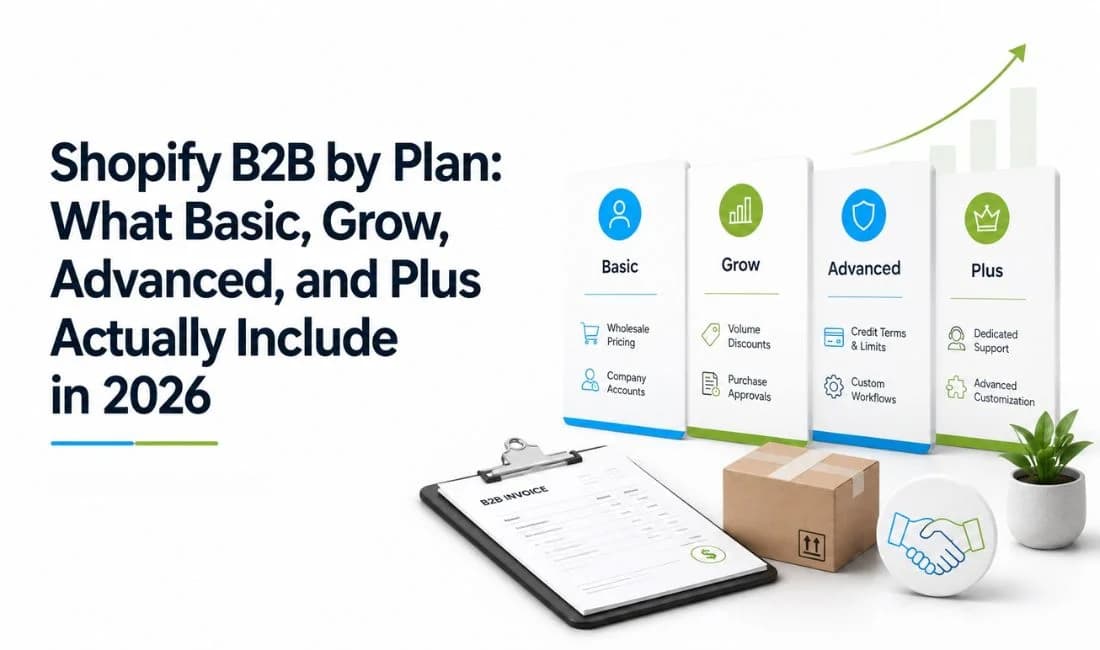
Shopify B2B by Plan: What Basic, Grow, Advanced, and Plus Actually Include in 2026
August 25, 2026 • 13 min read

How to Build Shopify BFCM Wholesale Strategy: Survive Bulk Order Spike
October 19, 2026 • 14 min read