On this page
- Key takeaways
- The buyer's side: "Yeah, but..."
- The friction map
- 1. The store sells products, the buyer needs a trip
- 2. Missing pieces
- 3. Parts that don't work together
- 4. "I already own some of this"
- 5. One part is out of stock
- 6. The price looks like a trick
- What it costs the store
- Corrective decisions
- Decision 1: build kits around a trip
- Decision 2: let people swap out what they own
- Decision 3: check compatibility inside the kit
- Decision 4: make every component count as stock
- Decision 5: price the kit so it reads as fair
- Decision 6: check shipping before launch
- Write the kit page for the second conversation
- Gift buyers are a different kit customer
- Change kits with the seasons
- Selling kits in store as well
- The merchant checklist
- What to measure after launch
- A worked example
- FAQ
Short answer: Outdoor starter kits fail on Shopify when the store sells gear one item at a time and leaves the customer to work out what a trip needs. Buyers forget pieces, pick parts that don't work together, like a summer sleeping bag on a thin pad for a cold night, or skip the kit because they already own half of it. The fix is to build kits around a trip, not a product: let customers swap out what they already own, check compatibility inside the kit, make sure every component is in stock, and price the kit so it reads as fair rather than as an upsell.
A first-time camper spends forty minutes choosing a tent. They read the reviews, compare floor sizes, check the weight. They buy it.
Then they arrive at the campsite on a Friday night in October and realise the tent was the easy part. There's no pad, so the cold ground pulls the heat out of them all night. The sleeping bag they borrowed is rated for summer. The head torch is in a drawer at home.
None of this is the tent's fault. But the review they leave on Sunday probably mentions your store.
This post is for outdoor equipment retailers on Shopify and the CRO and development agencies that work with them. It looks at the starter kit problem from the buyer's side, maps where the friction sits, shows what it costs, and ends with the decisions that fix it.
Key takeaways
New campers don't know what they don't know. A product page can't tell them; a kit built around a trip can.
Kits fail for three reasons: missing pieces, parts that don't work together, and "I already own some of this".
Sleep gear is the clearest compatibility trap. REI pairs sleeping pad R-values with sleeping bag ratings for each temperature range, and recommends a more insulated pad if you want a bag to live up to its rating (REI).
Fixed kits are simple, but they force buyers to pay for gear they already own. A build-your-own kit with swaps solves that.
Shopify's free Bundles app supports fixed bundles only. Swappable kits need a mix-and-match or build-a-box app.
Kits contain bulky items. Shopify Bundles don't have their own shipping profile, so shipping rates come from the components inside (Shopify Help Center). Check your rates before launch.
The buyer's side: "Yeah, but..."
Every outdoor kit has to win two conversations in the buyer's head. The first is "I want to go camping." The second is the one that loses the sale. It always starts with "yeah, but".
"Yeah, but I already have a sleeping bag."
"Yeah, but I don't know if this pad is warm enough."
"Yeah, but kits are where shops dump the stuff they can't sell."
"Yeah, but I'm only going twice a year."
"Yeah, but what if the tent's fine and the stove's rubbish?"
Most kit pages answer the first conversation with lovely photos and a "save 15%" badge. Very few answer the second. That's the gap, and it's the gap competitors leave too. Look at the typical app roundup for camping stores: it lists bundle apps, free shipping bars and countdown timers, but says nothing about checking that a kit is complete for a trip, that the sleep system matches the season, or that each part is in stock.
The friction map
Here's where outdoor starter kit sales go wrong on a typical Shopify store.

1. The store sells products, the buyer needs a trip
A first-timer doesn't think "I need a 3-season two-person dome tent and an R4 pad". They think "we're going to the lakes for two nights in May". If the store's navigation starts with product types, the buyer has to translate their trip into a shopping list on their own. Most can't, so they buy the obvious item, the tent, and stop.
A good starting point for what a trip actually needs is REI's Ten Essentials: navigation, light, sun protection, first aid, a knife or tools, fire, shelter, extra food, extra water and extra clothes. REI's own advice is to tailor the list to the location, weather and activity. That's exactly what a trip-based kit does.
2. Missing pieces
Even buyers who think in trips forget things. A head torch. A repair kit. A footprint for the tent. Pegs that work in hard ground. The cost of a forgotten item is a bad first night, and a bad first night is how new campers become ex-campers.
3. Parts that don't work together
This is where outdoor kits are harder than most bundles. Some combinations look fine in a cart and fail in a field.
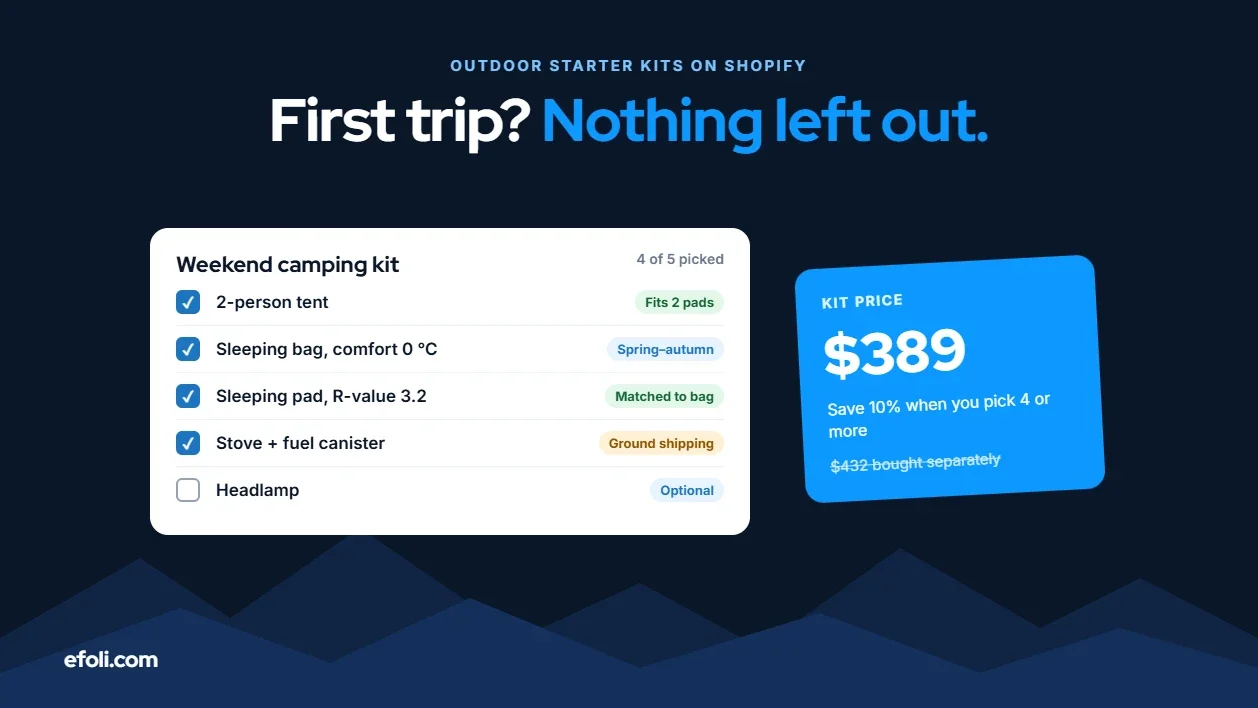
The sleep system. A sleeping bag's temperature rating assumes it's used on a suitable pad. Bags tested to ISO 23537 get a Comfort rating, the lowest temperature for a relaxed sleeper, and a Limit rating, the lowest temperature for someone curled up and fighting the cold. Rab's explainer notes the test places the bag on a standard foam mat. Since 2020, sleeping pads have had their own test standard for R-value, and REI's guide pairs them by conditions. For lows around freezing, it suggests a pad with an R-value of 2 to 3.9 and a bag rated 20°F or lower.

So a kit that pairs a 30°F bag with a thin summer pad and sells it as "three-season" isn't just a bad kit. It's a cold night someone will blame on you.
The footprint. Tent footprints are cut to fit specific tent models. A "universal" footprint that's bigger than the tent floor catches rain and channels it underneath.
The stove and fuel. Stoves take specific fuel types and fittings. Fuel itself can be restricted for shipping by carriers, so check what your carrier allows before you put it in a shipped kit.
4. "I already own some of this"
This is the most common reason a fixed kit doesn't sell. A buyer who already owns a good sleeping bag won't pay for a second one just to get the kit price on everything else. So they buy the tent alone, or they buy the kit somewhere that lets them swap.
5. One part is out of stock
A kit is only as available as its scarcest item. If the pad sells out and the kit page still says "in stock", someone orders a kit you can't ship complete. Now you're splitting shipments, substituting, or cancelling. Our Push Bundle team covers recovery options in what to do when a bundle product sells out.
6. The price looks like a trick
"Save 15%" on a kit of items nobody's heard of reads as a clearance bin. Buyers have learned that kits are sometimes where shops hide slow stock. If the kit's items aren't individually recognisable, priced and reviewed, the discount makes the buyer more suspicious, not less.
What it costs the store
The friction doesn't just lose kit sales. It shows up all over the business.
Lower order values. The buyer who wanted a weekend kit leaves with a tent. Everything they forgot gets bought later, often somewhere else.
Returns on bulky items. A tent returned because "it was too cold" was really a pad problem. Bulky returns cost a lot to ship back.
Support time. "Will this bag be warm enough?" is a question your team answers by email, one customer at a time, if the store doesn't answer it on the page.
Bad first trips, lost second ones. Outdoor gear is a hobby purchase. A buyer whose first trip goes well comes back for a better pack, a lighter stove and a second tent. A buyer who froze doesn't.
Corrective decisions
Here's how to fix each point on the map. You don't have to do all of them at once. Start where your returns and support emails point.
Decision 1: build kits around a trip
Start with three to five trip types your customers actually take. For example:

Kit | For | Must include |
|---|---|---|
Weekend car camping | Families, campsites with parking | Tent, pads, bags, lantern, stove, first aid |
Two-night backpacking | Couples or solo, carrying everything | Lighter tent, pad and bag matched to season, head torch, stove, water treatment, navigation |
Summer festival | Short trips, warm nights | Easy-pitch tent, light bag, pad, head torch |
Resist building a kit for every trip you can imagine. Three to five well-made kits are easier to keep in stock, easier to compare and easier for staff to recommend than fifteen near-identical ones. If two kits differ by a single item, they should probably be one kit with a swap.
Name kits after trips, not products. "Two-night spring backpacking kit" tells the buyer it was designed for their trip. "Tent bundle" doesn't.
Each kit page should say, in plain words, what conditions it's built for. "For nights down to around freezing, in spring and autumn" is the sentence that answers "yeah, but is it warm enough?". Make sure it's true for the pad and bag in the kit.
Decision 2: let people swap out what they own
A build-your-own kit, with sensible defaults, beats a fixed kit for most outdoor stores. It should:
Start with every slot filled with a recommended item.
Let the buyer remove a slot they already own, such as the sleeping bag, and keep the kit price on the rest.
Let them upgrade a slot, such as a warmer bag, within a shortlist that still fits the kit's conditions.
Keep a minimum, so the "kit" can't become a single tent with a discount.
Shopify's free Bundles app can't do this, because it doesn't support mix-and-match bundles. A mix-and-match or build-a-box app can. Push Bundle lists a multi-step bundle builder, Build-a-Box and Mix & Match bundles, and min and max quantity and variant limits on its Growth plan ($14 a month at the time of writing, with a 14-day trial). Its listing also says bundles work in Shopify POS, which matters if you sell kits in a physical shop as well as online.

If you're still deciding between a fixed kit and a build-your-own one, our Push Bundle post on fixed vs mix-and-match bundles compares the two. Whichever you choose, show a running total as the buyer fills each slot, so the kit price is never a surprise at the end.
Decision 3: check compatibility inside the kit
Don't leave compatibility to the buyer. Build it into each slot's options.
Sleep system: only offer pads and bags that suit the kit's stated conditions, using REI's pairing as a sense check. Show the R-value and the Comfort and Limit ratings on each option.
Footprint: only offer the footprint made for the kit's tent.
Stove: offer fuel and accessories that fit the stove, or say clearly where to buy fuel locally if you don't ship it.
If you've written a compatibility rule like this for other products, it'll feel familiar. Our eFoli post on electronics accessory bundles deals with the same idea for devices and accessories. The outdoor version is harder because the rule depends on the weather, not just the model number.
Decision 4: make every component count as stock
A kit should stop selling, or the affected slot should switch to an alternative, the moment a component runs out. With Shopify Bundles, the component with the lowest stock decides how many fixed bundles can be sold. Push Bundle's listing describes inventory synced between the bundle and its products. Whichever you use, test it: set one component to zero and try to buy the kit.
Watch out for products set to keep selling when out of stock. Shopify's Help Center notes that those, and untracked products, are left out of the bundle calculation.
Decision 5: price the kit so it reads as fair
The kit price should be easy to check. Show:
Each item's normal price.
The kit total.
The saving in money, not just percent.
A modest, honest saving on recognisable items converts better than a big percentage on unknowns. Tiered savings also work well for kits: for example, a small saving with three items, a bigger one with five. DiscountRay offers quantity discounts and tiered pricing on its free plan, and lists volume bundle discounts and offer badges on collection pages and product cards on its Growth plan ($14 a month). Badges on the collection page matter for kits, because that's where buyers compare.
If you're unsure which discount structure to use, our DiscountRay guide to quantity breaks vs volume discounts vs tiered pricing explains the difference, and the Push Bundle team's good, better, best bundle pricing guide shows how to build price tiers, which works well for a basic, standard and premium version of the same trip kit.

Decision 6: check shipping before launch
Kits put bulky items in one order. Shopify's Help Center notes that bundles don't have their own shipping profiles, and rates are calculated from the products inside. A kit with a tent, two pads and two bags can trip weight or size bands you never hit with single items. Place a test order to each of your main shipping zones and check the rate the buyer sees.
Write the kit page for the second conversation
Once the kit itself is right, the page has to answer the "yeah, but" questions. Here's what that looks like in practice.
The buyer thinks | The page says |
|---|---|
"I already have a sleeping bag." | "Already own a bag? Remove it and keep the kit price on everything else." |
"Is it warm enough?" | "Built for nights down to around freezing. Pad R-value 3.2, bag Comfort rating listed below." |
"Kits are clearance stock." | "Every item is sold on its own too. See each one's reviews below." |
"I'm only going twice a year." | "Everything packs into the tent bag, so it fits in a cupboard between trips." |
"What if one part's rubbish?" | "Return any single item within our normal return window." |
That last row needs a policy decision. If a buyer wants to return one item from a kit, does the kit discount come off the refund? Decide, and say so on the page. It's a question someone will ask in the first week.
Use specific outcomes, not specs alone. "R-value 3.2" is a fact. "Warm enough on a frosty April night at a lakeside campsite" is what it means for the buyer. Give both.
Gift buyers are a different kit customer
It's worth a separate thought in November and December. A lot of outdoor kits are bought as presents, and the person buying isn't the person camping.
That changes the "yeah, but" list:
"Yeah, but I don't know what they already own."
"Yeah, but I don't know their size."
"Yeah, but what if they hate it?"
Gift buyers need kits built from items that don't depend on fit or existing gear: a head torch, a stove set, a first aid kit, a water filter, a camp cooking set. Name them for the person, not the trip. "Gift kit for someone who's just started camping" is clearer than "accessory bundle". Make exchanges easy and say so on the page, and include a gift receipt option if your checkout supports one. The recipient can swap the head torch for a bigger one without the giver ever knowing the price.
Our eFoli roundup of Shopify BFCM bundle ideas has more ways to package bundles for the gifting season.
Change kits with the seasons
Outdoor demand moves with the weather. Spring and autumn are busy for camping gear, summer is steady, and winter is a smaller, more specialist market. Kits should move with it.
Update the conditions line each season. A kit described as "for spring and autumn" in July sends the wrong message to someone planning a summer trip.
Swap sleep defaults. In summer, pre-fill a lighter bag and pad. In autumn, pre-fill warmer ones. The kit name can stay the same.
Retire kits that don't sell. A kit with no sales for a season isn't helping. Rebuild it around a trip people actually take.
Selling kits in store as well
Many outdoor retailers have a shop as well as a website, and the in-store conversation is where kits are easiest to sell. A staff member can ask "where are you going and when?" and build the kit in two minutes.
If your kits are built in a bundle app, check that they work in Shopify POS and draw from the same stock as online. Push Bundle's listing says its bundles work in Shopify POS. Train staff to use the same trip names as the website, so a customer who starts online and finishes in the shop sees the same kit.
The merchant checklist

Is each kit named after a trip, with the conditions it's built for stated plainly?
Does each kit include everything that trip needs, checked against a list like the Ten Essentials?
Can buyers remove items they already own and keep a kit saving?
Is there a minimum, so the kit can't shrink to one item?
Do sleep options only include pads and bags that suit the stated conditions?
Is each footprint matched to its tent model?
Does the kit stop selling, or switch slots, when a component runs out?
Are the individual prices, the kit price and the saving all visible?
Have you checked shipping rates for the full kit in each zone?
Is the return policy for single items from a kit written on the page?
Do kits work the same way in your shop through POS?
Do you review kit returns and support questions monthly to find the weak slot?
What to measure after launch
Check these every month for each kit:
Kit attach rate. Of the buyers who bought a tent, how many bought it as part of a kit?
Most removed slot. If buyers remove the sleeping bag in most kits, your default bag may be the wrong one, or your customers already own bags and want a pad upgrade instead.
Returns by slot. A slot with high returns usually has a compatibility or description problem.
Support questions by kit. Repeated questions about the same kit mean the page isn't answering them.
These numbers tell you which slot to fix next, and they're far more useful than an overall conversion rate.
A worked example
This is a made-up but typical setup. An outdoor retailer sells online and from one shop, and has a strong range of tents but weak kit sales.
They replaced two fixed "camping bundles" with three trip kits: weekend car camping, two-night spring backpacking and summer festival. Each kit is a build-your-own bundle with every slot pre-filled. Buyers can remove any slot except the tent and still get the kit saving on the rest, as long as at least three items remain. The backpacking kit's sleep slot only shows pads with R-values from 2 to 3.9 and bags with a Comfort or Limit rating suited to nights near freezing, with both ratings shown.
The kit page leads with the trip, then the conditions, then a line for people who already own gear. The saving shows in money. Footprints are matched to each tent.
The biggest change they noticed wasn't the kit sales. It was the support inbox. "Will this be warm enough?" emails dropped, because the page answered the question before it was asked.
FAQ
What should an outdoor starter kit include?
Can I sell camping kits with Shopify's free Bundles app?
How do I let customers remove items they already own from a kit?
How do I match sleeping pads and bags in a kit?
What does a sleeping bag's Comfort and Limit rating mean?
Do bundles change my Shopify shipping rates?
Should outdoor kits be discounted?
Can I sell the same kits in my shop and online?
Does a tent footprint have to match the tent?

Anika Anamta Mehnaz
This article is written by Anika Anamta Mehnaz, a Content Writer and Content Marketing Strategist specializing in Shopify, eCommerce, and SaaS. With over four years of content writing experience, she creates SEO and AI search-optimized content that helps Shopify merchants make better business decisions through practical, research-backed insights. Her work covers Shopify apps, product variants, bundles, discounts, B2B commerce, and conversion-focused strategies. Outside of work, Anika enjoys watching anime, reading John Grisham novels, and discovering new ideas in digital marketing and e-commerce. If you enjoy discussing Shopify, content marketing, or online growth, feel free to connect with her. Twitter: https://x.com/mehnaz2201 Medium: https://medium.com/@mehnaz_78932
Keep reading
View all articles →
The Embedded Commerce Playbook for Brands With Reseller Websites
November 13, 2026 • 17 min read
The Roses Are Gone. The Orders Keep Coming. Why Florists Oversell on Shopify
November 13, 2026 • 18 min read
"Send Us a Drawing" Shouldn't Be the Whole RFQ: Where Industrial Parts Quotes Break on Shopify
November 13, 2026 • 18 min read