How to Build Sports Nutrition Bundles on Shopify Without Making Unsupported Claims
An agency playbook for sports nutrition bundles on Shopify: plan sets around routines, check claims by market, build rule-based boxes and keep a claims register.
On this page
- Key takeaways
- Step 1: Plan sets around routines, not results
- Questions to settle in planning
- Step 2: Understand the claims rules that apply
- United States: FTC and FDA
- European Union and United Kingdom
- Step 3: Write about the set without overpromising
- Step 4: Set up the bundles in Shopify
- Fixed sets
- Build-your-own sets
- Pricing and savings
- Subscriptions
- Worked example: three sets for one brand
- Step 5: Testing and third-party certification
- Step 6: Keep a claims register
- Step 7: Hand off and launch
- What this looks like for agencies
- Common mistakes to avoid
- The short version
- FAQ
Short answer: Build sports nutrition bundles around a routine the shopper already has, such as "training days" or "long runs", not around an outcome you'd have to prove, such as "build muscle fast". Every claim the bundle makes, including claims implied by its name, images and reviews, needs evidence for the bundle as sold, not just for one ingredient. In the US, follow the FTC's Health Products Compliance Guidance and the FDA's rules for structure/function claims. In the EU and UK, use only authorised health claim wording. On the Shopify side, use fixed bundles for curated stacks, a mix-and-match builder with rules for build-your-own sets, and set pricing that shows real savings. Then keep a simple claims register and have someone qualified review it before launch.
Every sports nutrition brand eventually gets the same request from its marketing team: "Let's do stacks." Protein, creatine and electrolytes in one box. A pre-workout and a recovery drink as a pair. A "summer shred" kit for June.
Stacks make commercial sense. Shoppers who buy a routine tend to buy more than one product, and a well-built set helps them work out what goes together. The trouble is that a stack is a story, and stories in this category are where most compliance problems start. A bundle called "Lean Muscle Stack" with a before-and-after photo is making a claim, even if no single sentence on the page says so.
This is a playbook for Shopify agencies and in-house teams building sports nutrition sets. It covers how to plan sets, how to write about them, how to set them up in Shopify, and how to hand them over with a review process that keeps them out of trouble. It isn't legal advice. Treat it as a way to organize the work so the right questions reach the right people before launch.
Key takeaways
Name sets after when and how they're used, not after results. "Training day set" is safer than "Mass builder".
A bundle can imply claims through its name, images, reviews and the combination itself. The FTC holds marketers responsible for implied claims as well as stated ones.
Evidence for one ingredient doesn't automatically support a claim about the whole set.
In the US, structure/function claims on supplements need the FDA disclaimer and a notification to the FDA within 30 days of first marketing.
In the EU and UK, health claims must match authorised wording and conditions of use.
Use fixed bundles for curated sets and rule-based builders for build-your-own boxes, with limits on stimulant products per box.
Keep a claims register so every claim has evidence, an owner and a review date.
Step 1: Plan sets around routines, not results
The safest bundles are also often the most useful. They answer the shopper's real question: "What do I take, and when?"
Here are four ways to group products, from lowest to highest claims risk:
Grouping | Example | Claims risk |
|---|---|---|
By routine or occasion | Training day set, long run set, travel pack | Low |
By format or flavor | Chocolate lovers' set, single-serve sampler | Low |
By activity | Endurance set, strength set | Medium, depends on wording |
By outcome | Fat burn stack, muscle gain kit | High, needs strong evidence |

Routine-based sets describe what's in the box and when a shopper might use it. They don't promise a body change. That gives the marketing team plenty to work with, such as convenience, flavor, value and simplicity, without needing clinical trials to back up the headline.
Activity-based sets sit in the middle. "Endurance set" is a description. "Endurance set for longer, stronger runs" is a performance claim that needs evidence.
Outcome-based sets carry the highest risk. If you build one, assume every word will need support, and get the evidence reviewed before anyone designs the packaging.
Questions to settle in planning
Who's the set for? Gym beginners, runners, team sport players?
When is each product used? Before, during or after training, or daily?
Does the set include caffeine or other stimulants? How much per serving, in total?
Is any product unsuitable for some shoppers, for example during pregnancy or under 18?
Are any products tested for banned substances, and does that matter to your buyers?
Which countries will you sell the set in?
The last question matters more than most teams expect. A claim that's fine on a US product page may not be allowed on the same page shown to UK or EU shoppers.
Step 2: Understand the claims rules that apply
You don't have to be a regulatory expert to build bundles, but you need to know which rules exist so you can ask the right person.
United States: FTC and FDA
The FTC regulates advertising, including product pages, emails and social posts. Its Health Products Compliance Guidance, published in December 2022, replaced the agency's 1998 guide for supplements and now applies to health-related claims for any product. A few points from it are especially relevant to bundles:
Implied claims count. The guidance says marketers are responsible for claims "reasonably implied" by an ad, not just stated ones. Product names, images and before-and-after photos can create claims.
Evidence should match the product. It generally expects health benefit claims to be supported by competent and reliable scientific evidence, usually randomized controlled human trials. Studies on one ingredient may not support a claim about a product that combines several, or that uses a different dose or form.
Testimonials aren't evidence. A customer's honest experience doesn't support a claim the brand couldn't support on its own. Dramatic results need context about typical results.
Vague qualifiers don't fix weak claims. Adding "may" or "can help" doesn't make an unsupported claim acceptable.
The FDA covers labels and labelling for dietary supplements. If a supplement makes a structure/function claim, such as "supports muscle recovery", the FDA requires the standard disclaimer, "This statement has not been evaluated by the Food and Drug Administration. This product is not intended to diagnose, treat, cure, or prevent any disease," and a notification to the FDA no later than 30 days after first marketing the product with that claim. Disease claims, such as treating or preventing a condition, aren't allowed for supplements at all.
European Union and United Kingdom
In the EU, health claims on foods, including sports supplements, must come from a list of authorised claims under Regulation (EC) No 1924/2006, with the list set out in Regulation (EU) No 432/2012. Great Britain kept a similar system after Brexit, with its own register.
Creatine is a useful example because it's in many stacks. The authorised claim is that creatine "increases physical performance in successive bursts of short-term, high intensity exercise", with conditions of use that include a daily intake of 3 g. A later claim for adults over 55, linked to resistance training, was also authorised. You can use the authorised wording, or wording with the same meaning, if the product meets the conditions. You can't extend it to "builds muscle fast" or apply it to a set where the creatine serving is below the condition.
The practical lesson for bundles: in the EU and UK, check every claim against the register, product by product, and don't let the set's name make a claim that no product inside it is allowed to make.
Step 3: Write about the set without overpromising
Product page copy is where most bundle claims are made, often by accident. Here's a structure that keeps the page useful and the claims under control.
1. Name. Describe the use or contents: "Training Day Set: Whey, Creatine and Electrolytes".
2. Who it's for. "For adults who train three or more times a week and want their basics in one order." No body types, no promised changes.
3. What's inside. Each product, its serving size and number of servings. Link to each product's own page and label.
4. When to use each product. Follow the label directions exactly. "One scoop of electrolytes in 500 ml water during training" is a usage instruction, not a claim.
5. What each product does, in approved wording only. If a product has an approved claim, use that exact claim on that product's line. Don't merge them into a new claim for the set.
6. Cautions. Caffeine content per serving and per day if taken together, who shouldn't use it, and allergen information.
7. Disclaimers. The FDA disclaimer next to any structure/function claim on a US page.
Here's how the same set might read in risky and safer versions:
Element | Risky version | Safer version |
|---|---|---|
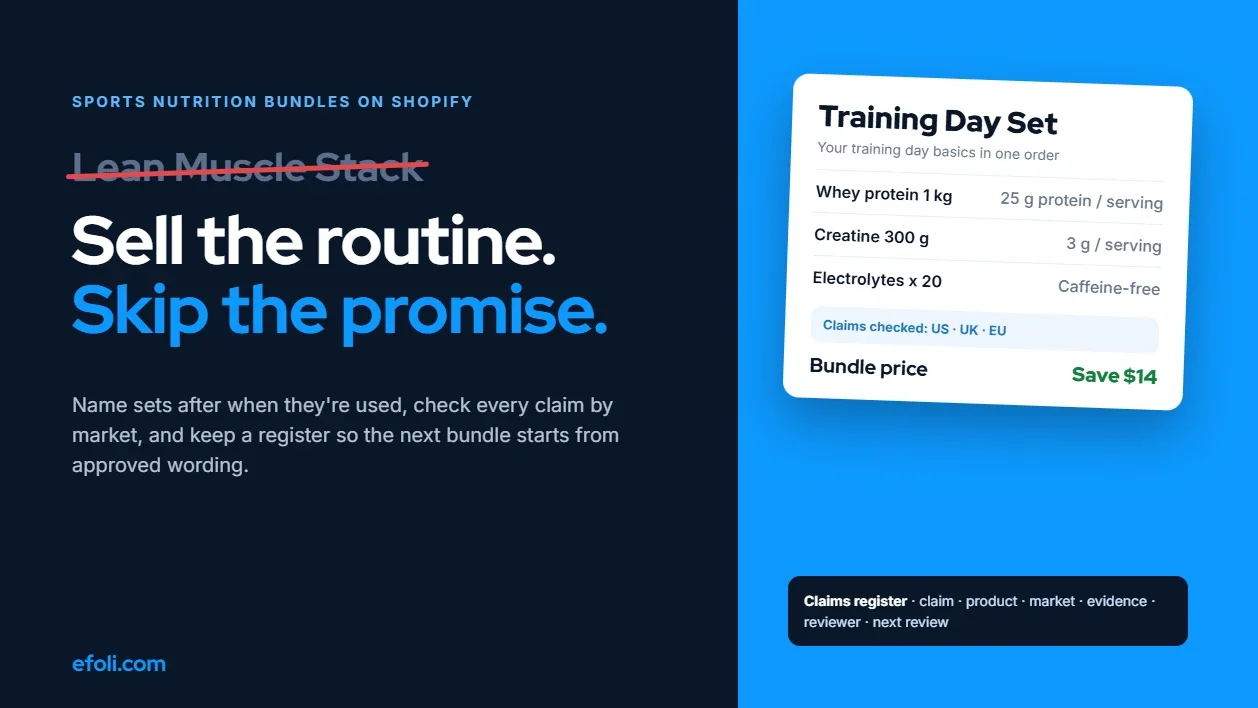
Set name | Lean Muscle Stack | Training Day Set |
Headline | Pack on muscle in 30 days | Your training day basics in one order |
Image | Before-and-after photos | Products, serving sizes, a training scene |
Benefit line | Burns fat while you sleep | Whey protein: 25 g protein per serving |
Reviews shown | "Lost 10 lb in two weeks!" | Reviews about taste, mixing and value |
Savings | "Worth $180, yours for $99" (inflated) | "Save $14 compared with buying separately" |

Notice the reviews row. If a brand features a review that makes a weight loss claim, the FTC's guidance treats that as the brand making the claim. Moderating which reviews appear prominently on bundle pages, and avoiding outcome-heavy quotes in ads, is part of the job.
For broader guidance on content in this category, the EmbedUp team's piece on supplement educational content covers how to educate without drifting into claims.
Step 4: Set up the bundles in Shopify
With the sets planned and the copy agreed, the build is the straightforward part.
Fixed sets
A fixed set has the same products every time, such as a "Training Day Set" with one tub of whey, one creatine, and one box of electrolyte sachets. Shopify's free Bundles app can create fixed bundles. Its limits are worth knowing before you start: availability follows the lowest-stock component, bundles can't include products sold as subscriptions, and mix-and-match isn't supported.
Build-your-own sets
If you want shoppers to choose, for example, "pick a protein, a pre-workout and a recovery product", you'll need a bundle builder. Push Bundle offers Build-a-Box and Mix & Match bundles with minimum and maximum quantity and variant limits, plus a multi-step builder, on its Growth plan, which is $14 a month with a 14-day trial at the time of writing. Bundles appear as a single product in the cart, with stock synced for each item.
Rules matter more in this category than most:
Limit stimulant products per box. If your range has more than one caffeinated product, consider allowing only one per set. The FDA notes that 400 mg of caffeine a day is not generally associated with negative effects for most healthy adults, but sensitivity varies, and a box with two high-caffeine products could make it easy to go over that.
Keep incompatible products apart. If two products shouldn't be used together, don't let the builder put them in the same box.
Show serving info in the builder. Each choice should show serving size and caffeine where relevant, not just a flavor and a price.
Handle sold-out flavors. A builder that lets someone pick a sold-out flavor creates a support ticket. Hide or disable it.
The Push Bundle team's guide to fixed and mix-and-match bundles helps you choose between the two formats, and Anika's post on mix-and-match bundle challenges covers the setup problems worth avoiding.
Pricing and savings
Set discounts are a big part of why shoppers buy bundles, and they're another place where claims can go wrong. Pricing claims are a separate area of advertising rules. In the US, the FTC's long-standing Guides Against Deceptive Pricing warn against comparisons with "former" prices that weren't genuinely charged.
Keep it simple:
Compare with the real price of the items bought separately, at the time of the offer.
Show the saving as a number, such as "Save $14", not an inflated "worth" value.
Use quantity tiers for multi-packs, such as a lower price per tub at two or three tubs.
A Shopify discount tier app such as DiscountRay can add quantity tiers and show a pricing table on the product page, which helps shoppers see the real saving. If you're weighing different pricing models, the DiscountRay team's explainer on quantity breaks, volume discounts and tiered pricing is a useful reference. And before you settle on a set price, check the margin. The Push Bundle team's guide to bundle profit margins shows how to price a set so the discount doesn't wipe out the profit.
Subscriptions
Many sports nutrition shoppers want a monthly refill. Shopify's own Bundles app doesn't support bundles with subscriptions, so if a subscribe-and-save set is important, check that your subscription app and bundle app work together before you promise it on the page. Test the full cycle: first order, renewal, a skipped month, and a flavor change.
Worked example: three sets for one brand
Here's how a fictional brand, Northline Nutrition, might plan its first three bundles using this playbook. The products, prices and claims are illustrative.
Set | Format | What's inside | How it's described | Claims used |
|---|---|---|---|---|
Training Day Set | Fixed | Whey 1 kg, creatine 300 g, electrolyte sachets x 20 | "Your training day basics in one order" | Approved claims on each product line only |
Long Run Pack | Fixed | Energy gels x 12, electrolyte tabs x 2 tubes, recovery shake x 10 | "Fuel and fluids for runs over an hour" | Carbohydrate and electrolyte claims checked per market |
Build Your Own Box | Builder, 3 steps | One protein, one pre-workout or caffeine-free option, one recovery product | "Pick your three, save $12" | None at set level |
A few decisions are worth calling out.
The fixed sets don't have outcome names. The team's first draft called the Training Day Set "Strength Stack". After the planning workshop, they renamed it, because the evidence they had related to creatine alone, not to the combination.
The builder gives shoppers a caffeine-free route. Step two offers two pre-workouts and one caffeine-free option, and the builder allows only one choice in that step. Each option shows caffeine per serving.
The savings are real numbers. The Training Day Set costs $14 less than the three products bought separately at today's prices. That's the number on the page, with no "worth" figure.
The claims register came first. Before any page was designed, the team listed every claim they wanted, checked each one for the US, the UK and the EU, and noted where the FDA disclaimer was needed. Two claims were dropped for the EU pages because they didn't match authorised wording.
The result is three bundles that the marketing team can promote freely, because everything on the page has already been checked.
Step 5: Testing and third-party certification
Shoppers who compete in tested sport often look for products certified by programmes such as Informed Sport or NSF Certified for Sport. Informed Sport, for example, says it tests every batch of a certified product before release, and recommends that athletes verify the batch number on its website.
Two things to get right when you include certified products in a set:
Be precise about what's certified. If one product in the set is certified and the others aren't, don't call the whole set "certified". Mark the certified product.
Don't treat certification as a performance claim. Batch testing for banned substances is about risk, not results. Informed Sport itself notes that no testing programme can test for every prohibited substance.
Step 6: Keep a claims register
This is the step most bundle projects skip, and the one that saves the most trouble later. A claims register is a simple sheet with one row per claim:
Column | Example |
|---|---|
Claim wording | "Creatine increases physical performance in successive bursts of short-term, high intensity exercise" |
Product | Creatine monohydrate, 3 g serving |
Where it appears | Product page, Training Day Set page, email template 4 |
Market | UK and EU |
Evidence or authorisation | Authorised claim, conditions met (3 g daily) |
Reviewer | Regulatory consultant, initials |
Review date | 10 November 2026 |
Next review | Six months, or when the formula changes |

The register makes three things easier. New bundles reuse claims that are already approved instead of inventing new ones. When a formula changes, you can find every page that mentions it. And when someone asks why a claim is on the site, there's an answer.
Step 7: Hand off and launch
Before launch, run a short review with the brand team and whoever handles regulatory sign-off. Bring the bundle pages, the claims register and a test checklist.
Pre-launch test checklist:
Read each set name and headline aloud. Does it promise a body change? If so, is there evidence for the set as sold?
Check every benefit line against the claims register.
Check the FDA disclaimer appears next to each structure/function claim on US pages.
Switch to a UK or EU market view. Do the claims match the authorised wording?
Build a box with two stimulant products. The builder should stop you if that's your rule.
Pick a sold-out flavor in the builder. Can you still check out? You shouldn't be able to.
Compare the bundle saving with the real separate prices today.
Read the featured reviews. Do any make outcome claims the brand couldn't make?
Check allergen and caution information appears on the bundle page, not only on single products.
Test the subscription cycle if the set is sold on subscription.
Check certification badges are on the right products only.
Place a full order on a phone and read every email it sends.
Handoff notes for the brand team:
Where the claims register lives and who owns it.
How to add a new set using approved claims only.
Which settings in the bundle app control limits and sold-out behavior.
When to review: every formula change, every new market, and at least twice a year.
What this looks like for agencies
If you're an agency, this playbook changes the shape of a sports nutrition project in a useful way. Instead of "design and build three stacks", the scope becomes:
Set planning workshop: routines, products, markets.
Claims review with the brand's regulatory contact, using the register.
Copy using approved claims and the page structure above.
Bundle build and rules.
Testing and handoff.
It takes a little longer up front. It also means the bundles can run through a full season without being pulled for a claims problem, and the brand can add new sets without starting the review from scratch.
For more on choosing tools in this category, Anika has written roundups of Shopify apps for protein powder stores and apps for vitamins and supplements.
Common mistakes to avoid
Letting the bundle name do the selling. If the name promises a result, the whole page has to prove it.
Borrowing an ingredient study for the whole set. A good creatine study doesn't support a claim about creatine plus a pre-workout plus a fat burner.
Copying US copy to EU and UK pages. Claims that work under FDA rules may not be authorised wording in Europe.
Treating "may help" as a safety net. Softer verbs don't make an unsupported claim acceptable.
Featuring dramatic reviews. A five-star review that says "lost 10 lb" is a claim once you promote it.
Forgetting the builder. A build-your-own box with no rules can put two high-caffeine products in one order.
The short version
Sports nutrition bundles are good for shoppers and good for sales, as long as the bundle describes a routine rather than promising a result. Plan sets around when products are used, check every claim against the rules in each market, write pages that describe rather than promise, build rules into the bundle builder, and keep a claims register so the next set starts from approved wording. That way, the stack your marketing team wants can launch, and stay live.
FAQ
What is a sports nutrition bundle on Shopify?
Can I call a supplement bundle a "muscle building stack"?
Do I need the FDA disclaimer on bundle pages?
Can customer reviews make claims about my bundle?
Should a build-your-own box limit caffeine products?
How do I show bundle savings honestly?

Anika Anamta Mehnaz
This article is written by Anika Anamta Mehnaz, a Content Writer and Content Marketing Strategist specializing in Shopify, eCommerce, and SaaS. With over four years of content writing experience, she creates SEO and AI search-optimized content that helps Shopify merchants make better business decisions through practical, research-backed insights. Her work covers Shopify apps, product variants, bundles, discounts, B2B commerce, and conversion-focused strategies. Outside of work, Anika enjoys watching anime, reading John Grisham novels, and discovering new ideas in digital marketing and e-commerce. If you enjoy discussing Shopify, content marketing, or online growth, feel free to connect with her. Twitter: https://x.com/mehnaz2201 Medium: https://medium.com/@mehnaz_78932
Keep reading
View all articles →
Build Influencer Seeding Kits on Shopify That Marketing Teams Can Configure and Track
November 16, 2026 • 17 min read
QuotWay vs a Custom RFQ Build: What Shopify Distributors Really Need
November 16, 2026 • 17 min read
A Shelter Needs 200 Bowls, Not 200 Clicks: Selling Bulk Pet Supplies to Shelters on Shopify
November 16, 2026 • 18 min read