On this page
- Key takeaways
- Who you're selling to
- The 200 clicks: walking through one monthly order
- Step 1: Bowls in three sizes
- Step 2: Litter and food come in cases
- Step 3: The price doesn't reflect the account
- Step 4: Checkout charges tax the shelter may not owe
- Step 5: The board approved a purchase order, not a card payment
- Step 6: Next month, start again
- The buyer you didn't plan for: donors
- Plan for the seasonal spikes
- How to verify a shelter account
- Worked example: Tailwind Pet Supply and Maple County Rescue
- Which setup fits your store?
- Mistakes to avoid
- Pre-launch checklist for a shelter program
- For agencies: discovery questions
- The short version
- FAQ
Short answer: Animal shelters and rescues buy pet supplies like small organizations, not like pet owners. They order the same items every month in large, mixed quantities, often under a budget or grant, sometimes tax-exempt, sometimes with a purchase order, and sometimes paid for by donors. A Shopify store can serve them well with five changes: a quantity grid for sizes and case packs, a separate price for verified organizations, account settings for tax status and purchase orders, a one-click reorder, and a simple way for donors to buy what a shelter needs. Shopify's B2B features now cover several of these on every plan, and apps such as MultiVariants and DiscountRay fill the rest.
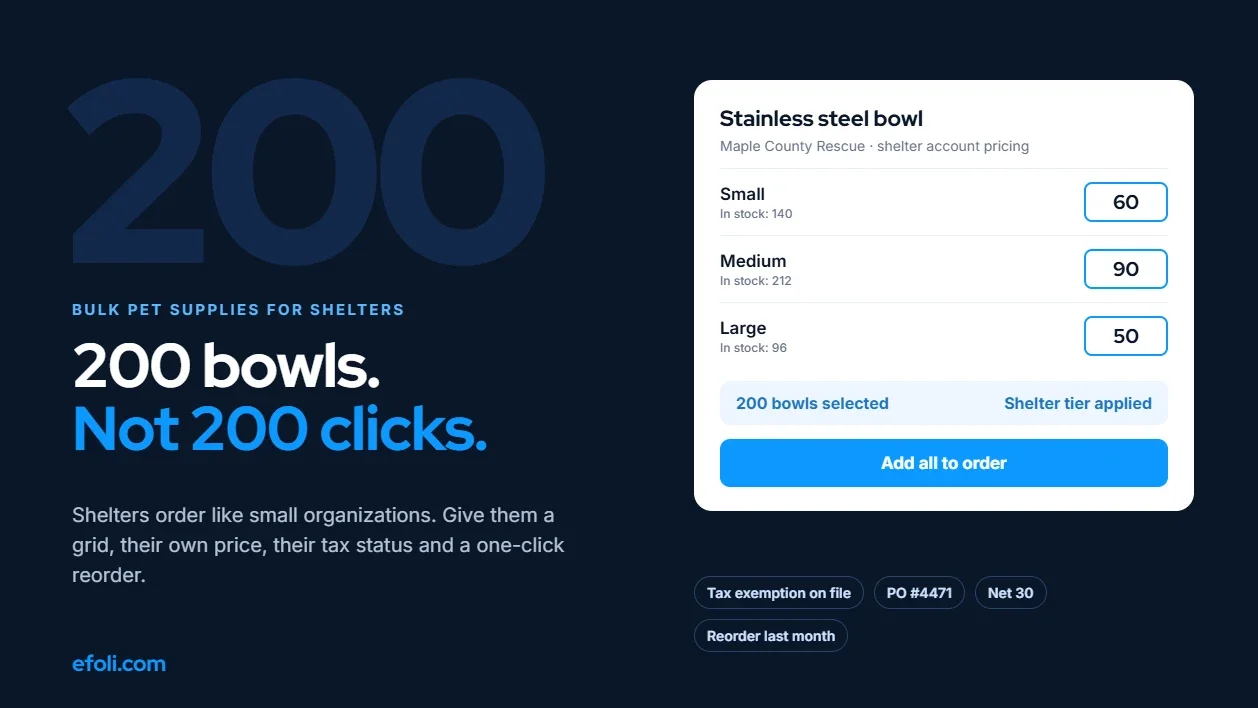
The supply list on the office wall at a mid-sized rescue looks something like this. Stainless steel bowls in three sizes, about 200 in total because they get chewed, lost and sent home with fosters. Forty bags of adult dog food. Kitten formula. Litter by the case. Slip leads. Enzyme cleaner by the gallon. Most of it, every month.
The person who orders it is usually juggling three other jobs. They might be the operations manager, a volunteer coordinator or the director. They're not browsing. They know exactly what they need, and they need to get it ordered between an intake and a vet visit.
Now picture them on a typical pet supply store. Choose the small bowl, type 60, add to cart. Back to the product, choose medium, type 90, add to cart. Back again for large. Then food, then litter, then cleaner. Then a checkout that charges sales tax they may not owe, asks for a card when the board approved a purchase order, and offers a "first order 10% off" popup that does nothing for a buyer who orders every month.
They'll finish it once. Next month, they'll go somewhere that makes it easier.
This post is for Shopify merchants who sell bulk pet supplies for shelters and rescues, or want to, and for the agencies who set up their stores. It covers how shelters actually buy, where a normal pet store gets in the way, and how to set up Shopify so a month's supplies takes minutes rather than an afternoon.
Key takeaways
Shelters and rescues are a large, repeat-buying market. Shelter Animals Count's 2024 analysis covers 13,527 organizations in the US, made up of 4,110 shelters and 9,417 rescues.
A shelter order is a list, not a basket. Design for entering many quantities at once, in sizes and case packs.
Give verified organizations their own pricing and terms. Don't make them hunt for a coupon.
Tax-exempt status, purchase order numbers and payment terms belong on the account, not in an email.
Make reordering last month's supplies a one-click job.
Donors are a second buyer for the same order. A "shop this shelter's list" page can bring sales you'd otherwise lose to big retailers' wish lists.
Who you're selling to
Shelter Animals Count, which collects data from shelters and rescues across the US, reported in its 2024 year-end analysis that the organizations in its data took in about 7 million dogs and cats in 2024 and completed about 4.2 million adoptions. The same report notes that dogs are staying longer in care, with large dogs staying longest. Longer stays mean more food, more bedding and more cleaning supplies per animal.
These organizations range from large city shelters with procurement rules to small rescues run from a network of foster homes. They're different in size, but they share a few habits that matter for your store:
How a pet owner buys | How a shelter or rescue buys |
|---|---|
One or two of each item | Dozens or hundreds, often across sizes |
Buys when something runs out | Orders on a schedule, often monthly |
Pays by card at checkout | May need a purchase order, invoice or payment terms |
Pays sales tax | May hold a tax exemption, depending on the state and the organization |
One person decides | Someone orders, someone else approves or pays |
Delivery to home | Delivery to a shelter, a clinic or a foster coordinator |
Price-sensitive per item | Budget-sensitive per month, often under a grant |
Buys for their pet | Sometimes buys with donor money, or donors buy for them |
None of these are unusual business needs. They're the same things a café or a salon needs from a supplier. The difference is that most pet stores on Shopify were built for the left column only.
The 200 clicks: walking through one monthly order
Let's follow the rescue's operations manager through a normal store, item by item. Each step shows where the time goes and what fixes it.

Step 1: Bowls in three sizes
The bowl is one product with three sizes. The store shows a size dropdown and one quantity box. To order 60 small, 90 medium and 50 large, the buyer goes through the select, type, add cycle three times. If they get one wrong, they have to find it in the cart and fix it.
The fix: show every size in a grid with its own quantity box, and add them all at once. On a product with colors as well as sizes, a matrix (colors down, sizes across) is even faster. MultiVariants adds this kind of grid to product pages. Its free plan includes the list view with quantity inputs and stock display, and paid plans add grid and matrix layouts.
Step 2: Litter and food come in cases
The supplier ships litter in cases of four and food on a pallet discount at 20 bags. A buyer who orders 37 bags of litter creates a split case that someone in the warehouse has to sort out.
The fix: set quantity increments. If litter only ships in fours, the quantity box should step 4, 8, 12, and won't accept 37. On Shopify's B2B features, quantity rules (minimum, maximum, and increment) are available on every plan for B2B catalogs. MultiVariants' Professional plan adds increments and minimums on the product page for any shopper, which helps if you serve shelters without setting up full B2B. The MultiVariants team's guide to quantity increment models explains the options.
Step 3: The price doesn't reflect the account
Shelters expect a price that reflects their volume and their mission. Many suppliers offer one. But if the only way to get it is a coupon code emailed once a year, the buyer has to find it, type it, and hope it still works.
The fix: give verified organizations their own pricing that applies automatically when they log in. On Shopify's B2B features, that's a catalog with a price list, assigned to the shelter's company account. On plans below Plus, Shopify allows up to three active catalog assignments across B2B markets, so you'll usually create one "Shelter and rescue" catalog rather than one per organization. Our colleague's breakdown of Shopify B2B by plan covers what each plan includes.
If you don't use B2B, an app can apply pricing by customer tag. DiscountRay's Growth plan supports B2B pricing by customer groups and tags, so a customer tagged "rescue-verified" sees the shelter price on the product page and in the cart. Its Pro plan adds pricing by company and customer list for when one large shelter needs its own price.
Step 4: Checkout charges tax the shelter may not owe
Whether a nonprofit pays sales tax on supplies depends on the state and on the organization's own status, so you can't assume every shelter is exempt. But the ones that are exempt will expect your store to respect it without a refund request every month.
The fix: record the exemption on the account. In Shopify, you can set a customer's tax settings to don't collect tax, or collect tax unless exemptions apply. For B2B company accounts, each company location can hold its own tax ID and exemption. The customer has to check out with the same email as their account for the setting to apply, so ask shelters to use one shared ordering login or add each staff member as a contact. Keep the organization's exemption certificate on file and check it with your tax adviser.
Step 5: The board approved a purchase order, not a card payment
Larger shelters, especially city and county ones, often need a purchase order number on the invoice and can't pay by card at checkout. Smaller rescues might pay by card but need an invoice their treasurer can match to a receipt.
The fix: on Shopify's B2B features, payment terms (such as Net 30), PO numbers, ACH in the US, and vaulted cards are available on all plans. That means a shelter can submit an order with its PO number and pay against an invoice. If you aren't using B2B, a draft order is the fallback: the shelter sends the list, you build the order, and send an invoice. It works, but it doesn't scale beyond a handful of accounts.
Step 6: Next month, start again
The order next month will look 80% the same. Making the buyer rebuild it from scratch is the single biggest reason they'll drift to a store that remembers.
The fix: reorders. Shopify's B2B features include easy reorders and a quick order list on all plans. Outside B2B, a "Buy it again" link in the account page or a saved list in an app can do the same job. The aim is simple: last month's order, edited, in under five minutes. Anika's post on B2B self-service ordering on Shopify covers what repeat business buyers expect from the ordering screen.
The buyer you didn't plan for: donors
Here's the part most pet supply stores miss. A lot of shelter supplies are paid for by people who aren't the shelter.
Big retailers know this. Chewy runs a wish list program where any US 501(c)(3) shelter or rescue can list items, and donors buy them for delivery straight to the organization. Shelters share wish list links on social media, in newsletters and at adoption events, and donors use them because it's simple: pick the shelter, pick the items, check out.
An independent pet supply store can offer a smaller version of the same thing, especially with local shelters it already supplies:
A shelter list page. A collection or landing page for each partner shelter with the items they need most, in the quantities they need. Donors choose items and check out as normal.
Ship to the shelter. Set up a local delivery or shipping option to the shelter's address, so donors don't have to type it. Keep the address off public pages if the shelter prefers.
Preset bundles. "Feed the kennel for a week" or "Kitten intake kit" as a fixed bundle at a round price makes giving easier than choosing ten items. A bundle app such as Push Bundle or Shopify's own Bundles app can handle fixed sets.
A donor note. A gift note field lets donors say who the gift is from, so the shelter can thank them.
Two cautions. First, your store is selling goods, not running a charity. Be careful how you describe tax deductibility, and don't promise donors a receipt from the shelter unless the shelter has agreed to issue one. Second, agree the list with the shelter and update it. A donation of 30 bags of a food the shelter has stopped using is a problem, not a gift.
For more on building consumer pet bundles, the Push Bundle team has a separate guide to pet product bundles on Shopify.
Plan for the seasonal spikes
Shelter orders aren't flat across the year, and a store that expects the same order every month will run short at the worst moment.
The best-known spike is kitten season. Shelters and rescues in much of the US see far more kittens in spring and summer, and with them a run on kitten formula, bottles, heating pads, small litter trays and kitten food. Chewy's own guidance on what shelters need in winter points to a different set of items in the cold months, such as blankets, beds and warm bedding. Disasters and large hoarding cases can bring sudden intakes at any time, and with them an urgent order that's two or three times the usual size.
A few setup choices help here:
Show stock in the grid. A buyer who can see that only 40 medium bowls are left can split the order or choose another size, instead of finding out after checkout.
Let accounts see incoming stock dates. A short "back in stock around 12 May" note saves an email.
Offer a seasonal bundle. A "kitten intake kit" with formula, bottles and a heating pad, priced for shelters, is easier to order in a rush than six separate items.
Talk to your partner shelters before the season. Ask what they expect to need. It's the cheapest demand forecast you'll ever get.
None of this needs new apps. It needs the store to treat shelter accounts as regular customers with a calendar, not as one-off bulk buyers.
How to verify a shelter account
If you're giving organizations better pricing and terms, you need a way to check they're real. Keep it light, or shelters won't bother.
Ask for the basics once. Organization name, EIN, address, contact person, and, if they claim exemption, the exemption certificate.
Check the status. US charities' 501(c)(3) status can be checked with the IRS's free Tax Exempt Organization Search. Many small rescues operate under a fiscal sponsor, so allow for that.
Approve and tag. Add the customer to a B2B company or tag them, for example, "rescue-verified". Pricing and terms then apply automatically.
Recheck once a year. A quick annual check catches closed organizations and changed contacts.
A short "Shelter and rescue accounts" page with an application form makes this self-service. Say how long approval takes and what the account gets.
Worked example: Tailwind Pet Supply and Maple County Rescue
Here's how a fictional regional pet supply store might set up a shelter account. The prices are illustrative.
The rescue's monthly list:
Item | Detail | Quantity | Rule |
|---|---|---|---|
Stainless bowl | Small 60, medium 90, large 50 | 200 | Grid, all sizes in one add |
Adult dog food, 30 lb | Two recipes | 40 bags | Shelter tier at 20+ |
Kitten formula | Powder | 12 cans | None |
Clumping litter | Case of 4 | 32 bags (8 cases) | Increment of 4 |
Enzyme cleaner | 1 gallon | 10 | None |
Slip leads | Mixed colors | 50 | Grid |
The store setup:
Maple County Rescue applied through the shelter accounts page. Tailwind checked its status and approved the account in two days.
The rescue was added to a B2B company with one location, a tax exemption on file, and Net 30 terms.
The "Shelter and rescue" catalog gives 15% off list price and a 20+ tier on food.
Bowls and leads show a size and color grid. Litter steps in fours.
After the first order, the rescue reorders from the account page, edits two lines, and submits with a PO number.
Tailwind added a public "Shop Maple County's list" page for donors, with three preset bundles and delivery to the rescue.
What changed for the buyer: the first order took about 20 minutes, mostly checking the list. Reorders took about five. No coupon codes, no tax refunds, and no emailed spreadsheets.
What changed for Tailwind: a predictable monthly order, fewer manual draft orders, and a trickle of donor sales from people who'd never have found the store otherwise.

Which setup fits your store?
You don't need Shopify Plus to serve shelters well. Here's a rough guide:
Your situation | Suggested setup |
|---|---|
A few local rescues, card payments | Customer tags, tag-based pricing app, quantity grid |
Many shelters, some with POs | Shopify B2B companies, one shelter catalog, payment terms |
City or county shelters with procurement rules | B2B with PO numbers, invoices, and possibly a quote step for large tenders |
Shelters plus donor sales | Either of the above, plus shelter list pages and preset bundles |
Wholesale to other retailers as well | B2B catalogs for both, kept separate |
If you're also selling wholesale to other retailers, keep shelter pricing in its own catalog or tag. Shelters and retailers need different prices and rules, and mixing them causes problems at renewal time. Anika's Shopify wholesale setup guide covers the retailer side, and the DiscountRay team's comparison of Shopify B2B volume pricing and DiscountRay helps if you're deciding where tier pricing should live.
Mistakes to avoid
Some setups look helpful but make things harder for shelters:
A "nonprofit discount" code in a footer. It leaks to coupon sites, and verified shelters still have to remember it.
Hiding the shelter price until login without saying so. Shelters comparing suppliers will assume your prices are high. Say "Verified shelters and rescues get account pricing".
Per-variant quantity tiers on bowls. A shelter buying 200 bowls across three sizes should get the 200-bowl price.
Card-only checkout for accounts that need invoices. The order won't happen, or it'll happen somewhere else.
Shipping rates built for 5 lb parcels. A month's food and litter can weigh hundreds of pounds. Check your rates before the first big order, or offer freight.
One login shared by every volunteer, with no record of who ordered. Add contacts to the company account so each order shows who placed it.
Pre-launch checklist for a shelter program
Run these on a test account before inviting your first shelter.
Order 200 bowls across three sizes in one add. Does the total match?
Try to order 37 bags of litter. Does the store stop you?
Log in as a verified shelter. Does the shelter price show on the product page, not only in the cart?
Check out as a tax-exempt account. Is tax removed, and does the order show the exemption?
Submit an order with a PO number. Does it appear on the invoice?
Reorder last month's order and change two lines. How long did it take?
Place a donor order from the shelter list page. Does the shipping address fill in correctly?
Add a gift note as a donor. Does it reach the shelter with the order?
Check shipping on a 400 lb order. Is the rate sensible, or does it need freight?
Ask a volunteer at a partner shelter to try it, and watch where they hesitate.
For agencies: discovery questions
If a pet supply client wants shelter accounts, ask these early:
How many shelters and rescues buy today, and how do they order? Email, phone, store?
Do any need purchase orders, invoices or Net terms?
How is shelter pricing handled now? Codes, manual discounts or a price list?
Which shelters claim tax exemption, and how are certificates stored?
What ships in cases or pallets, and what's the minimum?
Would the client support donor orders, and which shelters would take part?
Which Shopify plan are they on, and are they already using B2B for wholesale?
The answers decide whether B2B, an app-based setup, or a mix is the right call, and they give you a before-and-after measure: time per order, manual draft orders, and repeat rate.
The short version
A shelter doesn't need a better product page. It needs a store that understands it's an organization. Let buyers enter 200 bowls in one go, respect case sizes, show their price when they log in, keep their tax status and PO numbers on the account, and make next month's order a reorder. Then give their donors an easy way to help. The bowls are the same ones a pet owner buys. The way they're ordered is completely different.
FAQ
Can animal shelters buy wholesale from a Shopify store?
How do I make a shelter tax exempt in Shopify?
How can shelters order many sizes of one product at once?
Can donors buy supplies for a shelter from my store?
Should shelter pricing be a discount code or a price list?
Do I need Shopify Plus to sell to shelters?

Anika Anamta Mehnaz
This article is written by Anika Anamta Mehnaz, a Content Writer and Content Marketing Strategist specializing in Shopify, eCommerce, and SaaS. With over four years of content writing experience, she creates SEO and AI search-optimized content that helps Shopify merchants make better business decisions through practical, research-backed insights. Her work covers Shopify apps, product variants, bundles, discounts, B2B commerce, and conversion-focused strategies. Outside of work, Anika enjoys watching anime, reading John Grisham novels, and discovering new ideas in digital marketing and e-commerce. If you enjoy discussing Shopify, content marketing, or online growth, feel free to connect with her. Twitter: https://x.com/mehnaz2201 Medium: https://medium.com/@mehnaz_78932
Keep reading
View all articles →
Build Influencer Seeding Kits on Shopify That Marketing Teams Can Configure and Track
November 16, 2026 • 17 min read
How to Build Sports Nutrition Bundles on Shopify Without Making Unsupported Claims
November 16, 2026 • 18 min read
QuotWay vs a Custom RFQ Build: What Shopify Distributors Really Need
November 16, 2026 • 17 min read