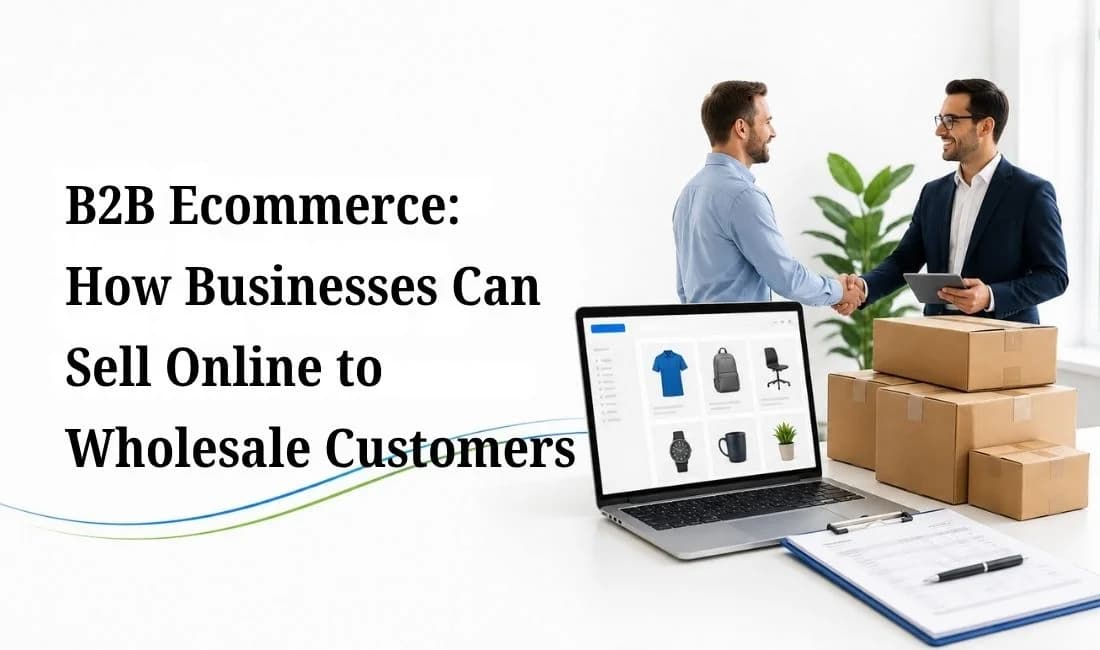
B2B eCommerce: How Businesses Can Sell Online to Wholesale Customers
Explore what B2B ecommerce means, why businesses are moving wholesale sales online, and how small to mid-sized merchants can build a better buying experience for business customers. Learn the key models, platform options, and practical steps to start selling online without relying on manual orders, emails, and spreadsheets.
On this page
- What Is B2B eCommerce?
- Who Needs B2B eCommerce?
- B2B eCommerce vs B2C eCommerce: Understanding the Difference
- Wholesale vs Retail: Understanding Different Business Models
- Retail eCommerce
- Wholesale eCommerce
- Hybrid B2B and B2C eCommerce
- B2B eCommerce Examples: How Different Businesses Use Online Selling
- Example 1: Manufacturer Selling Directly to Businesses
- Example 2: Wholesale Supplier Managing Repeat Orders
- Example 3: Retail Brand Expanding Into Wholesale
- Why Businesses Are Moving B2B Sales Online
- What Makes a Good B2B eCommerce Experience?
- Choosing a B2B eCommerce Platform
- Shopify for B2B eCommerce
- BigCommerce for B2B eCommerce
- WooCommerce for B2B eCommerce
- How to Start B2B eCommerce
- Step 1: Understand How Customers Buy Today
- Step 2: Choose the Right B2B Model
- Step 3: Choose a Platform That Matches Your Needs
- Step 4: Start With Existing Customers
- Common B2B eCommerce Mistakes
- Treating B2B Like Regular Retail
- Building Too Much Too Early
- Ignoring the Existing Sales Process
- Not Planning for Growth
- Frequently Asked Questions
- Conclusion
Many B2B businesses still manage wholesale orders through emails, spreadsheets, phone calls, and manual invoices. These processes may work when a business has only a few customers, but they become difficult to manage as order volume and customer expectations increase.
B2B eCommerce gives businesses a way to sell online to other businesses through a more organized buying experience. Instead of manually handling every order, merchants can allow customers to browse products, access relevant information, and complete purchases online.
For small and mid-sized businesses, starting B2B eCommerce is not about building a complex enterprise system. It is about solving everyday problems, such as repeated order requests, manual pricing discussions, and time-consuming sales processes.
This guide explains what B2B eCommerce is, who needs it, how it differs from B2C selling, what makes a good B2B buying experience, and how businesses can choose the right platform to get started.
TL;DR
B2B eCommerce helps businesses sell products online to other businesses, including wholesalers, retailers, distributors, and commercial buyers.
Many merchants move to B2B eCommerce because managing orders through emails, phone calls, and spreadsheets becomes difficult as sales grow.
A successful B2B store focuses on making business buying easier through better ordering experiences, customer access, pricing, and repeat purchases.
Shopify, BigCommerce, and WooCommerce can all support B2B selling, but the right platform depends on a merchant’s business model and requirements.
Businesses do not need an enterprise system to start. A practical approach is to improve the existing buying process and expand gradually.
What Is B2B eCommerce?
B2B eCommerce is the process of selling products or services online to business customers instead of individual consumers.
The buyers in B2B eCommerce may include:
Retail stores purchasing inventory
Restaurants buying supplies
Distributors sourcing products
Companies purchasing equipment or materials
Other businesses buying products for their operations
For example, a clothing manufacturer may sell directly to retail stores through an online wholesale portal. A food supplier may allow restaurants to reorder ingredients online. A packaging company may let businesses purchase shipping materials without contacting a sales representative every time.
The basic idea is simple: businesses should be able to purchase from suppliers online in a way that matches their buying process.
However, B2B eCommerce is not just a normal online store with larger quantities. Business buyers usually have different expectations. They may need access to specific products, different pricing structures, larger order options, or easier ways to repeat purchases.
A good B2B eCommerce setup helps merchants replace unnecessary manual steps while giving customers a smoother way to buy.
Who Needs B2B eCommerce?
B2B eCommerce is useful for any business that sells products or services to other businesses. It is especially valuable for merchants who already receive wholesale requests or repeat business orders.
Some common examples include:
Manufacturers
Manufacturers often sell products directly to retailers, distributors, or commercial buyers.
They may need a better way to manage:
Bulk purchases
Distributor relationships
Repeat orders
Business customer access
An online B2B system can help manufacturers reduce dependency on manual sales processes while keeping customer relationships organized.
Wholesalers
Wholesalers are one of the most common users of B2B eCommerce.
Their customers usually purchase larger quantities and reorder frequently. Instead of managing every order through email or phone, wholesalers can give buyers a more direct purchasing experience.
Distributors
Distributors often manage large product catalogs and many business customers.
B2B eCommerce can help them provide customers with easier access to products, ordering information, and purchasing workflows.
Retailers Expanding Into Wholesale
Some consumer brands eventually start selling to other businesses.
For example, a skincare brand selling directly to consumers may begin supplying salons or retailers. A clothing brand may start offering wholesale accounts to boutiques.
In these cases, B2B eCommerce allows the business to support both consumer and business buyers.
B2B eCommerce vs B2C eCommerce: Understanding the Difference
Although both involve selling online, B2B eCommerce and B2C eCommerce serve different types of buyers and buying behaviors.
Understanding the difference helps merchants create the right experience instead of simply copying a consumer store.

Buyer Type
The biggest difference is who is making the purchase.
In B2C eCommerce, an individual customer usually buys products for personal use.
In B2B eCommerce, the buyer represents a business. The purchase may support inventory management, daily operations, or resale.
Order Size
B2C customers often make smaller individual purchases.
B2B buyers usually purchase larger quantities because they need products for business purposes.
A retailer buying hundreds of products from a supplier has different requirements from a customer buying one item.
Pricing Expectations
B2C stores usually display one public price.
B2B customers may expect pricing that depends on factors such as order size, customer relationship, or business agreement.
Decision Process
B2C purchases are often quick decisions made by one person.
B2B purchases may involve multiple people, internal approvals, or purchasing policies.
Payment Expectations
Consumer buyers usually expect immediate payment.
Business buyers may have different payment preferences depending on their relationship with the supplier and industry.
The key difference is that B2B eCommerce is built around ongoing business relationships, while B2C eCommerce is usually focused on individual transactions.
A deeper comparison of these differences helps merchants understand which selling approach fits their business model.
Wholesale vs Retail: Understanding Different Business Models
Wholesale and retail are closely connected, but they serve different purposes.
Retail usually means selling products directly to individual consumers. Wholesale means selling products in larger quantities to other businesses.
Both models can exist online, but they require different approaches.
Retail eCommerce
Retail eCommerce focuses on individual shoppers.
The buying journey usually involves:
Product discovery
Comparing options
Individual checkout
Personal delivery
Wholesale eCommerce
Wholesale eCommerce focuses on business buyers.
Customers may care more about:
Availability
Pricing
Order quantities
Repeat purchasing
Business relationships
A wholesale buyer is usually not browsing for inspiration. They are trying to complete a business task efficiently.
Hybrid B2B and B2C eCommerce
Many merchants operate both models.
A brand may sell products directly to consumers while also supplying retailers or other businesses.
This approach can be effective, but businesses need to create different experiences for different customer groups.
A customer purchasing one item should not necessarily have the same experience as a retailer ordering hundreds of units.
Understanding whether your business is mainly retail, wholesale, or a combination of both is an important first step before building a B2B eCommerce strategy.
B2B eCommerce Examples: How Different Businesses Use Online Selling
B2B eCommerce can look different depending on the type of business and customers being served.
A manufacturer, wholesaler, and retailer moving into wholesale may all sell online, but their needs are not exactly the same.
Understanding these examples helps merchants identify what type of B2B eCommerce experience makes sense for their own business.
Example 1: Manufacturer Selling Directly to Businesses
A manufacturer that produces products for retailers or distributors may use B2B eCommerce to simplify ordering.
Before moving online, the process may involve:
Customers requesting product lists
Sales teams preparing quotes
Buyers confirming orders manually
With B2B eCommerce, business customers can access product information, place orders, and manage purchases through an online system.
The manufacturer still maintains customer relationships but reduces repetitive administrative work.
Example 2: Wholesale Supplier Managing Repeat Orders
A wholesale supplier often has customers who purchase the same products regularly.
For example, a restaurant supplier may provide ingredients, packaging, or equipment to hundreds of businesses.
The main goal of B2B eCommerce in this case is convenience. Customers should be able to quickly find products, place repeat orders, and manage purchases without starting from scratch every time.
Example 3: Retail Brand Expanding Into Wholesale
A brand that originally sells directly to consumers may later decide to work with retailers.
For example:
A skincare company may supply salons.
A clothing brand may supply boutiques.
A food brand may supply stores.
The business now needs to support two types of buyers: consumers and business customers.
B2B eCommerce helps create a structured way to manage both groups without forcing every order through the same process.
Why Businesses Are Moving B2B Sales Online
Many businesses do not start with a dedicated B2B eCommerce strategy. They usually begin with manual processes that work when the company is smaller.
A customer sends an email asking for pricing. A salesperson replies. An invoice is created. Someone updates the order details.
This approach can work for a limited number of customers, but it becomes harder as the business grows.
The problem is not only the number of orders. It is the amount of repeated work involved in every order.
As businesses grow, they often face challenges such as:
Spending too much time answering common questions
Managing different customer requests manually
Updating pricing information repeatedly
Handling repeat orders through the same process every time
B2B eCommerce helps solve these problems by creating a more organized buying experience.
Instead of depending completely on sales representatives for routine purchases, customers can complete many common tasks themselves.
This is especially useful for small and mid-sized businesses because they often need to grow without adding unnecessary operational complexity.
The goal is not to remove personal relationships from B2B selling. Business customers may still want support, negotiation, and direct communication.
The goal is to make routine buying easier so sales teams can spend more time on valuable customer interactions.
What Makes a Good B2B eCommerce Experience?
A good B2B eCommerce experience is not simply a retail store with wholesale products added.
Business buyers expect an online process that matches how they already purchase.
The exact requirements depend on the business, but most successful B2B eCommerce setups focus on a few important areas.
Easier Customer Access
Business buyers often need a different experience from regular shoppers.
A merchant may need to provide certain customers with access to specific products, pricing, or purchasing options.
This is where customer accounts and business-specific access become important.
A dedicated account experience helps merchants organize relationships with different types of buyers.
Better Product and Pricing Management
B2B businesses often sell to customers with different needs.
Some buyers may purchase larger quantities. Others may have agreed pricing arrangements.
A good B2B eCommerce setup should make the purchasing process clear instead of requiring customers to ask for information before every order.
Support for Business Ordering Requirements
Many B2B businesses have ordering rules that are different from normal retail.
Examples include:
Minimum order requirements
Bulk purchasing needs
Quantity-based ordering
Specific product availability
These requirements help businesses manage operations more efficiently.
Faster Repeat Purchasing
Many B2B buyers are repeat customers.
A supplier’s success often depends on making future purchases easier, not just helping customers place their first order.
A good experience helps buyers quickly return, find products, and complete orders without unnecessary steps.
Flexible Payment Options
Business customers may have different expectations around payment.
Some prefer immediate online payment, while others may work through established payment arrangements.
The right approach depends on the business relationship and industry.
A strong B2B eCommerce strategy considers these needs without adding unnecessary complexity.
The important point is that merchants should build around customer behavior first. Features should support the buying process, not define it.
Choosing a B2B eCommerce Platform
The right platform can make B2B eCommerce easier to manage, but the best choice depends on a merchant’s existing setup and requirements.
Small and mid-sized businesses often make the mistake of choosing platforms based only on the number of features available.
A better approach is to consider:
How customers currently purchase
How much customization is needed
How complex pricing and product management are
Whether the business also sells directly to consumers
Three popular eCommerce platforms for B2B selling are Shopify, BigCommerce, and WooCommerce.

Shopify for B2B eCommerce
Shopify is a popular choice for merchants that already use Shopify for online retail and want to expand into B2B selling.
Shopify provides native B2B features, including company profiles, catalogs, pricing options, quantity rules, volume discounts, and payment terms. Shopify B2B is no longer limited to Plus.
This makes Shopify useful for merchants that want to manage consumer and business selling within the same ecosystem.
However, businesses should understand which capabilities are available on their specific plan and whether their requirements need additional customization.
BigCommerce for B2B eCommerce
BigCommerce is designed to support merchants that need structured B2B selling capabilities.
It can be a good fit for businesses managing larger product catalogs, multiple customer relationships, or more advanced business purchasing workflows.
Merchants considering BigCommerce should evaluate whether its built-in B2B capabilities match their current needs and growth plans.
WooCommerce for B2B eCommerce
WooCommerce provides flexibility because it runs on WordPress.
Unlike platforms with more fixed structures, WooCommerce allows businesses to customize their eCommerce setup through extensions and development.
This can be valuable for merchants with unique workflows.
The tradeoff is that businesses may need more technical involvement to manage their setup over time.
The right platform is not necessarily the one with the most features. It is the one that supports the way your customers actually buy.
How to Start B2B eCommerce
Starting B2B eCommerce does not require completely changing your business overnight.
The best approach is usually to understand your current sales process first, then build an online experience that solves the biggest problems.
Many businesses make the mistake of trying to create a perfect B2B system before understanding what customers actually need.
A practical approach usually starts with four steps.
Step 1: Understand How Customers Buy Today
Before choosing a platform or adding features, review your existing ordering process.
Ask questions like:
How do customers currently place orders?
Which parts of the process require manual work?
What information do buyers ask for repeatedly?
Which products are purchased most often?
What causes delays during ordering?
For example, if customers regularly email asking for availability and pricing, improving product information and access may be the first priority.
If customers repeatedly purchase the same items, making reordering easier may provide the biggest improvement.
The goal is to understand the actual buying process before building the online version.
Step 2: Choose the Right B2B Model
Different businesses need different approaches.
A manufacturer selling to distributors may need a different setup from a wholesaler selling products to retailers.
Consider:
Who your buyers are
How frequently they purchase
Whether they need special pricing
Whether you also sell directly to consumers
Understanding your model helps you avoid creating unnecessary complexity.
Step 3: Choose a Platform That Matches Your Needs
Once you understand your requirements, evaluate eCommerce platforms based on what they support.
Consider:
Existing technology
Required customization
Product catalog size
Customer management needs
Future growth plans
A merchant already using Shopify may prefer expanding within the same ecosystem. A business needing more customization may prefer a flexible platform like WooCommerce.
The best platform decision depends on the business, not simply the number of available features.
Step 4: Start With Existing Customers
Testing with existing business customers is usually the safest approach.
Current customers already understand your products and can provide useful feedback.
A gradual rollout allows merchants to improve the experience before expanding to more buyers.
The goal is to create a system that works in real-world situations, not just one that looks good during planning.
Common B2B eCommerce Mistakes
Moving B2B sales online can improve efficiency, but merchants often make mistakes during the transition.
Understanding these mistakes can help businesses create a better experience from the beginning.
Treating B2B Like Regular Retail
One of the biggest mistakes is creating a standard consumer store and simply adding wholesale products.
Business buyers often have different expectations.
They may need:
Business-specific access
Different ordering processes
Larger purchasing options
Easier repeat buying
A B2B eCommerce experience should reflect how businesses purchase, not just how consumers shop.
Building Too Much Too Early
Some merchants try to create a highly complex system before they have identified their actual needs.
This can lead to unnecessary costs and complicated workflows.
A better approach is starting with the problems customers already experience and expanding over time.
Ignoring the Existing Sales Process
A common mistake is moving orders online without understanding why customers buy the way they do.
For example, a merchant may remove personal support options even though customers rely on them for important purchasing decisions.
The goal is not replacing every human interaction. It is removing unnecessary manual work while keeping valuable relationships.
Not Planning for Growth
A system that works for ten customers may not work for hundreds.
Merchants should consider whether their chosen approach can support:
More customers
More products
More complex ordering needs
Additional sales channels
Planning ahead helps avoid rebuilding the entire system later.
Frequently Asked Questions
Can I Sell B2B and B2C From the Same Website?
Do I Need an Expensive B2B eCommerce Platform?
Is Shopify Good for B2B eCommerce?
What Features Does a Wholesale Store Need?
Is WooCommerce Suitable for B2B?
Conclusion
B2B eCommerce gives businesses a practical way to sell online to wholesale customers while reducing the manual work involved in traditional ordering processes.
The biggest opportunity is not simply creating another sales channel. It is creating a better buying experience for business customers.
A manufacturer may need a simpler way for distributors to place orders. A wholesaler may need an easier way for retailers to reorder products. A consumer brand expanding into wholesale may need a way to support both B2B and B2C customers.
The right approach depends on the business model, customer expectations, and platform requirements.
Merchants exploring B2B eCommerce should consider the full picture: how customers access products, how pricing is managed, how orders are placed, and how repeat purchases are handled.
Whether a business chooses Shopify, BigCommerce, WooCommerce, or another platform, the goal remains the same: make buying easier for business customers while creating a process that can grow with the company.
B2B eCommerce is not about adding complexity. It is about replacing inefficient manual processes with a more reliable way to sell online.

Syeda Rehnoma Tanzom
This article is written by Syeda Rehnoma Tanzom, an SEO content writer with 3+ years of experience specializing in eCommerce content. What makes the work here a little different? A close collaboration with support teams to understand what merchants are actually going through, their frustrations, their questions, and their wins. The goal is simple: write content that speaks to real problems, not just search engines. When not buried in keywords and content briefs, you'll find her nose-deep in a good book, binge-watching true crime documentaries or psychological thrillers, and occasionally switching gears with a feel-good rom-com.
Keep reading
View all articles →
How to Optimize Your Shopify Store for ChatGPT, Gemini, and AI Shopping
October 2, 2026 • 17 min read
When Should You Replatform Your eCommerce Store? 10 Warning Signs
September 9, 2026 • 10 min read
10 Major Reasons Why Your eCommerce Store Fails And How To Solve It
August 29, 2024 • 8 min read