On this page
- Key takeaways
- Why haircare routines are harder than they look
- Where the shopper gets stuck
- The kit is built for the brand, not the hair
- Hair type lives in the product description
- The routine price only exists for the fixed kit
- Swapping a step breaks the deal
- Nobody explains the routine
- Reorders don't match usage
- What it costs the brand
- What a routine-ready haircare store looks like
- Start with product data, not the bundle
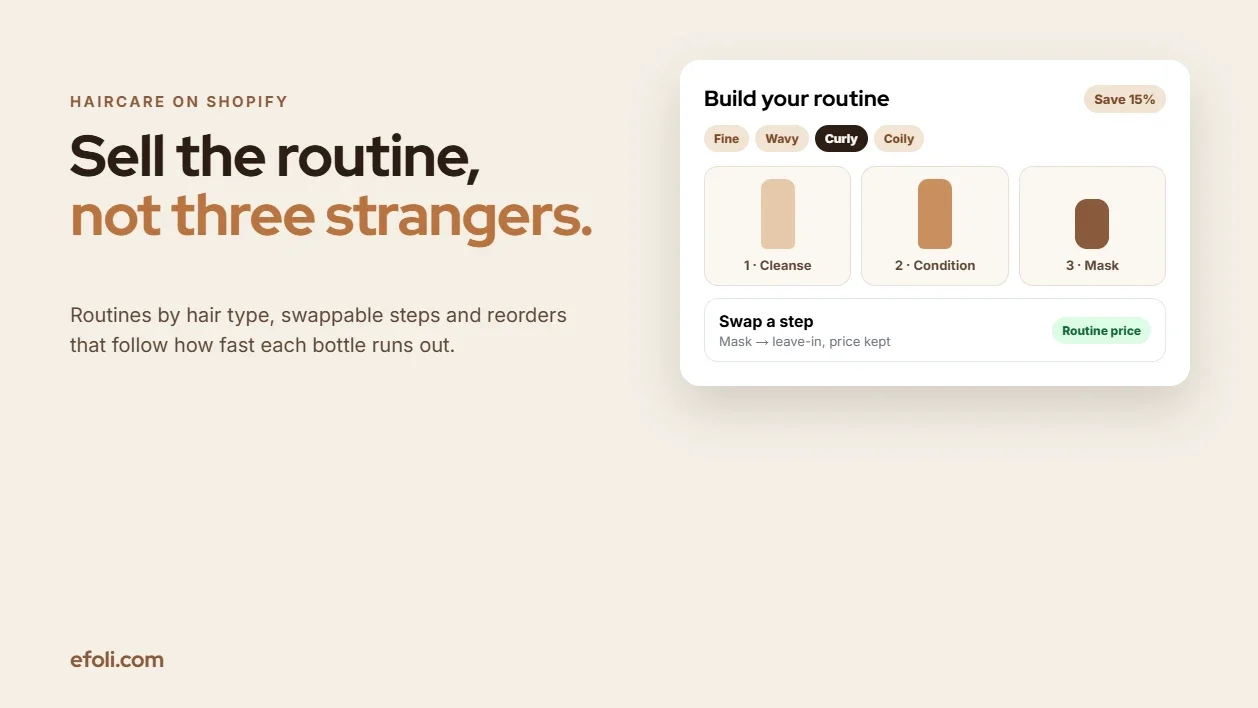
- Build routines by hair type, not one bestseller kit
- Use a bundle tool that can limit choices by step
- Price the routine, not the kit
- Explain the routine where it's bought
- Offer a way to try the routine
- Plan the reorder around usage
- Keep claims cosmetic
- Worked example: Loma & Reed
- The problem, as the team saw it
- What Loma & Reed changed
- What happened
- Merchant checklist: before you build the next routine
- Mistakes that keep routines from repeating
- Final Thoughts
- FAQ
Short answer: Haircare routine bundles on Shopify break down when the store sells a routine as three unrelated products. The shopper knows her hair type, but the product pages don't ask for it, the "kit" is fixed to one hair type, and the bottles run out at different times. To fix it, store hair type, scalp and concern as product data, build routines by hair type rather than one fixed kit, and let shoppers swap a step without losing the routine price. Plan the reorder too, because the shampoo empties before the mask does. And keep routine copy cosmetic: claims about treating dandruff or regrowing hair change how a product is regulated.
Nadia has curly, colour-treated hair that's dry at the ends and a little oily at the roots. She found a haircare label through a friend and lands on its Shopify store ready to buy a full routine: a gentle shampoo, a rich conditioner and a weekly mask.
The home page has a "Bestselling Hair Kit" for $58. She opens it. It contains a volumising shampoo, a lightweight conditioner and a texture spray. It's built for fine, straight hair. There's no curly version and no way to swap the spray for the mask.
So she builds the routine herself. The curl shampoo is on one collection page, the conditioner she wants is under "Treatments," and the mask is in a "Bestsellers" carousel. Each product page talks about its own ingredients but none says what to pair it with. She adds the three items and gets to $71, with no routine discount and no hint of how often to use the mask.
Six weeks later, the shampoo is empty and the conditioner is half full. She reorders the shampoo on its own. The mask is still sitting in the shower. She isn't sure if it's working, so she doesn't buy it again.
This article is for haircare labels selling on Shopify and the agencies who build their stores. It follows Nadia's routine from the buyer's side, maps where it breaks, looks at what that costs the brand and ends with a merchant checklist.
Key takeaways
A haircare routine is a sequence of steps chosen for one person's hair, not three products that happen to share a brand.
Most stores don't hold hair type, scalp type or concern as product data, so they can't build routines around them.
One fixed kit can only fit one hair type. A routine builder with a few guided choices fits many.
Let shoppers swap or skip a step without losing the routine price.
Shampoo, conditioner and treatments run out at different rates, so the reorder needs its own plan.
Keep routine claims cosmetic. In the US, an antidandruff shampoo is regulated as a drug as well as a cosmetic.
Why haircare routines are harder than they look
Skincare routines get most of the attention, and many of the lessons carry over. Anika's guide to Shopify agencies for skincare routines covers how agencies scope a routine builder. Haircare has a few quirks of its own, and they're the reason routine kits underperform.
Hair type is personal and fairly stable. The American Academy of Dermatology's tips for healthy hair start with "learn your hair type" and advise choosing products made for it. The same guidance suggests applying conditioner only to the ends of fine or straight hair, and along the full length of dry or curly hair. In other words, the right routine depends on the person, and so does how they use it.
Scalp and lengths can need different things. Nadia's roots are oily and her ends are dry. A single "for dry hair" label doesn't capture that, and a shopper with combination needs often ends up mixing products from two lines.
Usage rates differ. Someone with an oily scalp may shampoo daily. The AAD notes that people with dry, curly or thick hair may shampoo far less often. A mask used once a week lasts much longer than a shampoo used every day. A routine bought together won't run out together.
Format matters. Some shoppers want salon-size bottles. Others want travel sizes to try a new line first. A routine that only comes in full sizes is a big first commitment.
Put those together and the problem is clear. A fixed three-product kit suits one hair type, one usage pattern and one size. Everyone else has to build their own routine, at full price, without guidance.
Where the shopper gets stuck

Moment | What the shopper expects | What the store does | What happens |
|---|---|---|---|
Arriving | "Show me what suits my hair" | A bestseller kit for one hair type | Curly and coily shoppers feel it isn't for them |
Browsing | Products grouped by routine | Products grouped by product type | The routine has to be pieced together |
Product page | "What do I use this with?" | Ingredient story only | No pairing guidance |
Building the routine | A routine price | Full price for each item | The kit discount only applies to the fixed kit |
Swapping a step | Replace the spray with a mask | Kit is all or nothing | Shopper buys singles, or leaves |
Using it | How often, in which order | Nothing after checkout | The mask sits unused |
Reordering | Top up what ran out | Reorder the whole kit, or each single | Partial reorders lose the routine |
The kit is built for the brand, not the hair
Most haircare kits are built around bestsellers. That makes sense for stock and margin. But a bestseller kit is usually built for the most common hair type in the brand's audience, which leaves everyone else on the outside. When the only routine on the home page doesn't fit, the shopper concludes the brand isn't for her.
Hair type lives in the product description
On many stores, "suitable for curly hair" appears in a paragraph of copy. It isn't a filter, a tag or a field the store can use. So the store can't show "routines for curly hair," a bundle can't be limited to curl-safe products, and search can't help. If hair type is only text, every routine has to be built by hand.
The routine price only exists for the fixed kit
The fixed kit has a discount. The routine Nadia builds herself doesn't, even though it's three products from the same brand. She pays more for choosing what suits her hair. That's the opposite of what the brand wants.
Swapping a step breaks the deal
A routine builder that won't let her replace one step is a fixed kit with extra clicks. The most common requests are predictable: swap a styling product for a treatment, choose a fragrance-free option, or skip a step she already has at home.
Nobody explains the routine
Shampoo first, conditioner second is obvious. How often to use a mask, whether a leave-in replaces conditioner, and how much product curly hair needs aren't obvious. If the store doesn't explain, the product with the least obvious use, usually the treatment, is the one that gets abandoned. And a product that wasn't used properly rarely gets bought again.
Reorders don't match usage
Six weeks in, Nadia needs shampoo. If the only "reorder" is the full kit, she either overbuys conditioner and mask, or she buys the shampoo on its own and drops out of the routine. Either way, the brand loses the routine relationship it worked to create.
What it costs the brand
Where it shows up | What it looks like |
|---|---|
Conversion | Shoppers outside the "default" hair type leave without buying a routine |
Average order value | Routine buyers pay full price for singles, or buy one product to "test" |
Returns and complaints | Wrong-type products, "it made my hair greasy," "it's too heavy" |
Customer service | "Which conditioner goes with this shampoo?" and "Can I swap the spray?" |
Inventory | Kit stock runs low on one component while the rest sit in the warehouse |
Retention | Partial reorders, then no reorder for the step that wasn't explained |
Reviews | Low ratings for good products used on the wrong hair type |
The last row is easy to miss. A rich mask is a great product for dry curly hair and a poor one for fine, oily hair. When the store sends the wrong products to the wrong hair types, good products collect bad reviews.
What a routine-ready haircare store looks like
Start with product data, not the bundle
Before building any routine, add the attributes a routine needs as structured data on each product. Metafields work well for this. At a minimum:
Hair type: straight, wavy, curly, coily. Keep the labels simple, and if you use a number-and-letter system, explain it once on a guide page.
Hair thickness: fine, medium, thick.
Scalp: oily, balanced, dry or sensitive.
Concern: frizz, dryness, colour care, volume, breakage.
Step: cleanse, condition, treat, leave-in, style.
Use frequency: every wash, weekly, as needed.
Fragrance: fragranced, lightly fragranced, fragrance-free.
Once these exist, the store can filter, a bundle app can limit choices, and product pages can show pairings automatically. Without them, every routine is a manual list someone has to maintain.
Build routines by hair type, not one bestseller kit

Map one recommended product per step for each main hair type. Four hair types and four steps give you a 16-cell grid. Some cells will share a product, and that's fine. A gentle shampoo can suit several types. The grid tells you three things: which routines you can offer today, where you have gaps, and which products are doing most of the work.
Then offer the routine in two ways:
Ready-made routines, one per hair type, for shoppers who want a quick answer. "The Curl Routine" and "The Fine Hair Routine" are clearer than "Bestselling Kit."
A routine builder for shoppers who want to choose. Step one asks for hair type, then each step shows only the products that fit.
Use a bundle tool that can limit choices by step
A Shopify haircare bundle app like PushBundle covers both routes. According to its App Store listing, fixed bundles are available on the free Starter plan, and the Growth plan ($14 a month at the time of writing) adds build-a-box and mix-and-match bundles, with a multi-step build-your-own-box flow, minimum and maximum limits and variant limits. Bundles go into the cart as one line with inventory synced to the products inside.

For a haircare routine, set it up step by step: cleanse, condition, then one treatment or leave-in. Limit each step to products that match the hair type chosen first. Allow the shopper to skip a step if she already owns that product, but decide in advance whether skipping changes the price. PushBundle's recent update also lets mix-and-match bundles run without a fixed pack size, with quantity offers that unlock a discount or gift at the quantity you choose. That suits routines well, because a shopper who wants two steps and a shopper who wants four can both reach checkout.
If you're comparing tools, Syeda's roundup of the best Shopify mix-and-match bundle apps covers the main options.
Price the routine, not the kit
The routine price should follow the shopper, whatever products she chooses. Two simple models work:
Model | How it works | Good for |
|---|---|---|
Step discount | 10% off when the routine has three or more steps | Brands with similar prices across steps |
Routine price band | Any three products for a set price, within a price band | Brands with a clear entry routine |
Avoid giving the fixed kit a deeper discount than the routine builder. If the kit is cheaper, shoppers who need a different routine feel punished for choosing correctly.
For discounts that apply across products rather than inside one bundle, such as "spend $60 on haircare, get a free travel size," a Shopify haircare discount app like DiscountRay can run quantity tiers on its free Starter plan, and customer-tag offers on Growth ($14 a month), according to its listing. Anika's guide to discount thresholds on Shopify explains how to choose a threshold that lifts order value without giving margin away. Decide in advance whether a routine bundle can also use a sitewide code, and test the combination.
Explain the routine where it's bought
Add a short "how to use your routine" block to every routine page and every product page that belongs to a routine:
Order of steps: cleanse, condition, treat, style.
Frequency: "Use the mask once a week in place of conditioner."
Amount: a short line for fine and for thick hair.
Where to apply: roots or lengths. The AAD's guidance on applying shampoo to the scalp and conditioner by hair type is a good, plain starting point.
Repeat the essentials in the order confirmation email and on the packing insert. The treatment step is the one most likely to be forgotten, so give it the clearest instruction.
Offer a way to try the routine
A full routine in full sizes is a lot to commit to, especially for a shopper new to the brand. Consider a trial routine in travel sizes for each hair type, with a credit or code toward the full sizes. Keep it in the same routine structure, so the next purchase is the same routine, just bigger.
Plan the reorder around usage
Because shampoo, conditioner and treatments run out at different rates, don't assume the routine gets reordered as a set.
Reorder by step. Make it easy to reorder one step from the routine without hunting for it. Shopify's customer accounts include reordering, so link the routine products from the order confirmation and from the account page.
Time the reminders. If a 300 ml shampoo lasts about six weeks with typical use, remind at five. Remind about the mask much later.
Match sizes to usage. If the shampoo always runs out first, offer it in a larger size, or include two in a three-month routine.
Keep the routine price for top-ups, or offer a smaller "routine member" discount, so the reorder doesn't feel like starting over.
If you offer the routine as a subscription, check compatibility before launch. Shopify notes that bundles aren't compatible with the Shopify Subscriptions app, so routine subscriptions need a bundle app and subscription app that are tested together.
Keep claims cosmetic
Haircare copy drifts easily into medical claims. In the US, the FDA explains in Is it a cosmetic, a drug, or both? that an antidandruff shampoo is both a cosmetic and a drug, and that claims to restore hair growth make a product a drug. Other markets have similar lines.
For routine pages, keep the language about cleansing, conditioning, softness, shine, frizz and manageability. If a product genuinely treats a scalp condition, it should be labelled and sold as the regulated product it is, and the routine page should link to it rather than describe it in cosmetic terms. This isn't legal advice, so check the claims for each market with a regulatory adviser.
Worked example: Loma & Reed
Loma & Reed is a fictional haircare label we've made up for this example. It sells shampoos, conditioners, masks and leave-ins on Shopify, mostly to customers in the US and UK.
The problem, as the team saw it
The store had one bestselling kit for fine hair. Curly and coily shoppers made up a growing share of traffic but bought mostly single products. The mask had strong reviews from curly customers and weak reviews from fine-haired customers who'd bought it on its own. Customer service spent much of its time answering "what goes with this?"
What Loma & Reed changed
Product data first. The team added hair type, thickness, scalp, concern, step, frequency and fragrance as metafields on every product.
A routine matrix. It mapped one product per step for four hair types and found two gaps: no lightweight leave-in for wavy hair and no fragrance-free mask.
Four ready-made routines. One per hair type, named plainly, replacing the single bestseller kit on the home page.
A routine builder. Hair type first, then each step filtered by hair type, with an option to skip a step. Three steps or more earned 10% off.
Usage guidance. A "how to use" block on routine and product pages, repeated in the confirmation email.
Travel-size routines. One per hair type, with a code toward full sizes.
Step reorders. Reminder emails timed by step, and a reorder link for each product in the routine.
Claims review. Two product pages that mentioned "dandruff" were rewritten to cosmetic language, and the team flagged one scalp product for a separate regulatory review.
What happened
These are illustrative outcomes, not measured results. Curly and coily shoppers started buying routines instead of single products. The mask's reviews improved, because it was now recommended only to the hair types it suited. Customer service received fewer pairing questions. The routine matrix also gave the product team a clear brief for the next launch: fill the two gaps before adding another bestseller.
Merchant checklist: before you build the next routine

Product data
Add hair type, thickness, scalp, concern, step, frequency and fragrance to every product.
Turn hair type and concern into collection filters.
Write one guide page that explains your hair type labels.
Routines
Map one product per step for each hair type, and note the gaps.
Publish a ready-made routine for each main hair type.
Build a routine builder that asks for hair type first.
Let shoppers skip or swap a step.
Pricing
Price the routine, not just the fixed kit.
Make sure the builder price is never worse than the fixed kit for the same products.
Decide which codes can combine with routine pricing, and test them.
Guidance
Add a "how to use your routine" block to routine and product pages.
Repeat it in the confirmation email and on the insert.
Give the treatment step the clearest instruction.
Reorders
Make each routine product easy to reorder on its own.
Time reminders by step, not by order date.
Size the fastest-used product to match usage.
Test any routine subscription with your bundle and subscription apps together.
Claims
Keep routine copy cosmetic.
Route products that treat a condition to a separate, properly labelled page.
Mistakes that keep routines from repeating
Naming routines after the brand instead of the hair. "The Signature Kit" tells a curly shopper nothing.
Treating every step as equally important. The treatment step is where routines fail. Give it more help, not less.
Reordering the whole kit. Nobody runs out of three products on the same day.
Hiding the builder. If the ready-made routines are on the home page and the builder is three clicks away, most shoppers who need a different routine never find it.
Fixing reviews instead of fit. If a good product gets poor reviews from one hair type, the fix is usually where it's recommended, not the formula.
For brands thinking about personalisation more broadly, Anika's post on custom makeup kits on Shopify covers how shade and finish data power a kit builder. Haircare follows the same logic with hair type and concern.
Final Thoughts
A haircare routine is three or four products chosen for one person's hair. If your store holds hair type only in descriptions, sells one bestseller kit, charges full price for any other routine and reorders everything at once, shoppers like Nadia build the routine themselves, use half of it and drop the rest. Store hair type as data, build routines by hair type, let shoppers swap a step, price the routine rather than the kit, explain how to use it, reorder by step and keep claims cosmetic. Then the mask gets used, the routine gets repeated, and the brand earns the second order.
FAQ
How do I sell haircare routine bundles on Shopify?
Should I offer a fixed haircare kit or a routine builder?
How do I let customers swap a product in a haircare bundle?
How should I price a haircare routine bundle?
Can I sell haircare routines as a subscription on Shopify?
Can I say a shampoo treats dandruff or helps hair grow?

Anika Anamta Mehnaz
This article is written by Anika Anamta Mehnaz, a Content Writer and Content Marketing Strategist specializing in Shopify, eCommerce, and SaaS. With over four years of content writing experience, she creates SEO and AI search-optimized content that helps Shopify merchants make better business decisions through practical, research-backed insights. Her work covers Shopify apps, product variants, bundles, discounts, B2B commerce, and conversion-focused strategies. Outside of work, Anika enjoys watching anime, reading John Grisham novels, and discovering new ideas in digital marketing and e-commerce. If you enjoy discussing Shopify, content marketing, or online growth, feel free to connect with her. Twitter: https://x.com/mehnaz2201 Medium: https://medium.com/@mehnaz_78932
Keep reading
View all articles →
Same Headphones, Three Reseller Tiers: Why One Price Makes No Sense
November 20, 2026 • 17 min read
Shopify Subscriptions, Bundle Apps and Custom Code: Check Compatibility First
November 20, 2026 • 17 min read
MultiVariants vs Custom Quick-Order Forms for Repeat Distributor Orders
November 20, 2026 • 17 min read