Six Students, Six Kits, Thirty Missing Brushes: Why Craft Workshop Kits Break on Shopify
Why craft teachers end up short of supplies, and how kits per student, table packs, class-size pricing, safety info and substitution rules fix it on Shopify.
On this page
- Key takeaways
- The buyer's side: how a teacher actually orders
- The friction map: where the store and the teacher disagree
- Gap 1: Units
- Gap 2: Sharing
- Gap 3: Class size
- Gap 4: Stock
- Gap 5: Timing
- The operational effects: what it costs the store
- Safety information belongs on the kit
- What a class-ready store looks like
- Kits that match a real materials list
- Shared items in a separate pack
- A class-size selector
- Clear tiered pricing
- Availability for the whole kit
- A substitution policy
- How to build it in Shopify
- Kits per student
- Class-size pricing
- The class-size selector
- Timing
- Worked example: a craft store rebuilds its workshop range
- Questions to ask teachers before you build kits
- Merchant checklist: decisions that fix the friction
- For agencies: a better brief for craft stores
- Ordering mistakes the store can prevent
- FAQ
- The short version
Short answer: Craft teachers buy for a class, not for themselves. They start with a materials list per student, then have to translate it into a store's pack sizes, shared items and stock levels, usually under a deadline. Most Shopify craft stores make them do that maths alone, so they order the wrong number of packs, miss shared items, or find a key product out of stock a few days before the class. The fix is to sell the class, not the parts. Build a kit per student that matches a real materials list, sell shared supplies as a separate table or class pack, let teachers choose a class size and see the full order, price by class size with clear tiers, show age and safety information on the kit, and decide in advance what happens when an item runs out. A bundle app such as Push Bundle handles the kits, and a tiered pricing app such as DiscountRay handles class-size pricing.
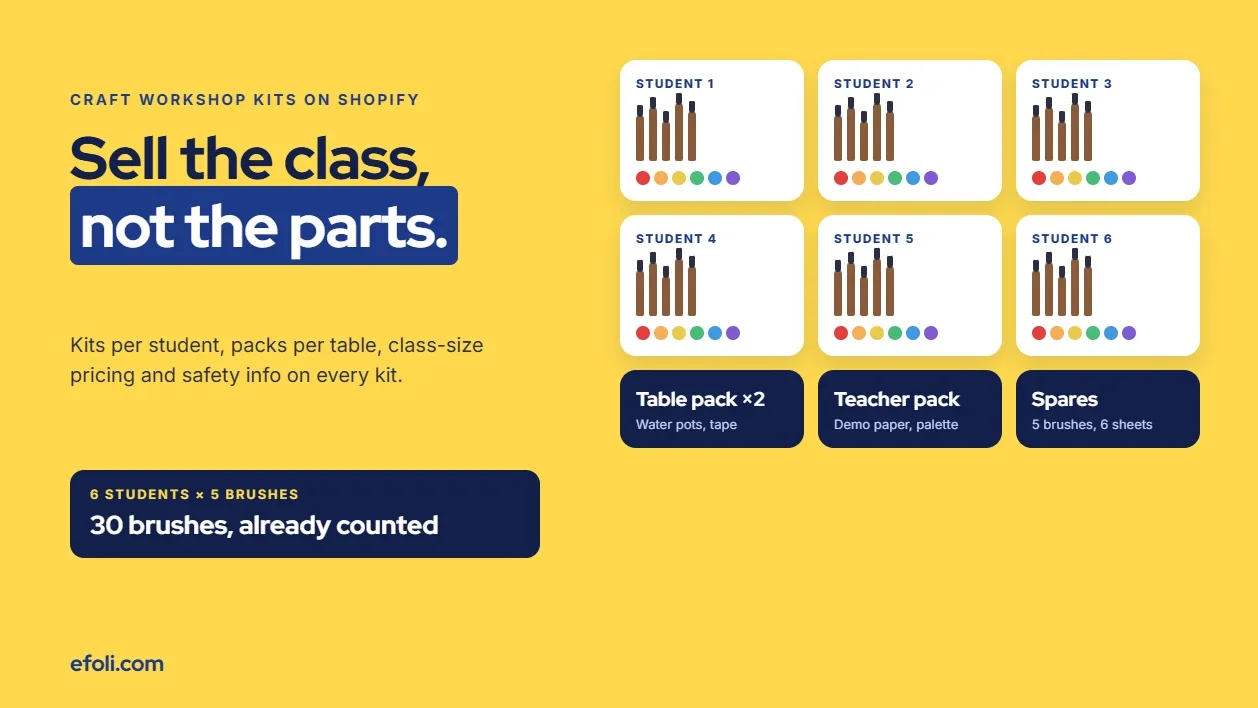
A watercolour teacher is running a Saturday workshop for six adults. Her materials list says each student needs five brushes, a pad of cold-press paper, a 12-colour paint set, a palette and a water pot. She goes to her usual craft store, adds six "watercolour brush" products to the cart, six paper pads, six paint sets, six palettes and six water pots, and checks out.
On Friday the parcel arrives. The paint, paper and palettes are fine. But the "watercolour brush" product was a single brush, not a set of five. She has six brushes for six students who each need five. Thirty-minus-six is twenty-four missing brushes, and with the spares she'd planned, it's closer to thirty. The class starts in 18 hours.
She didn't misread anything on purpose. The store sold the parts. She was trying to buy a class.
This article is for craft supply stores, workshop organisers who sell kits, and the agencies that build their Shopify stores. It looks at the problem from the teacher's side, maps where the friction comes from, explains what it costs the store, and ends with a checklist of decisions. The examples are illustrative.
Key takeaways
Teachers buy from a materials list per student. Stores sell in pack sizes. The gap between the two causes most ordering mistakes.
Some items are per student, some are shared per table, and some are for the teacher. A kit has to separate them.
A kit's availability is only as good as its scarcest item. Plan substitutions before you need them.
Class sizes vary. Let teachers choose the number of students and see the full order before checkout.
Price by class size with clear tiers, not codes teachers have to ask for.
Show age suitability and safety information on the kit, especially for children's classes.
Class dates are fixed. Make delivery timing clear before checkout.
The buyer's side: how a teacher actually orders
The teacher's process is worth following step by step, because each step is a chance for a mistake.
Start from the materials list. The list is usually written for one student: five brushes, one pad, one paint set. Some items say "per table" or "for the teacher".
Count the students. Six for a weekend workshop, 28 for a school class, maybe a few more for no-shows who turn up.
Translate the list into products. Is the brush sold singly or in a set? How many sheets in a pad? Does the paint set include a palette?
Work out shared items. Water pots might be one between two. Masking tape might be one roll per table.
Add spares. Brushes get lost, paper gets ruined, someone always needs another pencil.
Check stock and delivery. Everything has to arrive before the class.
Check the price. Is there a discount for buying 30 brushes? Is there an education or group price?
That's a lot of arithmetic for someone who'd rather be planning the lesson. Every step happens in the teacher's head or on a spreadsheet, because the store doesn't help with any of it.
Anika's guide to bulk ordering for art supply stores covers the volume side of this problem in more detail, especially for schools buying the same items in large quantities.
The friction map: where the store and the teacher disagree
The friction comes from five gaps between how the teacher thinks and how the store sells.
Gap | The teacher thinks in | The store sells in |
|---|---|---|
Units | Items per student | Singles, sets and packs of different sizes |
Sharing | Per student, per table, for the teacher | Everything as separate products |
Class size | A number of students | Quantities per product |
Stock | The whole list must arrive | Each product's own stock level |
Timing | A fixed class date | Standard shipping times |

Gap 1: Units
The brush problem is the classic example. A product called "watercolour brush" might be one brush, a set of three or a set of five. Paper pads come in 10, 12 or 20 sheets. Paint might be a set or single tubes. Teachers have to read every product carefully and convert, and a single misread item is enough to ruin a class.
Gap 2: Sharing
Materials lists mix three kinds of item:
Per student: brushes, paper, paint.
Shared: water pots between two, a roll of masking tape per table, a hairdryer for the room.
Teacher only: demonstration materials, a larger palette, spare everything.
A store that sells everything as separate products forces the teacher to work out the shared items alone. They're the ones most often forgotten.
Gap 3: Class size
Teachers don't think "I need 30 brushes". They think "I have six students". When the store asks for quantities product by product, the teacher has to multiply every line by hand, and adjust a few for sharing and spares.
Gap 4: Stock
A class needs every item on the list. If the paint set is out of stock, the class can't run, even if everything else is available. A store that shows each product's stock separately doesn't tell the teacher whether the whole list can be filled.
Gap 5: Timing
Workshops and classes have fixed dates. Standard delivery estimates don't help a teacher who needs everything by Friday. If part of the order is on backorder, the class is affected, not just the order.
The operational effects: what it costs the store
The friction isn't only the teacher's problem. It lands on the store as well.
Support emails. "Is this brush a single or a set?" "Do I need one palette per student?" Every question is staff time, often at the busiest point of the term.
Wrong orders. When teachers order the wrong pack size, the store deals with returns, exchanges and urgent second orders, often with express shipping the store absorbs to keep the customer.
Split shipments. If one item is out of stock, the store either ships part of the order and the rest later, which doubles shipping costs, or holds the whole order and risks missing the class.
Lost repeat business. Teachers who run regular classes are valuable customers, because they reorder every term. A teacher whose workshop went badly because of an ordering mistake may not come back.
Discount confusion. Teachers often ask for a group or education discount. If the store handles it with one-off codes, staff spend time issuing them, and different teachers get different prices.
Safety information belongs on the kit
Craft kits for classes raise a question that individual products don't: who will use these materials, and are they suitable? Teachers running children's classes need to know quickly. Stores need to get the information right.
In the US, the Labeling of Hazardous Art Materials Act applies to art materials. The CPSC's business guidance on art materials says art materials must carry a statement of conformance with ASTM D-4236, such as "Conforms to ASTM D-4236", and must have a toxicological assessment for chronic hazards at least every five years. Materials that do pose a hazard need cautionary labels.
Many teachers also look for certification seals from the Art & Creative Materials Institute. ACMI's classroom safety guidance explains that the AP (Approved Product) seal means a toxicologist has certified the product as safe, including for children, and recommends AP products for children in sixth grade and younger. The CL (Cautionary Labeling) seal means known risks are labeled with instructions, and ACMI says CL products shouldn't be given to children in sixth grade or younger.
If a kit is designed for children 12 and younger, it may also be a children's product that needs testing and a Children's Product Certificate under US rules. A store that assembles kits from other brands' products should check with its suppliers and a compliance adviser rather than assume.
On the store, this means:
Show the suitable age on each kit, not only on individual products.
Show the seal or labeling status of each item in the kit, so a teacher can check at a glance.
Offer an age-appropriate version of popular kits, using AP products, for children's classes.
Keep the safety information with the kit's contents, so it changes if an item is substituted.
What a class-ready store looks like
Before the checklist, here's what the store needs to do once the gaps are closed.
Kits that match a real materials list
A "Watercolour Workshop Kit, per student" contains exactly what one student needs: five brushes, one pad, one paint set, one palette. The product page shows the materials list it was built from, so the teacher can check it against their own.
Shared items in a separate pack
A "Table Pack" contains the shared items for one table of four: two water pots, one roll of masking tape, paper towels. A "Teacher Pack" contains demonstration materials. The teacher buys kits per student and packs per table.
A class-size selector
Instead of quantities per product, the teacher chooses a class size, for example "6 students, 2 tables", and sees the full order: six student kits, two table packs, one teacher pack and an optional spares pack. The total and the per-student price update as they change the numbers.
Clear tiered pricing
The kit price drops at set class sizes, for example 10, 20 and 30 students. The tiers are shown on the product page, so teachers can see the saving without asking.
Availability for the whole kit
The kit shows as unavailable if any item inside it is out of stock, instead of letting the teacher buy a kit that can't be completed. Shopify's own Bundles app works this way: a bundle's availability follows the component with the lowest stock. Bundle apps that sync inventory per component do the same.
A substitution policy
When an item runs out, the store has a plan: an equivalent product with the same specification and safety status, agreed in advance and shown on the kit page. "If this brush set is unavailable, we'll send an equivalent five-brush set of the same sizes."

How to build it in Shopify
Kits per student
A fixed kit with the same items every time can be a fixed bundle in Shopify's free Bundles app, which also lets students' items have variants, such as a choice of paper size. For kits where teachers choose options, such as a colour set or a brush type, a bundle app adds more control. Push Bundle supports fixed bundles, multipacks, mix-and-match and build-a-box bundles, with minimum and maximum quantities and a multi-step builder on its Growth plan, $14 a month with a 14-day trial at the time of writing. Kits go into the cart as one product, with stock synced for each item inside.
The Push Bundle team's guide to handling out-of-stock bundle products explains the options when one item in a kit runs out, which is the heart of the substitution question.
Class-size pricing
Tiered pricing rewards larger classes without codes. DiscountRay adds quantity discounts and tiered pricing on its free Starter plan, and can show a pricing table on the product page, so teachers can see the per-kit price at each class size. If schools or education customers need their own prices, DiscountRay can also set pricing by customer, company, tag or customer group. Its paid plans start with Growth at $14 a month with a 14-day trial at the time of writing, so check which plan includes the rules you need.
Anika's post on why tiered discounts don't work as expected is worth reading before you launch, because tier rules that count per variant instead of per product are a common surprise. The DiscountRay team's back-to-school guide covers timing offers around the school calendar.
The class-size selector
A class-size selector is the piece that most stores don't have. There are two practical ways to build it:
A build-a-box flow with steps: choose student kits, choose table packs, add a teacher pack, add spares. Minimum and maximum limits keep the numbers sensible.
A simple calculator section on the kit page that takes the number of students and tables and adds the right quantities of each kit and pack to the cart.
The first needs no code with a bundle app. The second needs a small theme customisation. Either way, the teacher should see the full order, including shared items, before checkout.
Timing
Show the delivery estimate on the kit page, and ask for the class date if timing is critical. A simple line such as "Order by Wednesday for delivery before Saturday classes" in the class kit description saves a lot of anxious emails. For stores with many class orders, a delivery date app can enforce lead times so teachers can't choose a date the store can't meet.
Worked example: a craft store rebuilds its workshop range
Here's how a fictional store, Paper & Pigment, might apply this. The details are illustrative.
Before: 40 separate products for watercolour classes. Teachers emailed every week asking which brushes and how many. Three or four urgent second orders a month, usually brushes or water pots.
After:
Product | Contents | Per |
|---|---|---|
Watercolour Student Kit | 5 brushes, 12-sheet pad, 12-colour set, palette | Student |
Watercolour Student Kit, Junior | AP-seal paints and pencils, 3 brushes, 10-sheet pad | Student, ages 6–11 |
Table Pack | 2 water pots, masking tape, paper towels | Table of 4 |
Teacher Pack | Demonstration paper, large palette, spare brushes | Teacher |
Spares Pack | 5 brushes, 6 sheets | Optional |
The pricing: student kits drop in price at 10, 20 and 30 kits, shown in a table on the product page.
The selector: a three-step build-a-box flow. Step 1: number of student kits. Step 2: table packs, with a hint of one per four students. Step 3: teacher and spares packs.
The substitution policy: each kit lists approved substitutes for its three most popular items, with the same safety status.
What changed: fewer "how many do I need?" emails, almost no urgent brush orders, and teachers reordering the same kit each term. The store also found it could plan stock better, because it was selling kits with known contents instead of 40 unpredictable lines.
Questions to ask teachers before you build kits
The best kits come from the people who use them. Before designing a range, talk to three or four teachers who order from the store regularly. Twenty minutes each is enough, and the answers usually change the kit design.
What's on your materials list, and where does it come from? Many teachers reuse a list from a course or a book. If several use the same list, that's your first kit.
How many students do you usually have, and how much does it vary? This sets the class-size tiers and the spares pack.
What do students share? The answer defines the table pack.
What do you always run out of? Usually brushes, paper or pencils. These go in the spares pack.
What do you buy elsewhere, and why? This often reveals a gap in the range or a price problem.
How far ahead do you order? This sets the delivery message and any order cutoff.
Who pays, and how? A school may need an invoice or a purchase order, while a weekend workshop host pays by card. The answer affects checkout and pricing.
What went wrong last time? The most useful question of all. Every answer is a fix for the product page.
Write the answers down and keep them with the kit specification. When a teacher later says a kit doesn't work for them, you can see which assumption was wrong.
Merchant checklist: decisions that fix the friction
Start from real materials lists. Ask teachers for the lists they use, and build kits that match them.
Separate per-student, shared and teacher items into different kits and packs.
Name pack sizes in product titles. "Watercolour brush set of 5", not "Watercolour brush".
Offer a class-size selector that shows the full order before checkout.
Show tiered prices by class size on the product page.
Make the kit unavailable when any item inside is out of stock, or substitute automatically from an approved list.
Write a substitution policy with equivalent items of the same safety status.
Show age suitability and safety information on each kit, including seals and labeling status.
Check whether children's kits need testing and certification, and ask suppliers for documents.
Make delivery timing clear before checkout, with a cutoff for classes on a given day.
Make reordering easy, because teachers run the same class every term.
Review support emails monthly, and fix the kit or product page behind each repeat question.
For more on the apps that suit this kind of store, Anika's roundup of Shopify apps for art supply stores is a good companion, and eFoli's guide to outdoor starter kits shows the same kit-first thinking in a different category.
For agencies: a better brief for craft stores
For agencies, a craft store project often starts as "add bundles". A better scope covers:
Materials list workshop with the store and a few regular teachers.
Kit and pack design: per student, per table, teacher, spares.
Class-size selector: bundle builder or calculator section.
Pricing tiers by class size, and any education pricing.
Safety content: age suitability, seals and labeling, per kit.
Stock and substitution rules.
Delivery messaging for fixed class dates.
Testing with a real teacher, ordering for a real class.
The last item is the one most often skipped, and the one that finds the most problems.
Ordering mistakes the store can prevent
Product names without pack sizes. "Brush" should say how many brushes.
Forgetting shared items. Water pots and tape are the ones teachers miss.
Showing stock per product only. A class needs the whole list.
Discounts by request. Tiered pricing on the page is faster and fairer.
Safety information only on single products. Teachers check the kit.
Substituting without checking safety status. An AP-seal item replaced with a CL-seal item changes who can use the kit.
Ignoring the class date. A kit that arrives after the class is a failed order.
FAQ
How do I sell craft workshop kits on Shopify?
How should I price craft kits for different class sizes?
What happens if one item in a craft kit is out of stock?
What safety information should a children's craft kit show?
How do teachers order kits for a whole class?
How can craft stores reduce ordering mistakes?
The short version
Teachers buy a class, not a list of products. When the store makes them convert materials lists into pack sizes, shared items and stock checks on their own, mistakes are inevitable, and they show up a day before the class. Sell kits per student, packs per table, clear class-size pricing and safety information on every kit, with a plan for substitutions and delivery dates. Then six students get thirty brushes, and the teacher gets to teach.

Anika Anamta Mehnaz
This article is written by Anika Anamta Mehnaz, a Content Writer and Content Marketing Strategist specializing in Shopify, eCommerce, and SaaS. With over four years of content writing experience, she creates SEO and AI search-optimized content that helps Shopify merchants make better business decisions through practical, research-backed insights. Her work covers Shopify apps, product variants, bundles, discounts, B2B commerce, and conversion-focused strategies. Outside of work, Anika enjoys watching anime, reading John Grisham novels, and discovering new ideas in digital marketing and e-commerce. If you enjoy discussing Shopify, content marketing, or online growth, feel free to connect with her. Twitter: https://x.com/mehnaz2201 Medium: https://medium.com/@mehnaz_78932
Keep reading
View all articles →
The Keepsake Buying Journey on Shopify: From Engraving Choices to Order Accuracy
November 17, 2026 • 18 min read
Shop the Room on Shopify: Native Tools, Push Bundle or Custom Code?
November 17, 2026 • 18 min read
You Sold Tomorrow's Lunch. The Kitchen Already Closed Today's Prep List.
November 17, 2026 • 18 min read