On this page
- Key takeaways
- How a holiday set sells out early
- Three buyers, three reasons to buy a set
- Where the gift buyer gets stuck
- No path from the sold-out set
- The contents are hard to rebuild
- The value story breaks
- Shades and scents for someone else
- Returns after the holiday
- Who pays for the friction
- What a resilient holiday set strategy looks like
- Pre-kitted vs virtual sets
- Split stock between sets and singles on purpose
- Give every set a fallback
- Make virtual sets feel like a gift
- Help gift buyers with shades and scents
- Price sets clearly, and claim value carefully
- Show delivery cutoffs on the set page
- Plan January before December
- Run the season in three phases
- Worked example: Sorrel & Pine Skincare
- The problem, as the team saw it
- What Sorrel & Pine changed
- What happened
- Merchant checklist: before the holiday sets go live
- Habits that leave gift buyers empty-handed
- The short version
- FAQ
Short answer: Holiday beauty gift sets on Shopify sell out early for a simple reason: a pre-packed set is its own stock item, so it can run out while most of what's inside is still on the shelf. Shoppers see "Sold out," don't see an alternative and leave. To fix it, decide which sets are pre-kitted and which are virtual bundles that draw stock from the single products. Plan how stock is split between sets and singles. Give every set a fallback, such as a build-your-own gift box from what's in stock. And keep the marketing honest: "worth" values and "free gift" offers have rules in many markets. Plan the January clean-up too, so leftover sets don't turn into dead stock.
It's 10 December. Aisha is buying a present for her sister, who loves a skincare brand she discovered on TikTok. The brand's holiday "Winter Glow" set has been all over her feed: a cleanser, a serum, a lip balm and a small candle in a printed box, "worth $96, yours for $68."
The set page says "Sold out." There's a "Notify me" button, which she doesn't trust to work before Christmas. There's no suggestion of what to buy instead. She checks the single products: the cleanser, the serum and the lip balm are all in stock. The candle isn't sold separately. She isn't sure whether buying the three items would cost more than the set, or whether they'd come in a gift box. She buys a gift card from somewhere else.
In the brand's warehouse, there are 300 lip balms, 180 serums, 220 cleansers and 40 printed boxes that never got packed, because the team only made as many sets as the November forecast suggested.
This article is for beauty and skincare brands running holiday gift sets on Shopify, and the agencies who build their stores. It follows the problem from the buyer's side, maps the friction, looks at what it costs and ends with a checklist. For build-your-own makeup kits and shade data, see Anika's guide to custom makeup kits on Shopify. This post is about seasonal gift sets.
Key takeaways
A pre-packed gift set has its own stock count. It can sell out while its contents are still available.
A virtual set draws stock from the single products, so it stays available as long as each item is in stock.
Most brands need both: a pre-kitted hero set for the unboxing, and virtual sets for flexibility.
Decide in advance how stock is split between sets and single products.
Every sold-out set needs a fallback, such as a similar set or a build-your-own gift box.
"Worth" values and "free with purchase" offers come with pricing rules in many markets.
Plan for January: what happens to leftover sets, and to the returns.
How a holiday set sells out early
Holiday sets are usually planned months ahead. The team forecasts demand, orders packaging, and kits a fixed number of sets in the warehouse. Each set becomes a product with its own SKU and stock count.
That's a sensible way to make a beautiful set. But it creates three problems in December:
The forecast is a guess. If one set goes viral, it sells out. If another doesn't, it sits.
Kitting locks stock away. Once a serum is inside a set box, it can't be sold as a single serum.
Kitting takes time. You can't make more sets quickly, even if you have the contents, because someone has to pack them.
So the same brand can have a sold-out hero set and a shelf full of the products inside it, at the same time.
Three buyers, three reasons to buy a set
Holiday sets attract different shoppers, and a sold-out page fails each of them differently.
The gift buyer is shopping for someone else, often to a deadline. They need an alternative right now, and reassurance about shades, scents and returns.
The existing customer wants the set for themselves, often because it's better value than the singles. They might accept a virtual version or wait for a restock.
The new customer found the set on social media. For them, the set is the brand's first impression. If it's sold out with no alternative, they may never come back.
Your fallback has to work for the first and third groups especially, because they're the least likely to wait.
Where the gift buyer gets stuck

Moment | What the buyer expects | What the store does | What happens |
|---|---|---|---|
The social post | The set is available | Links to a set that sold out | Disappointment on arrival |
The set page | An alternative | "Sold out" and "Notify me" | No path forward |
Single products | The same items, easily | Items scattered across collections | The buyer can't rebuild the set |
Price | Similar value | Singles cost more, with no box | The buyer feels they've missed out |
Shade or scent | Something safe for someone else | Several choices, no guidance | Worry about choosing wrong |
Delivery | Arrives before the holiday | Cutoffs not shown | Hesitation or a late gift |
After the holiday | Easy exchange | Opened beauty can't be returned | Frustration, and a lost repeat buyer |
No path from the sold-out set
"Notify me" is useful in July. On 10 December, a gift buyer needs something now. A sold-out set page with no alternative is a dead end.
The contents are hard to rebuild
Even when every item is available, the buyer has to find each one, in different collections, and add them one by one. Some items, like the candle in Aisha's set, may not be sold separately at all.
The value story breaks
The set was "worth $96, yours for $68." Buying the three singles might cost $80 with no box. The buyer reads that as "I missed the deal," even if the singles are fairly priced.
Shades and scents for someone else
Gift buyers often don't know the recipient's shade, skin type or scent preference. Sets with a shade choice, or with a strong fragrance, make them nervous.
Returns after the holiday
Many beauty brands don't accept returns of opened products for hygiene reasons. In the EU, the Consumer Rights Directive lets traders exclude sealed goods that aren't suitable for return for health or hygiene reasons once they've been unsealed after delivery. That's fair, but if the gift buyer didn't know it before buying, the recipient finds out at the worst time.
Who pays for the friction
Where it shows up | What it looks like |
|---|---|
Revenue | Lost sales on sold-out sets while contents sit in stock |
Marketing | Paid traffic landing on a sold-out page |
Warehouse | Rush kitting in December, or unopened boxes in January |
Customer service | "When will it be back?" and "Can I exchange this shade?" |
Finance | Leftover sets discounted heavily in January |
The buyer | A gift card bought somewhere else |
The brand | A first-time buyer who never meets the products |
The last row is the expensive one. Holiday gift sets are often how a new customer first tries a brand. A sold-out page loses the gift and the future customer it would have created.
What a resilient holiday set strategy looks like
Pre-kitted vs virtual sets
The most important decision is which sets are packed in advance and which are assembled at the time of the order.

Pre-kitted set | Virtual set | |
|---|---|---|
Stock | Its own count, set when kitted | Drawn from each single product |
Sells out when | The kitted sets run out | Any one item runs out |
Packaging | Printed set box, packed in advance | Gift box or bag added at packing |
Unboxing | The best | Good, if packing is planned |
Flexibility | Low | High |
January leftovers | Unopened sets to clear | Stock returns to singles |
Best for | The hero set everyone sees in ads | The rest of the range, and backups |
Most brands do best with a mix. Pre-kit the hero set, because the printed box and the unboxing are part of what sells it. Run the rest of the range as virtual sets, so they stay available as long as the contents are.
A Shopify holiday gift set app like Push Bundle handles virtual sets. According to its App Store listing, a bundle goes into the cart as one line, with inventory synced to the items inside, and the Growth plan ($14 a month at the time of writing) adds build-a-box and mix-and-match bundles. Shopify's own Bundles app also handles fixed bundles. Check its eligibility and considerations before relying on it, as some features aren't compatible with bundles.
Split stock between sets and singles on purpose
If a serum is in a virtual set and sold on its own, both draw from the same stock. In a busy week, the set can use up all the serum and leave none for single buyers, or the other way round.
Decide which matters more for each item:
Protect singles for products your repeat customers buy on their own, like a best-selling serum. Consider ending the set before the single runs out.
Protect sets for items that mostly sell as gifts, like a seasonal lip balm.
Set a review point. For example, when any set item drops below two weeks of expected sales, the team decides whether to keep the set live.
Anika's guide to BFCM inventory planning for bundles covers how to forecast bundle components before the season starts.
Give every set a fallback
When a set sells out, the page should still help the buyer. Options, in order of preference:
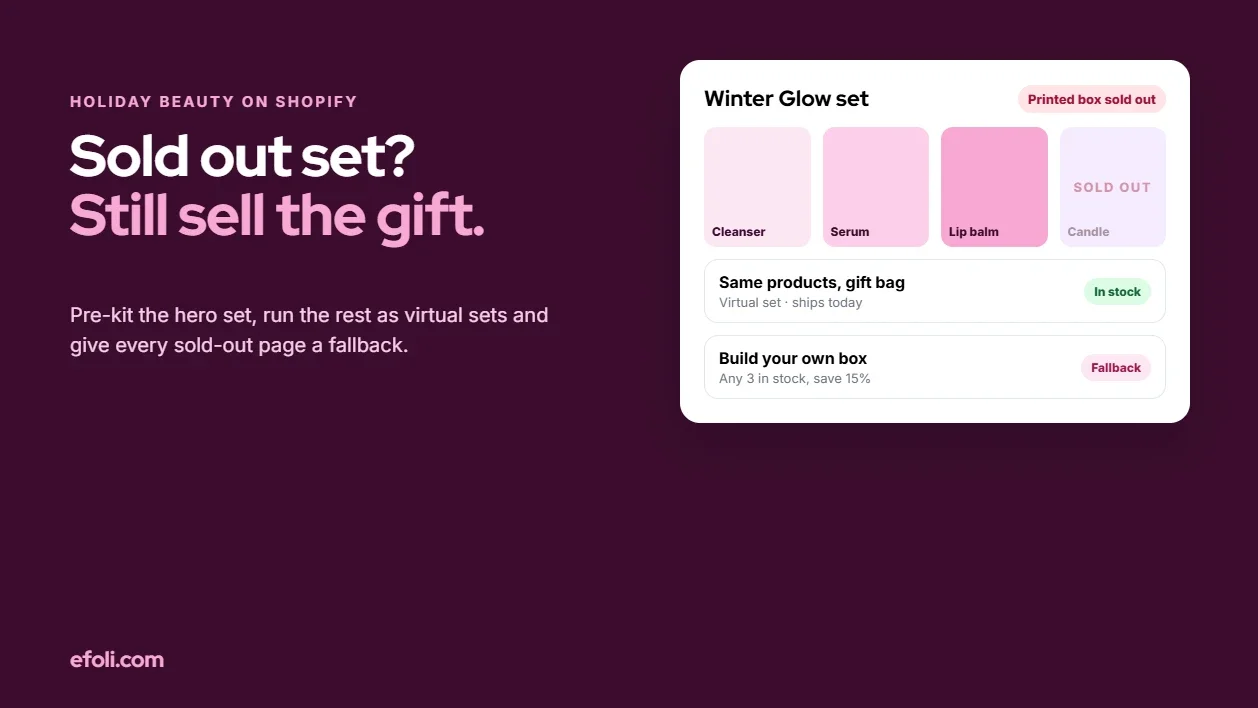
A virtual version of the same set, with the same items in a gift bag rather than the printed box. Say so plainly: "The printed box has sold out. This version has the same products in our holiday gift bag."
A similar set, shown first on the sold-out page: "Winter Glow has sold out. Try Winter Calm, with the same serum and a different cleanser."
A build-your-own gift box, where the buyer chooses three or four items from what's in stock, with a set discount.

Anika's post on what to do when a bundle product is out of stock goes into more detail on swaps and substitutions.
Make virtual sets feel like a gift
The usual worry about virtual sets is the unboxing. If the items arrive loose in a mailer, the set feels like three separate purchases. That's a packing problem, and it's solvable.
Stock gift packaging, not just products. Holiday gift bags, tissue and a printed card cost far less to hold than pre-packed sets, and they don't lock up product.
Flag set orders for the packing team. Make sure set orders are easy to spot on the pick list, so the packer knows to use the gift packaging.
Show the packed set in photos. Photograph the virtual set the way it actually arrives, so the buyer knows what to expect.
Keep the message card in the journey. Ask for the gift message on the set page or in the builder, not only in the cart.
Check the packing slip. Gift orders sent to the recipient shouldn't show prices.
Done well, a virtual set can arrive looking almost as good as a pre-packed one, and it's still available in the second week of December.
Help gift buyers with shades and scents
Make most holiday sets shade-free. Skincare, body care and clear lip products are safer gifts than foundation.
Label scent strength. "Lightly scented" or "fragrance-free" helps buyers choosing for someone else.
Offer one safe default where a set needs a choice, and say why it's a safe default.
Explain exchanges before purchase. If unopened sets can be exchanged, say so on the set page. If opened products can't be returned, say that too, kindly.
Price sets clearly, and claim value carefully
Holiday set marketing leans on two phrases: "worth $X" and "free gift with purchase." Both have rules in many markets.
In the US, the FTC's Guides Against Deceptive Pricing cover both. In summary, a comparison price should be a real price, one the items were actually sold at, by you or by a reasonable number of other sellers for comparable products, and not an inflated figure. A "free" offer tied to a purchase should state its conditions clearly at the outset, and the price of the item the buyer pays for shouldn't be raised to cover the "free" one. Other countries have similar rules. This isn't legal advice, so check with an adviser for the markets you sell in.
In practice:
Base "worth" on what the items really sell for on your own store, as singles, at the time.
Don't include items that aren't sold separately in a "worth" figure, unless you can support the value. The candle in Aisha's set is a good example.
State gift-with-purchase conditions up front: the minimum spend, while stocks last and what happens if the gift runs out.
For the discount side, a Shopify holiday discount app like DiscountRay can run tiers such as "buy two gift sets, save 10%" (free Starter plan), and scheduled offers and customer-tag pricing, such as early access for loyal customers, on Growth ($14 a month), according to its listing. For building a range of sets at different price points, Anika's guide to holiday gift tiers for every budget is a good companion.
Show delivery cutoffs on the set page
Gift buyers need to know when to order. Show the last order date for standard and express delivery on every set page and in the cart, and update it as the dates pass. After the last cutoff, point buyers to digital gift cards or click-and-collect, if you offer them.
Plan January before December
Virtual sets: switch them off after the season. Stock returns to the single products automatically.
Pre-kitted sets: decide in advance whether leftovers are discounted, unbundled back into singles (if the packaging allows), or kept for next year.
Shelf life: in the US, the FDA notes that no law requires cosmetics to carry a shelf life, but products still age. If a set includes products with a short life after opening, don't hold it over for another year.
Returns: be ready for exchange requests in early January, with a clear policy already on the set page.
Syeda's guide to Shopify beauty bundles has more ideas for keeping sets useful outside the holiday season.
Run the season in three phases
Holiday sets don't sell evenly. Treat the season as three phases, each with its own job.
Phase | Roughly when | The job |
|---|---|---|
Launch | Early to mid November | Pre-kitted hero set live, virtual sets live, build-a-box live |
Peak | Black Friday to early December | Watch component stock daily, switch on fallbacks fast |
Last minute | After the standard delivery cutoff | Promote express delivery, gift cards and click-and-collect |
In the peak phase, someone should own a short daily check: which sets are close to selling out, which components are low, and whether any paid ads point to a set that's about to go. Pausing an ad on a sold-out set is one of the quickest wins of the season.
Worked example: Sorrel & Pine Skincare
Sorrel & Pine Skincare is a fictional brand we've made up for this example. It sells cleansers, serums, balms and candles on Shopify, and does a large share of its yearly revenue in November and December.
The problem, as the team saw it
The previous year, Sorrel & Pine kitted 1,200 units across four holiday sets. The hero set sold out on 3 December after a creator post. Two other sets were left over in January and sold at 40% off. Customer service handled hundreds of "when will it be back?" messages, and the team estimated, roughly, that many buyers left without buying anything.
What Sorrel & Pine changed
One pre-kitted hero set. The hero set kept its printed box and was kitted to forecast.
A virtual twin. The same products, in a holiday gift bag, set up as a virtual bundle, ready to switch on if the hero set sold out.
Virtual sets for the rest. Three other sets became virtual bundles, drawing stock from the singles.
A build-your-own box. "Choose any three, save 15%," using products that were in stock.
Stock rules. The best-selling serum was protected for single buyers. If its stock fell below two weeks of expected sales, the sets using it were reviewed.
Honest value lines. "Worth" figures used single prices only. The candle, not sold separately, was described as "a gift from us," not given a value.
Cutoffs and exchanges on every set page. Last order dates and a clear line on exchanges for unopened sets.
What happened
These are illustrative outcomes, not measured results. When the hero set sold out in early December again, the virtual twin went live the same day, and the sold-out page pointed to it. Buyers who arrived from social media still had something to buy. Customer service saw fewer "when will it be back?" messages. In January, the virtual sets were switched off, and the stock went back to being singles, so there was far less to clear.
Merchant checklist: before the holiday sets go live

Choose set types
Decide which sets are pre-kitted and which are virtual.
Prepare a virtual twin for each pre-kitted hero set.
Set up a build-your-own gift box from core products.
Plan stock
Forecast set components, not just sets.
Decide which items are protected for singles and which for sets.
Set a review point for low-stock components.
Fallbacks
Show an alternative on every sold-out set page.
Make sure every item in a virtual set is easy to find as a single.
Test the sold-out page on a phone, because that's where social traffic lands.
Gift buyer help
Keep most sets shade-free.
Label scent strength.
Explain exchange and hygiene return rules on the set page.
Show delivery cutoffs on set pages and in the cart.
Pricing and claims
Base "worth" figures on real single prices.
State gift-with-purchase conditions up front.
Test how set prices combine with sitewide codes.
January
Plan what happens to leftover pre-kitted sets.
Switch off virtual sets after the season.
Prepare for exchange requests.
Habits that leave gift buyers empty-handed
Forecasting sets but not components. The set count tells you what to kit. The component count tells you what you can still sell.
Ads pointing at sold-out sets. Check every live ad's landing page during the peak phase.
"Notify me" as the only option. It's a July answer to a December question.
Hiding the returns rule. The recipient shouldn't discover the hygiene policy after opening the box.
The short version
A holiday gift set shouldn't sell out while its contents sit on the shelf. Pre-kit the hero set for the unboxing, run the rest as virtual sets, split stock between sets and singles on purpose, give every sold-out page a fallback, help gift buyers with shades and scents, keep "worth" and "free" claims honest, and plan January before December. Then Aisha buys her sister the serum, the cleanser and the lip balm in a gift bag, and the brand gets a new customer in the new year.
FAQ
Why does my holiday gift set sell out when the products inside are in stock?
What's the difference between a pre-kitted and a virtual gift set on Shopify?
What should I show when a holiday gift set is sold out?
Can I say a gift set is "worth" a certain amount?
Can customers return opened beauty gift sets?
What should I do with leftover holiday gift sets in January?

Anika Anamta Mehnaz
This article is written by Anika Anamta Mehnaz, a Content Writer and Content Marketing Strategist specializing in Shopify, eCommerce, and SaaS. With over four years of content writing experience, she creates SEO and AI search-optimized content that helps Shopify merchants make better business decisions through practical, research-backed insights. Her work covers Shopify apps, product variants, bundles, discounts, B2B commerce, and conversion-focused strategies. Outside of work, Anika enjoys watching anime, reading John Grisham novels, and discovering new ideas in digital marketing and e-commerce. If you enjoy discussing Shopify, content marketing, or online growth, feel free to connect with her. Twitter: https://x.com/mehnaz2201 Medium: https://medium.com/@mehnaz_78932
Keep reading
View all articles →
MultiVariants or Native Shopify B2B for Hospitality Supply Packs
November 19, 2026 • 17 min read
The Coach Needs 42 Jerseys. Your Store Only Sells One Size at a Time.
November 19, 2026 • 17 min read
One Case Costs More per Bottle Than Two. Why Is the Cart Hiding That?
November 19, 2026 • 17 min read