On this page
- Key takeaways
- How beverage buyers actually compare prices
- Where the buyer gets stuck
- The ladder lives in the cart
- The case price hides the bottle price
- Flavours don't add up
- Ordering four flavours takes four trips
- Alcohol is a different conversation
- Who pays for the friction
- What a clear volume pricing setup looks like
- Decide what counts toward a tier
- Choose a tool that matches the decision
- Show the ladder, with a per-unit price
- Let buyers order every flavour at once
- Give each buyer type its own ladder
- Get the units right
- Make the reorder as clear as the first order
- Keep promotions and tiers apart
- Be careful with mixed cases and bundles
- Worked example: Fernhill Botanical Sodas
- The problem, as the team saw it
- What Fernhill changed
- What happened
- Merchant checklist: fix volume pricing before your next price list
- Habits that make buyers distrust the price
- In Short...
- FAQ
Short answer: Wholesale beverage buyers think in price per bottle, but most Shopify stores show a price per case and reveal volume discounts only after something is in the cart. On top of that, Shopify's native volume pricing applies per variant, so a buyer who orders one case each of four flavours can miss a tier they'd reach if the flavours counted together. To fix wholesale beverage volume pricing on Shopify, show the full price ladder on the product page with a per-bottle figure at each step. Decide whether mixed flavours count toward a tier, and set your pricing tool up to match. Let buyers order every flavour from one form. And if you sell alcohol, check the local rules on quantity discounts before you publish any tier.
Marco runs two cafés and buys sparkling botanical sodas from a small drinks brand's wholesale store on Shopify. Every fortnight he orders a mix: a case of elderflower, a case of rhubarb, a case of ginger and a case of blood orange. Four cases of 24 bottles.
The product page says "$48 per case." Somewhere in the brand's welcome email, there was a mention of "better pricing at volume." Marco has never seen what that means on the site. He adds his four cases, and the cart shows $192. No discount.
Last month, by chance, he ordered two cases of elderflower for an event. The cart quietly dropped the price to $44 a case. Marco did the maths on a napkin: his regular order of four cases costs him $2.00 a bottle, but two cases of one flavour cost $1.83. He emailed the brand to ask why buying more cost him more per bottle. The rep said tiers were per flavour, apologised and offered a one-off credit.
Marco's reaction wasn't "great, a credit." It was "what else am I paying too much for?"
This article is for beverage brands and distributors selling wholesale on Shopify, and the agencies who build their stores. It follows the problem from the buyer's side, maps the friction, looks at what it costs and ends with a checklist.
Key takeaways
Beverage buyers compare price per bottle, can or litre, not price per case.
Volume tiers that only appear in the cart don't change buying behaviour. They just surprise people.
Shopify's native B2B volume pricing applies per variant. If flavours are variants, mixed orders don't combine toward a tier.
Decide on purpose whether mixed flavours count toward a tier, then set up your tools to match and say so on the page.
Let buyers order every flavour from one order form, with case sizes enforced.
Alcohol has its own rules. In Scotland, for example, quantity discounts on alcohol sold to consumers are restricted.
How beverage buyers actually compare prices
A café, bar, deli or office buyer doesn't think "this case is $48." They think "this is $2 a bottle, and I sell it for $4.50." The per-unit price is what they compare across suppliers, what they use to set their own menu prices and what their accountant asks about.
That means three things matter more on a wholesale beverage page than on a retail one:
The price per unit at each quantity. Not only the case price.
The full ladder. What the price is at one case, two to four, and five or more, before adding anything.
What counts toward the ladder. One flavour only, or any mix.
Marco knew none of these from the product page. He learned them from the cart, by accident, and then from a rep.
Where the buyer gets stuck

Moment | What the buyer expects | What the store does | What happens |
|---|---|---|---|
Product page | The price ladder, per bottle | One case price | The buyer can't plan their order |
Choosing flavours | Order all flavours in one go | One product page per flavour, or a dropdown | Ordering takes longer than it should |
Building a mixed case order | Mixed cases count toward volume | Tiers apply per flavour | The buyer misses a tier they think they've reached |
Cart | A clear saving | A price change with no explanation, or none | Confusion and distrust |
Invoice | Matches what they understood | Matches the store's rules | A price dispute |
Reordering | The same deal next time | Prices depend on the exact mix | The buyer splits or delays orders |
The ladder lives in the cart
Many stores set up volume pricing correctly but never show it before the cart. The buyer has to guess, add items, and watch the total change. That rarely leads to a bigger order. It leads to support emails.
The case price hides the bottle price
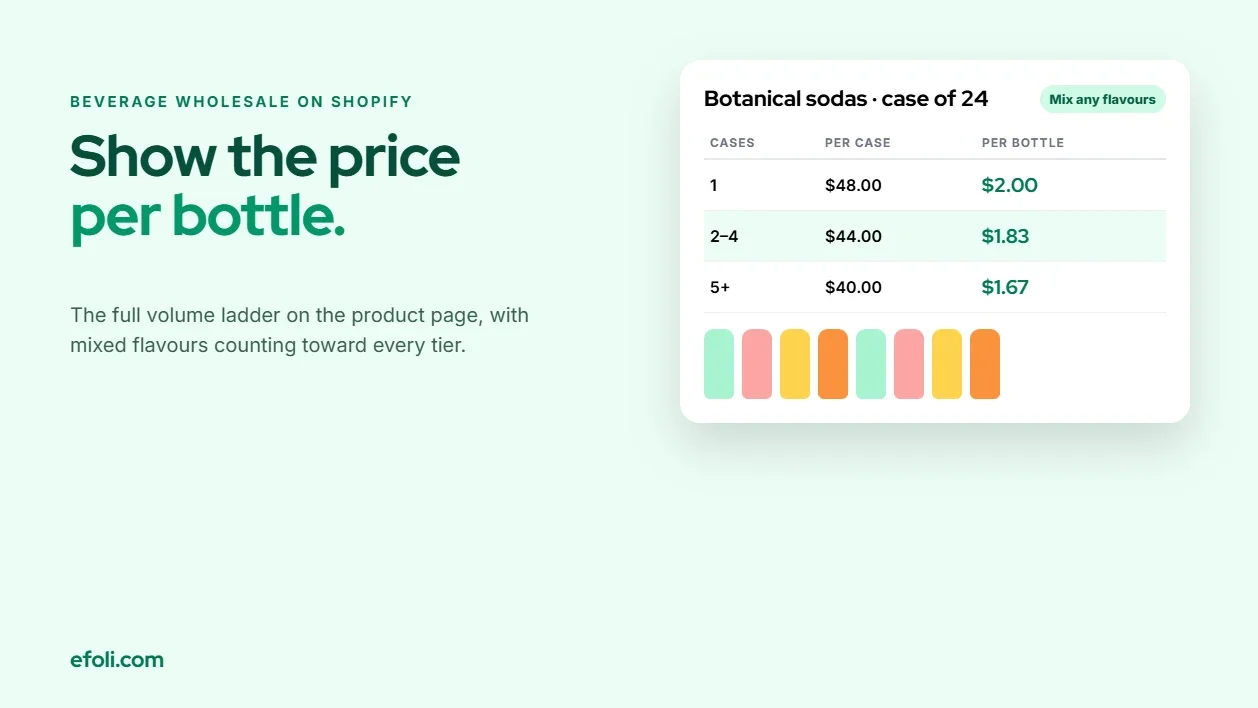
"$48 per case" and "$44 per case" don't look very different. "$2.00 a bottle" and "$1.83 a bottle" do, to a buyer who sells by the bottle. If the store only shows case prices, the saving at each tier is hard to see.
Flavours don't add up
On Shopify B2B, quantity rules and volume pricing are set per variant. You can set up to 10 price breaks per product, and they apply to each variant on its own. So if elderflower, rhubarb, ginger and blood orange are four variants of one product, four single cases are four orders of one case each, as far as the price break is concerned.
That's a reasonable design for many products. For beverage brands, where buyers mix flavours all the time, it often doesn't match how the brand wants to price. The mismatch is the problem. Neither model is wrong.
Shopify's volume pricing also sets a fixed price, so a percentage catalog adjustment doesn't apply on top of a volume price. That's worth knowing if you use catalogs to give some buyers a general discount.
Ordering four flavours takes four trips
If each flavour is a separate product, or a dropdown on one product, the buyer adds them one at a time. For a regular mixed order, that's tedious. It's also where mistakes creep in: three cases of ginger instead of one, or a missed flavour.
Alcohol is a different conversation
If the brand sells beer, cider, wine or spirits, volume discounts aren't just a pricing decision. In Scotland, the Alcohol etc. (Scotland) Act 2010 restricts quantity discounts on alcohol sold from licensed premises for consumption off the premises. Broadly, the price of a multipack must be at least the sum of its parts (two £4 bottles can't sell together for less than £8), and offers like "buy one get one free" or "3 for 2" aren't allowed. Scotland also has a minimum unit price for alcohol, currently 65p per unit.
These rules are aimed at sales to consumers, and how they apply to your trade sales is a question for a licensing adviser. Other places have their own rules too. Many US states, for example, regulate how alcohol wholesalers price and discount. The point is simple: check before you publish a tier on alcohol.
Who pays for the friction
Where it shows up | What it looks like |
|---|---|
Sales and account managers | Explaining tiers, issuing credits, re-quoting by email |
Customer service | Price questions, order edits to fix the mix |
Warehouse | Picking errors on mixed orders, re-packs |
Finance | Invoice disputes, credit notes, delayed payment |
Logistics | Small, frequent orders that cost more to ship |
The buyer | Overpaying, or splitting orders to chase tiers |
The relationship | The buyer stops trusting the online price and orders by phone |
The biggest cost is behavioural. A buyer who doesn't understand the tiers doesn't order more. They either order the same as always, or they game the system by splitting orders in ways that make your logistics worse.
What a clear volume pricing setup looks like
Decide what counts toward a tier
This is a business decision, not a technical one. Ask the brand:
Per flavour. Each flavour has its own ladder. Simple to explain, but punishes mixed orders.
Per product line. All sodas count together, all juices count together. Matches how most buyers order.
Per order. Every case in the order counts. Simple and generous, but can blur margins across lines with very different costs.
Most beverage brands land on "per product line" for mixed orders, with a few exceptions for products with much lower margins.
Choose a tool that matches the decision
If the brand is happy with per-flavour tiers, Shopify's native B2B volume pricing may be enough. If mixed flavours need to count together, you have two broad options:
Restructure the catalog. For example, sell a "mixed case" product with a flavour choice per bottle or per pack. This works for fixed mixed cases but gets complicated for free mixing.
Use a discount app that counts across variants or products. A Shopify volume pricing app like DiscountRay builds quantity tiers and shows the tier table on the product page. According to its listing, the free Starter plan covers tiers and the discount table, Growth ($14 a month) adds customer groups and tag-based targeting and variant-level discounts, and Pro ($29 a month) adds company and customer list pricing. Set the tier to count across the flavours you've chosen, then test a mixed order to confirm it behaves the way you expect.

For a deeper comparison of the two approaches, Syeda's post on Shopify B2B volume pricing vs DiscountRay goes through where each one fits. If your tiers aren't applying the way you planned, Anika's checklist for Shopify tiered discounts not working is the quickest way to find out why.
Show the ladder, with a per-unit price
Put the full ladder on the product page, above or next to the add-to-cart button:
Quantity | Price per case of 24 | Price per bottle |
|---|---|---|
1 case | $48.00 | $2.00 |
2 to 4 cases | $44.00 | $1.83 |
5+ cases | $40.00 | $1.67 |
Then say in one line what counts: "Mix any flavours from the Botanical range. Tiers count all cases in your order."
Shopify also has built-in unit pricing. You enter the total measure of the product (for example 24 × 330 ml) and a base unit (for example 1 litre or 100 ml), and Shopify calculates and displays a price per unit. It shows automatically in Online Store 2.0 themes. Shopify notes that showing a price per unit is a legal requirement in some regions, so it's worth turning on even if you also show a per-bottle figure.
Let buyers order every flavour at once
A wholesale buyer who orders four flavours every fortnight should be able to do it from one screen. A Shopify bulk order form app like MultiVariants shows all flavours in one list or grid with a quantity box for each. Its listing describes list, grid and matrix order forms with B2B catalog pricing on the Standard plan ($12.99 a month), and minimum and maximum rules on variant or total quantity on Professional ($29.99 a month).
That total rule is useful for beverages. You can require a minimum total across all flavours (for example, "at least 4 cases in total") without forcing a minimum on each flavour. You can also use quantity steps so bottles are ordered in full cases. MultiVariants has a post on ordering wholesale juice bottles that walks through the order form setup for a similar range.
Give each buyer type its own ladder
Not every wholesale buyer should see the same tiers. A café ordering four cases a fortnight, a regional distributor ordering pallets and a corporate office ordering for its kitchen all buy differently.
Buyer type | Typical order | What their ladder should reward |
|---|---|---|
Café, bar or deli | A few mixed cases, every week or two | Reaching a slightly bigger regular order |
Office or workplace | A steady monthly order | Consistency, often with a standing order |
Distributor or wholesaler | Pallets or layers of one or two flavours | Full pallets and margin for resale |
Keep the café ladder simple and visible. Distributor pricing is usually negotiated and often kept private, so it's better handled through a customer group, a company price list or a catalog than through a public tier table. Anika's guide to distributor pricing on Shopify covers how to keep those prices separate from your standard wholesale ladder, and her post on Shopify B2B catalog pricing rules helps you decide which rules belong in native catalogs and which in an app.
Get the units right
A lot of price confusion in beverage stores comes from mixed units. One flavour is sold in cases of 24, another in cases of 12, and a third in packs of 6. If the tier table says "2 to 4 cases," the buyer has to work out what a case is for each product.
Use the same pack size across a range where you can, so "case" means the same thing everywhere.
Put the pack size in the variant name. "Elderflower, case of 24 × 330 ml" is clearer than "Elderflower, case."
Base tiers on a unit buyers understand. If pack sizes differ, count bottles or litres, not cases, and show the conversion.
Keep unit pricing consistent. Pick one base unit (per litre or per 100 ml) for the whole range so buyers can compare flavours and sizes fairly.
Make the reorder as clear as the first order
Most beverage wholesale is repeat business. Marco orders the same four flavours every fortnight, give or take a case. The reorder is where clear pricing pays off, because the buyer is comparing this order with the last one.
Show the tier reached on past orders. If the order history and the invoice show "Tier: 2 to 4 cases, $44.00 per case," the buyer can see what changed when a total looks different.
Make the last order easy to repeat. A reorder button, or an order form that remembers the usual flavours, saves the buyer from rebuilding the mix each time.
Nudge toward the next tier, honestly. A line in the cart such as "Add 1 more case to reach $40.00 per case" works because it's useful, not because it's pushy. Only show it when the next tier is close.
Plan for seasonal swings. Cafés order more in summer and less in winter. If a buyer drops below a tier for a few months, decide whether they keep their usual price or move down the ladder, and tell them which.
Keep promotions and tiers apart
A summer promotion of 10% off sitewide, on top of a volume tier, can push a wholesale price below cost. Decide which discounts can combine, and keep a simple rule: wholesale tiers don't stack with retail promotions unless you've worked out the margin. Anika's post on Shopify volume discount challenges covers the common ways tiers and promotions collide.
Be careful with mixed cases and bundles
If you sell a pre-packed mixed case (six of each flavour, for example), treat it as its own product with its own ladder. Don't let it count twice, once as a bundle discount and once as a volume tier. Mehedi's post on bundle discounts for wholesale juice bottles covers how to price mixed packs without double discounting.
Worked example: Fernhill Botanical Sodas
Fernhill Botanical Sodas is a fictional drinks brand we've made up for this example. It sells four non-alcoholic sodas in 330 ml bottles, in cases of 24, to cafés, delis and offices through a Shopify B2B store.
The problem, as the team saw it
Fernhill had set up native volume pricing per flavour: $48 for one case, $44 for two to four, $40 for five or more. Most buyers ordered a mix, so most never reached a tier. The ladder only appeared in the cart. Account managers spent part of every week explaining the tiers and issuing credits.
What Fernhill changed
One decision. Tiers would count all cases of soda in the order, regardless of flavour.
A tier table on every product page. Case price and per-bottle price at each step, with the "mix any flavours" line underneath.
Unit pricing on. Every product showed a price per litre as well.
One order form. All four flavours in a single list, with a minimum of four cases in total and quantities in full cases only.
Promotions separated. Retail promotions were excluded from wholesale customers.
A note for alcohol. When Fernhill planned a hard seltzer, the team flagged it for a licensing check before setting any tier.
What happened
These are illustrative outcomes, not measured results. Buyers like Marco could see their per-bottle price before ordering. Mixed orders of four or five cases became the norm, and the account managers stopped issuing credits for tier confusion. The warehouse saw fewer mispicks because the order form showed every flavour in one place. The team also noticed some buyers moving from four cases to five to reach the top tier, because they could finally see it.
Merchant checklist: fix volume pricing before your next price list

Decide the rules
Decide whether tiers count per flavour, per product line or per order.
Decide which customers get which ladder (all wholesale, or by group).
Decide which promotions can combine with tiers.
Check alcohol rules for every market you sell alcohol into.
Set up the tools
Use native volume pricing if per-flavour tiers are what you want.
Use a discount app that counts across variants if mixed flavours should count together.
Test a mixed order at, below and above each tier.
Test a promotion code alongside a tier.
Show the price
Put the full tier table on the product page.
Show price per bottle, can or litre at each step.
Turn on Shopify unit pricing.
Say in one line what counts toward a tier.
Make ordering easy
Show all flavours on one order form.
Set a minimum on total quantity if that's your rule, not on each flavour.
Use quantity steps so buyers order full cases.
Price pre-packed mixed cases as their own product.
Check the paperwork
Make sure the invoice shows the tier applied.
Train account managers on the rules, so they explain the same thing the page does.
Habits that make buyers distrust the price
Tiers announced in emails but not on the site. If the welcome email mentions "better pricing at volume," the product page should show it.
Credits instead of fixes. A one-off credit solves one order. Fixing the rule solves every order after it.
Different answers from different people. If two account managers explain tiers differently, the buyer believes neither.
Price changes without notice. When you update a ladder, tell wholesale buyers before their next order, not on the invoice.
In Short...
Beverage buyers count bottles, not cases, and they mix flavours. If your store hides the tier table until the cart, shows only case prices and counts each flavour on its own, buyers like Marco end up paying more per bottle for buying more. Decide what counts toward a tier, set your tools up to match, show the full ladder with a per-bottle price, let buyers order every flavour from one form, and check the rules before you discount alcohol. Then the cart stops hiding the deal, and Marco stops doing maths on napkins.
FAQ
How do I show volume pricing for wholesale drinks on Shopify?
Does Shopify volume pricing combine different flavours toward one tier?
How do I show a price per bottle or per litre on Shopify?
Can I set a minimum order across all flavours?
Can I offer quantity discounts on alcohol?
Should wholesale volume tiers stack with other promotions?

Anika Anamta Mehnaz
This article is written by Anika Anamta Mehnaz, a Content Writer and Content Marketing Strategist specializing in Shopify, eCommerce, and SaaS. With over four years of content writing experience, she creates SEO and AI search-optimized content that helps Shopify merchants make better business decisions through practical, research-backed insights. Her work covers Shopify apps, product variants, bundles, discounts, B2B commerce, and conversion-focused strategies. Outside of work, Anika enjoys watching anime, reading John Grisham novels, and discovering new ideas in digital marketing and e-commerce. If you enjoy discussing Shopify, content marketing, or online growth, feel free to connect with her. Twitter: https://x.com/mehnaz2201 Medium: https://medium.com/@mehnaz_78932
Keep reading
View all articles →
The Perfect Gift Set Is Sold Out. Three Ingredients Are Still in Stock.
November 19, 2026 • 17 min read
MultiVariants or Native Shopify B2B for Hospitality Supply Packs
November 19, 2026 • 17 min read
The Coach Needs 42 Jerseys. Your Store Only Sells One Size at a Time.
November 19, 2026 • 17 min read