22 Shopify Experts on 7 Most Expensive Q4 Mistakes (How to Avoid These)
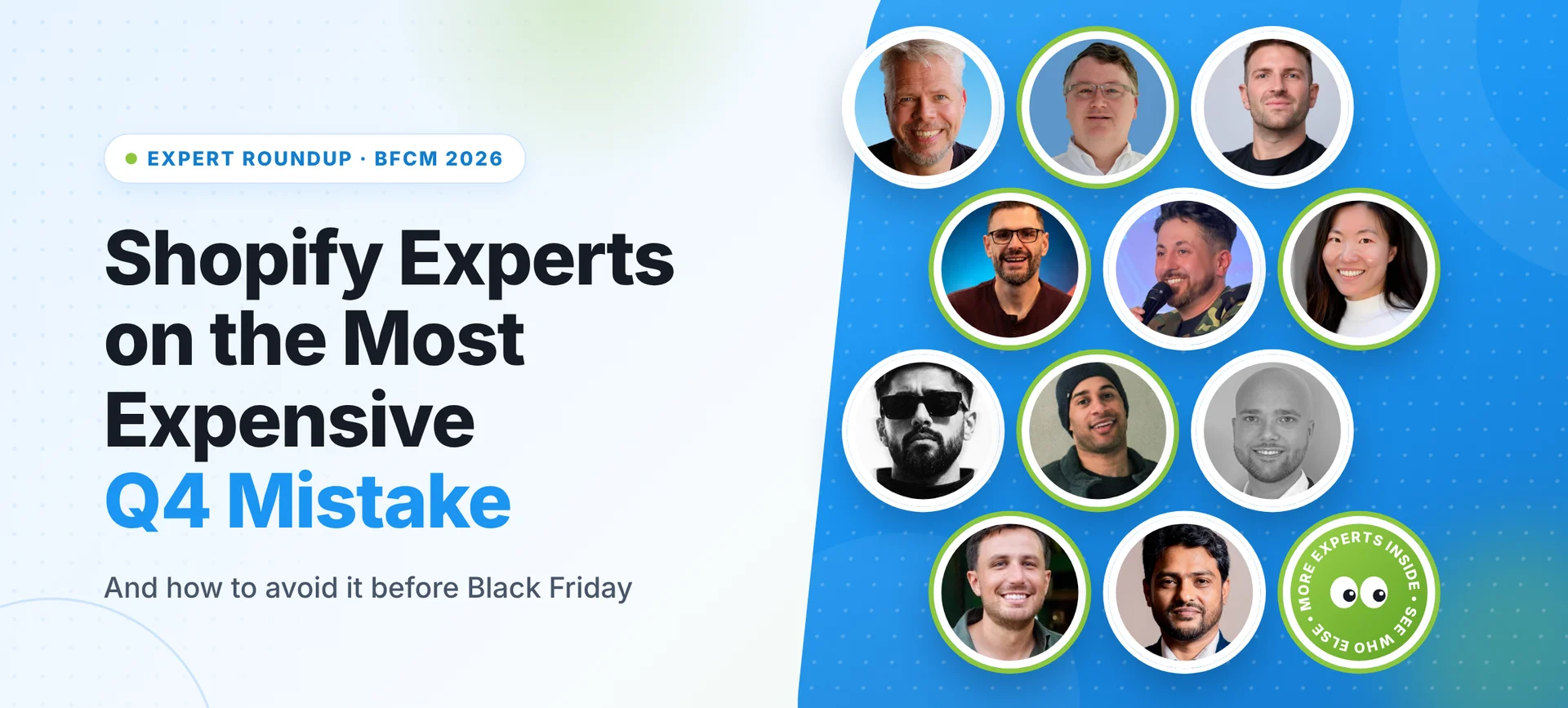
We asked 22 Shopify agency founders, app builders and ecommerce strategists one question: what's the most expensive Q4 mistake you'd stop brands from making? Their answers point to seven costly habits, and every one can still be fixed before Black Friday.
On this page
- How We Put This Together
- Mistake #1: Discounting Without Doing The Margin Math
- Mistake #2: Scaling Ad Spend on Broken Tracking
- Mistake #3: Giving Everyone The Same Discount
- Mistake #4: Changing Your Store in November
- Mistake #5: Guessing Instead of Testing
- Mistake #6: Letting Shoppers Leave Without Answers
- Mistake #7: Forgetting the customer after Black Friday
- Your Q4 Checklist
- FAQ
- The Bottom Line
Black Friday is less than four weeks away. You've probably got a discount planned, ads lined up and a to-do list that keeps getting longer.
Before you add anything else to it, read what the people who build, fix and market Shopify stores every day told us. We asked 22 of them one question:
"If you could stop ecommerce brands from making one expensive Q4 mistake, what would it be?"
Nobody told you to work harder. Almost everyone told you to stop doing something. Here's what they said, what we think, and what you can still do about it this month.
What is the most expensive Q4 mistake for ecommerce brands? The most recurring concern from 22 Shopify experts is discounting without checking what's left in margin. Close behind: changing your store's tech stack in November, scaling ads on broken tracking, waiting too long to test offers, and treating BFCM buyers like everyone else once the sale ends.
TL;DR
Do the margin math first. Price every offer after product costs, shipping, fees, returns and ad costs.
Don't give everyone the same discount. Bundles, gift options and targeted offers beat a blanket percentage.
Freeze your store. No new apps, theme changes or integrations in November.
Check your tracking before you scale ads. Bad data means buying unprofitable revenue at the year's highest ad prices.
Test early and decide on data, not on last year's assumptions.
Don't let paid traffic leak. Answer pre-sale questions and follow up on abandoned carts.
Plan for after Black Friday. Deal buyers need their own post-purchase journey.
How We Put This Together
In late October 2026, we asked Shopify agency founders, app builders, ad specialists and ecommerce consultants the same single question. 22 answered. We grouped their answers into seven themes, trimmed some for length without changing their meaning, and added our own view after each theme. Each expert's title, company and links are in their quote box.
Mistake #1: Discounting Without Doing The Margin Math
Short Answer: A big Black Friday discount can bring in record revenue and still lose you money. Before you set your offer, work out what's left after product costs, shipping, payment fees, returns and the ad spend it takes to win each order.

Check how your discounts combine before Black Friday, not after.
A sitewide 25% off, a free shipping threshold, and a forgotten welcome code can all stack at checkout, and suddenly you're paying customers to take your best sellers. Place a test order with every live code and make sure the math still leaves you a margin.

The biggest Q4 mistake is offering deep Black Friday discounts without calculating the impact on profit margins.
Add rising ad costs, shipping, and returns, and you can end up selling more while making less money.

The most expensive Q4 mistake is treating projected customer lifetime value as cash already in the bank.
Before scaling a discounted offer, calculate what remains after product costs, fulfilment, fees, expected returns and acquisition, then check how many customers actually repeat and their monetization lag, the time between the first and second purchase. The aim is to finish Q4 with profit and cash to operate in January.
eFoli's Take: Revenue is the number everyone screenshots on Cyber Monday. Profit is the number that pays for January. Pete's point is the one most merchants miss: if your offer only makes sense because customers will "come back later," you're betting your Q4 cash on a guess. Do the math per product, not per store, because your best sellers and your slow movers can't take the same discount. And do Kurt's test this week. Put every live code through checkout. Stacking mistakes don't show up in your plan, they show up in your margin.
Do This Before BFCM:
Calculate the margin left on your top 10 products at your planned discount.
List every active discount code and automatic discount, and switch off the ones you've forgotten.
Place a test order combining your sale price, free shipping and each live code.
Mistake #2: Scaling Ad Spend on Broken Tracking
Short Answer: If your conversion tracking is wrong, your ROAS numbers are wrong, and you'll pour budget into campaigns that only look profitable. Check that every purchase is tracked correctly before you raise budgets for Black Friday.

The biggest Q4 mistake is scaling ad spend before checking your tracking.
A great BFCM discount brings traffic, but most visitors leave without buying. If your tracking loses them, abandonment emails don't fire and ad platforms miss valuable signals. Installing a pixel doesn't mean everything works: landing pages, popups, and express checkouts can all create gaps. Test the full journey before increasing budgets.

The most expensive Q4 mistake is scaling ad spend into Black Friday without first checking that conversion tracking and profit margins are accurate.
Brands double budgets on campaigns that look like they hit their ROAS target, but with bad tracking or discounts eating into margin, they end up buying unprofitable revenue at the highest CPMs of the year. Spend the first two weeks of November checking that every purchase is being tracked, then scale only the campaigns that are profitable after discounts and shipping.
eFoli's Take: Notice that Jeff ties tracking back to Mistake #1. A campaign can hit its ROAS target and still lose money once the discount and shipping are taken out. So check two things: is every order being recorded, and is the target you're measuring against based on profit, not revenue? Yiqi's point about express checkouts and popups matters too. Those are exactly the places where new BFCM traffic goes, and exactly where tracking quietly breaks.
Do This Before BFCM:
Place test orders through normal checkout and each express checkout option, and confirm they show up in your ad platforms.
Recalculate your ROAS target using your BFCM discount and shipping costs.
Check that abandoned cart emails fire for visitors who arrive through popups and landing pages.
Mistake #3: Giving Everyone The Same Discount
Short Answer: A sitewide percentage off is easy for competitors to match and trains customers to wait for sales. Experts recommend building a better offer instead: BFCM bundles, gift options, and targeted rewards for the customers you most want to win or keep.

Mass discounting may drive short-term sales, but it also conditions customers to wait for the next sale, making future marketing more expensive and full-price conversions harder.
When everyone gets 30% off, you're not rewarding loyalty or influencing buying behavior; you're simply reducing margins, often on purchases that would have happened anyway. I believe in personalized incentives based on customer behavior, purchase history, and intent, giving people a reason to buy without publicly devaluing the product. The goal is to protect perceived value while making every offer feel earned, relevant, and personal.

The most expensive Q4 mistake I see is treating the discount as the entire offer.
A blanket percentage off is easy for competitors to match, and more orders don't necessarily mean more profit once you account for the margin you gave away. Start with what helps your customer buy: a thoughtful gifting bundle, an easy-to-find gift card for someone unsure what to choose, or a targeted offer that gives returning customers a reason to come back. Then test the full buying experience, especially how bundles and discounts behave in the cart and checkout, so customers actually get what you promised.
Not everyone thinks the answer is smaller discounts, though.

Stop being a scrooge in terms of promotions.
10% or 15% off is not going to motivate anyone. Also, be creative with bonus offers. It's about value. Giving away a free Widget X that's worth $25 but costs you much less, could be more effective than free shipping.
Read Mark's quote closely and he's on the same side as Ash and Taylor. A weak discount won't move anyone, but the fix isn't always a bigger percentage. It's a better offer. A free gift that's worth a lot to the customer and costs you little does more than another 5% off.

If I could stop ecommerce brands from making one expensive Q4 mistake, it would be discounting too aggressively just to chase revenue.
Q4 can create huge sales numbers, but revenue without healthy margin is not always growth. Blanket discounts can hurt profitability, train customers to wait for the next sale, and reduce the value of your brand. The smarter approach is to be more intentional: reward the right customers, bundle products, increase AOV, and use targeted offers instead of giving the same discount to everyone. The goal should not just be to win Q4 sales, but to turn those buyers into customers who come back after Q4.
eFoli's Take: Your offer doesn't have to be the biggest number on the internet. It has to be the most useful one for your customer. Bundles are a good example: a "gift set" raises your average order value, moves slower stock alongside your best sellers, and is much harder for a competitor to copy than "30% off." Just do what Taylor says and test it in the cart before launch. A bundle that shows the wrong price at checkout costs you more than it earns.
Do This Before BFCM:
Build one or two gift bundles around your best sellers.
Create a separate offer for returning customers instead of giving them the same public code.
Test every bundle and offer through cart and checkout on mobile.
Mistake #4: Changing Your Store in November
Short Answer: New apps, theme updates and integration changes are the most common cause of BFCM breakdowns. Lock your store's tech stack weeks before Black Friday, fix known issues before the freeze, and save new features for January.

Touching the stack inside Q4.
Replatforming, rewiring an ERP integration, swapping a checkout or a search app, any of it. We've run more than 380 Shopify migrations at Uncap, and the costliest ones were never the complex ones. They were the ones that started in October. During peak, your store and your ERP have to agree on every price, every inventory count, and every order, and every change you make is a bet against your busiest six weeks. Freeze the stack six weeks before Black Friday, close the integration gaps before the freeze, and spend Q4 selling. January is cheap. November is not.

Stop changing your store in November.
Every year I see brands install a new app, push a theme update or tweak checkout two weeks before Black Friday, then spend their biggest sales week firefighting instead of selling. Lock your tech stack by the end of October and put November's energy into offers and creative, not code.

I would say just wait out on changing anything on your store right now.
With multiple security incidents and with many vulnerabilities found on Shopify apps. Do not introduce anything new to your app stack and do not build new functionalities. Tighten up your store's security, prepare for the worst case scenario and be very, very cautious this BFCM.
eFoli's Take: As an app company, this might sound strange coming from us, but we agree completely. The best time to install a new app is when you have time to test it, not two weeks before your biggest weekend. If you're reading this in November and you haven't frozen your store yet, freeze it today. If something new is truly essential, test it on a duplicate theme, check it on a real phone, and have a rollback plan.
Do This Before BFCM:
Set a freeze date and tell your team and agency.
Remove apps you no longer use, and review which apps have access to your store data.
Run a full test order on mobile and desktop after the freeze.
Mistake #5: Guessing Instead of Testing
Short Answer: Last year's results and industry trends aren't a plan. Use your own data and the weeks before Black Friday to test offers, landing pages and ads, so you scale what's proven instead of hoping your big-day offer works.

The biggest Q4 mistake is making decisions based on assumptions rather than data.
Too many brands rely on last year's performance or industry-wide trends instead of analysing their own customer behaviour, product performance, inventory, conversion rates and margins. My advice is to use real data to identify where demand is coming from, which products and channels are driving profitable growth, and where to allocate budget as conditions change.

The biggest mistake we normally see brands make is not testing enough in early Q4.
It's the perfect time to test offers, landing pages, different promotions, etc. to find out what converts the best before the spike. A lot of brands wait until the week of BFCM and the offer they decide to run doesn't work, leaving a lot of revenue on the table. Test early and find out what works before the main event.

Don't stop your evergreen ads…
You've spent all year figuring out angles and personas and those will still do the majority of the heavy lifting in Q4 to make people aware of your brand and offer. Then people click your ads and get excited to see the BFCM deals you're running on the site and are more likely to buy. It's like going to the store to buy something and finding out it's on sale.
Waiting too long to start building 'top of mind' in the minds of established customers and potential new customers.
Do not assume they know you and that your store is a great place to shop for the holidays.
eFoli's Take: There's still time, but not much. You have roughly three weeks to learn something before Black Friday. Use them. Run two versions of your offer to your email list, see which one gets more clicks, and go into BFCM with the winner. Alex Stiehl's point is the quiet one worth remembering: the ads and messages that worked all year don't stop working in November. Keep them running, and let the sale be the pleasant surprise when shoppers land on your site.
Do this before BFCM:
Pull last 90 days of data: top products by profit, top channels, and conversion rate by device.
Test two offers or two landing pages this week.
Keep your best-performing evergreen ads live alongside your sale ads.
Mistake #6: Letting Shoppers Leave Without Answers
Short Answer: During BFCM you pay more than ever for every visitor. When shoppers have a question you don't answer, or leave a full cart with no real follow-up, that spend is wasted. Make it easy to get answers and recover abandoned carts, and be ready for shoppers arriving through AI tools.

It'd be to not have an AI Agent ready to answer all their customer pre-sale questions on the PDPs.
During Q4/BFCM most people are bombed with ads, promos, one time deals, etc. They get to your product page, have some 'doubts' that only a reassuring conversation can convert. If they don't get those reassurances, they'll close the shop and buy somewhere else.

The most expensive Q4 mistake is spending heavily to buy new traffic while letting the shoppers already in your store walk away.
Cart abandonment spikes in Q4, and most brands only follow up with a generic email that gets buried in a crowded inbox. A timely, personal text conversation recovers revenue you've already paid to earn, at a fraction of the cost of a new click.

The most expensive mistake brands are making today is blocking agentic commerce agents.
It's early and this is the best time to collect data on the pros and cons, then you can make a more informed decision in 2027.

Postponing the setup of a program to handle LLM bots (assuming it's just a small share of traffic).
eFoli's Take: Every question a shopper can't answer on your product page is a reason to leave: Will it arrive before the holidays? Does it fit? Can I return it? Start with the basics. Put shipping cut-off dates, sizing and your return policy right on the product page, and make sure your abandoned cart follow-up is more than one generic email. Scot and Taras are pointing at something newer: more shoppers now find products through AI assistants. You don't need a full strategy by Black Friday, but don't block that traffic by default before you know what it's worth.
Do This Before BFCM:
Add holiday shipping cut-off dates and return policy to your product pages.
Review your abandoned cart flow and add a second, more personal touchpoint.
Check whether your store or apps are blocking AI shopping agents and crawlers.
Mistake #7: Forgetting the customer after Black Friday
Short answer: BFCM buyers aren't worse customers, but they need different treatment. Give deal buyers their own post-purchase journey that shows why your product is worth full price, instead of sending them the next coupon.

The most expensive Q4 mistake happens after Black Friday, when brands treat their BFCM deal buyers like any other customer.
If you just serve them the next coupon, they learn to do one thing: wait for the next sale. Yet, these buyers aren't worse by default. For 2 out of 3 of the brands we analyzed that ran the playbook correctly, the November cohort even had a higher 365-day repurchase rate than the average months' cohorts. So give them their own post-purchase experience that shows specifically why the product is worth full price. Q4 should be about getting your product into the hands of more customers, not just cheaper ones.

Q4 is not a season of acquisition, it is a season of retention and expansion.
The CACs are too high and you will most likely acquire discount and deal hunters. Zoronto focuses on reactivating the inactive subscribers, testing offers in October to improve AOV and repeat purchases.

I'd stop brands from doing two things: First would be going into BFCM without having a post-purchase plan for these customers.
These customers are clearly incentivized by deals/discounts/rewards, so they could be a good candidate to join a referral program and bring you additional customers from their friends and family circles. The 2nd thing I'd stop them from doing is planning their BFCM discounts without checking how they interact with their referral offers. I've seen brands give referred customers 20% off while having a 40% sale on its website! Of course customers abandoned the referral code and the program appeared to stop working.
Focusing too much on one-time seasonal sales offers and treating email/SMS capture programs as less important (usually because they aren't measured correctly).
Collecting discount hunters without a clear, predictable strategy for turning them into loyal buyers.
eFoli's Take: Jeffrey's numbers should change how you think about Black Friday. Deal buyers can become your best customers, but only if the weeks after their first order give them a reason to stay. Build that journey now, while you still have time: a thank-you that explains the product, a how-to-get-the-most-from-it email, and a second-order offer that isn't another discount. And do Raul's quick check. If your referral reward is smaller than your public sale, nobody will use it.
Do This Before BFCM:
Write a separate post-purchase email flow for first-time BFCM buyers.
Compare your referral and loyalty rewards against your BFCM discount.
Plan a full-price reason to return in December or January, such as a new product, a guide or early access.
Your Q4 Checklist
If you only have an hour this week, do these five things:
Work out your real margin on your top products at your planned discount.
Put every live discount code through a test checkout.
Set a freeze date for your theme, apps and integrations.
Confirm every order is tracked, including express checkouts.
Write the first email your BFCM buyers will get after their order.
FAQ
What is the biggest Q4 mistake ecommerce brands make?
Should I make Shopify store changes in November?
How much should I discount for Black Friday?
How do I prevent Shopify discounts from stacking during BFCM?
When should I start preparing for BFCM?
How do I keep Black Friday customers coming back?
The Bottom Line
You don't need a bigger discount or a new app to win this Q4. You need an offer you've done the math on, a store you've stopped changing, tracking you trust, and a plan for the customers you win. Pick one mistake from this list, fix it this week, and go into Black Friday knowing your numbers.

Syeda Rehnoma Tanzom
This article is written by Syeda Rehnoma Tanzom, an SEO content writer with 3+ years of experience specializing in eCommerce content. What makes the work here a little different? A close collaboration with support teams to understand what merchants are actually going through, their frustrations, their questions, and their wins. The goal is simple: write content that speaks to real problems, not just search engines. When not buried in keywords and content briefs, you'll find her nose-deep in a good book, binge-watching true crime documentaries or psychological thrillers, and occasionally switching gears with a feel-good rom-com.
Keep reading
View all articles →
Best Shopify Apps for Q4 2026: From Holiday Prep to Q1 Retention
September 21, 2026 • 29 min read

Shopify Personalized Discounts: A BFCM Segmentation Framework
October 26, 2026 • 15 min read
How to Build Shopify BFCM Wholesale Strategy: Survive Bulk Order Spike
October 19, 2026 • 14 min read