How to Build Retail and Wholesale Pricing Without Splitting the Store
A boutique buys 100 pieces, a shopper buys one, and both use your store. A playbook for fashion brands running retail and wholesale pricing on one Shopify store without channel conflict.
On this page
- Key takeaways
- Two buyers, one dress
- Step 1: Build the price ladder
- Step 2: Decide who sees what
- Step 3: Set opening and reorder minimums
- Step 4: Stop retail promotions leaking into trade orders
- Step 5: Plan your sales with your stockists, not against them
- Step 6: Handle tax, terms and shipping for trade
- Step 7: Review the ladder every season
- Step 8: Bring stockists onto the single store gently
- International stockists: one ladder, several currencies
- Common mistakes in one-store pricing
- A 16-point QA checklist for one-store pricing
- Agency notes: questions that change the scope
- What one store gave Linden & Rye
- FAQ
Short answer: A fashion brand can run retail and wholesale pricing on one Shopify store if three things are true. First, every product has a clear price ladder from cost to wholesale to retail. Second, each audience only ever sees its own price, with retail shoppers seeing the full retail price and signed-in boutiques seeing wholesale. Third, consumer promotions can't leak into trade orders or undercut your stockists. On Shopify, B2B catalogs or a pricing app handle the second-tier price, minimums and quantity rules handle opening and reorder orders, and discount eligibility settings stop retail codes applying to wholesale carts. The hard part isn't the software. It's agreeing a price ladder and a sale calendar your boutiques can live with.
Key takeaways
Build the price ladder first: cost, wholesale and retail for every style, with the margin at each step written down.
Many fashion brands set wholesale at about half of retail, known as keystone, but your own costs decide what works.
Retail shoppers should never see wholesale prices, and boutiques should see wholesale as soon as they sign in.
Opening orders and reorders usually need different minimums.
Consumer discount codes can apply on top of B2B catalog prices on Shopify. Limit their eligibility.
Your own DTC sales are the biggest source of channel conflict. Plan them with your stockists, not against them.
Two buyers, one dress
Linden & Rye is a fictional womenswear label. It sells online direct to consumers and to about 70 independent boutiques. For three years it ran two Shopify stores: one for retail, one for wholesale. Products, images and stock were copied between them by hand. Every new season meant building the collection twice, and stock was regularly sold twice because the stores didn't share inventory.
The founder wants one store. The wholesale manager is nervous. "What stops a shopper seeing our wholesale prices? What stops a boutique using the 20% welcome code on top of wholesale? And what happens to the boutiques when we run our summer sale?"
They're the right questions, and they're the same ones most fashion brands ask when they try to bring retail and wholesale together. None of them is solved by a single setting. Each needs a small decision, written down, and then a setting to enforce it. This playbook answers them in the order you'll meet them.
Step 1: Build the price ladder
Before touching Shopify, write down three prices for every style: cost, wholesale and retail. Fashion has a common starting point for the relationship between them.
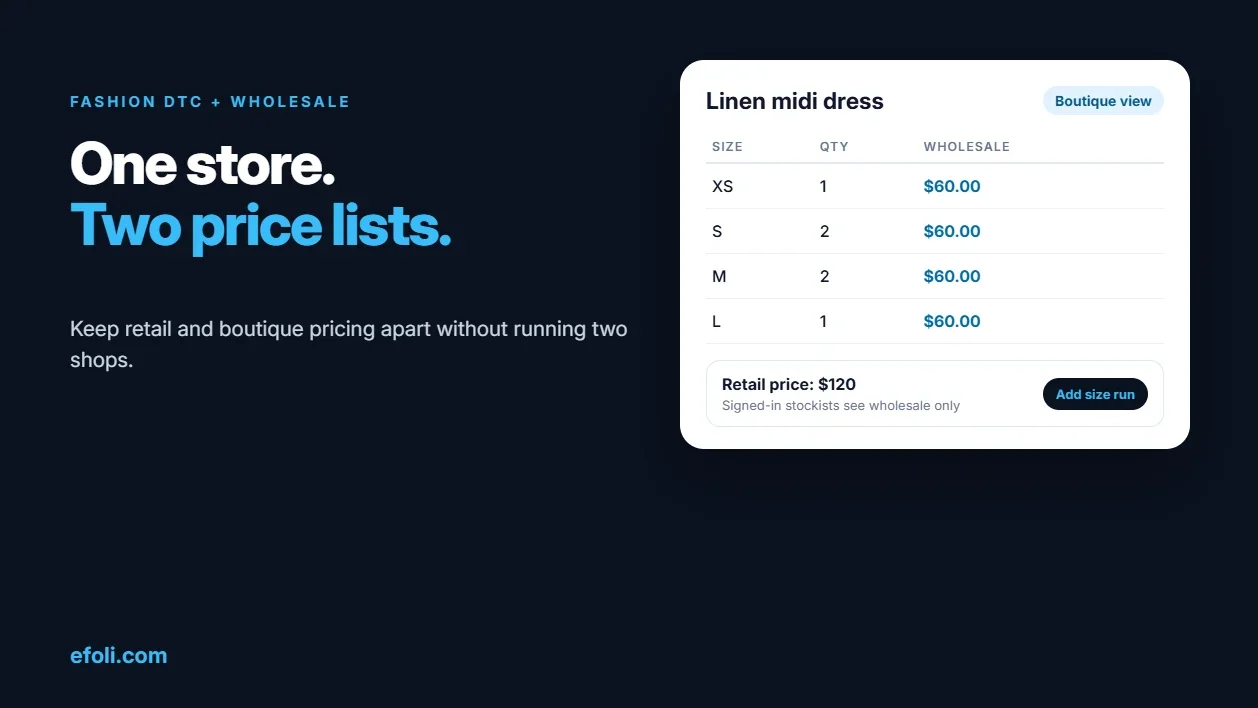
Keystone pricing. Many boutiques expect to double the wholesale price to set retail. In industry shorthand, that's a keystone markup, which gives the boutique a 50% margin on the retail price. So if your recommended retail price is $120, wholesale is $60.
From the brand's side, wholesale then needs to cover your cost plus your margin. A common rule of thumb in apparel is that wholesale should be at least twice the landed cost, but it varies widely by brand, category and volume.
Style | Landed cost | Wholesale | Retail (RRP) | Brand margin on wholesale | Boutique margin on retail |
|---|---|---|---|---|---|
Linen midi dress | $26 | $60 | $120 | 57% | 50% |
Cotton shirt | $15 | $35 | $70 | 57% | 50% |
Wool coat | $78 | $165 | $340 | 53% | 51% |
Knit scarf | $8 | $22 | $45 | 64% | 51% |
Illustrative prices for a fictional brand.
Three rules keep the ladder healthy:
Retail is the anchor. Set the retail price first, based on what your customer will pay. Then check wholesale and cost work beneath it. If they don't, change the cost (materials, factory, quantities) or drop the style from wholesale.
Round sensibly. Boutiques like clean numbers. $60 wholesale and $120 retail is easier to sell than $58.40 and $119.
Write the ladder down before the season. Boutiques buy from line sheets weeks or months ahead. Once a wholesale price is on a line sheet, changing it is a negotiation. Anika's guide to building a Shopify line sheet covers how to present it.
When keystone doesn't fit. Keystone is a habit, not a law. Some categories carry higher retail markups, often called "keystone plus", because boutiques face more markdowns or higher costs. Others, such as high-value outerwear, sometimes run below keystone because the retail price would otherwise look out of line. If a style can't support a sensible wholesale price at keystone, you have three honest options: raise retail, cut cost, or sell the style DTC-only. Quietly offering a thinner boutique margin on a few styles usually backfires, because buyers compare margins across the line sheet.

The price ladder for four styles: landed cost, wholesale at about half of retail, and retail.
Step 2: Decide who sees what
On one store, the most important rule is that each audience sees only its own price.
Visitor | What they should see | How |
|---|---|---|
Retail shopper, not signed in | Retail price; add to cart | Default store pricing |
Retail shopper, signed in | Retail price; their loyalty or member offers | Customer account; consumer discounts |
Boutique, not signed in | Retail price plus "Stockist? Sign in for trade prices" | A small banner or link |
Boutique, signed in | Wholesale price; minimums; trade-only styles | B2B catalog or pricing app |
Prospective stockist | Retail price and a "Become a stockist" form | Application form, approval, then account |
On Shopify, you have two main ways to show boutiques their wholesale price.
Shopify B2B catalogs. Available on the Basic, Grow, Advanced and Plus plans. You create a company for each boutique and assign a catalog that lowers prices by a percentage or sets fixed prices. Fixed prices override the percentage adjustment, which is useful for the odd style that doesn't follow keystone. Below Plus, you can have up to three active catalog assignments across your B2B markets, which is usually enough for "Standard", "Key account" and "International" price groups.
A pricing app. DiscountRay, a Shopify wholesale pricing app, shows prices by customer group or tag on its Growth plan ($14 a month) and by company or customer list on Pro ($29 a month). Brands that aren't ready to set up companies, or that need more price groups than the catalog limit allows, often start here.

Trade prices shown on collection pages, so signed-in boutiques see their price before opening each product. Source: DiscountRay App Store listing.
Trade-only styles. Some styles are only for boutiques, such as exclusive colourways, or only for DTC, such as online exclusives. With B2B catalogs, you can include or leave out products per catalog. For DTC-only styles, make sure they aren't published to the B2B catalog; for trade-only styles, keep them off your retail channels.
If you're still deciding between native catalogs and an app, the eFoli post on Shopify B2B catalog pricing rules walks through how to sort your price rules first. We won't repeat that here.
Step 3: Set opening and reorder minimums
Boutiques buy in two very different ways.
Opening orders come once or twice a season, often from a line sheet or showroom. They're bigger, spread across many styles and come with a size run per style.
Reorders come during the season, when something sells. They're smaller, focused on a few styles and urgent.
One minimum for both doesn't work. A $1,000 minimum makes sense for an opening order but blocks a $300 reorder of the best-selling dress. Linden & Rye uses:
Order type | Minimum | Per-style rule | Why |
|---|---|---|---|
Opening order | $1,000 | At least one full size run per style | Makes the collection look complete in store |
Reorder | $250 | Any quantity, whole units | Keeps best-sellers on the rail |
New stockist first order | $750 | At least one full size run per style | Lower barrier for a trial |
Size runs deserve their own process. If boutiques order a size run per style, a matrix or grid that shows every size and colour with quantity boxes is much faster than adding each size one by one. MultiVariants, a Shopify bulk order form app, shows variants as a list, grid or matrix with quantity inputs (grid and matrix are on Standard, $12.99 a month, which also adds cart minimums), and its Professional plan ($29.99 a month) adds minimums per variant, per option or on the total. The eFoli wholesale size-run playbook covers size-run ordering in depth, and Syeda's post on opening orders versus reorders on the MultiVariants blog explains how to set up each.
Step 4: Stop retail promotions leaking into trade orders
This is the step most brands miss, and it can quietly cost a lot of margin.
On Shopify, discounts apply on top of B2B catalog prices. So if your 20% welcome code is open to everyone, a boutique buying at wholesale ($60) can apply it and pay $48 for a dress you priced at $60 wholesale. That's not a hypothetical edge case. Boutique owners are also online shoppers, and they see your codes in newsletters and on social media.
Shopify's guidance is to limit discounts to the right audience. When you create a discount, you can restrict its eligibility to specific markets, customer segments or customers. Use this in both directions:
Consumer codes should be limited to retail customers or your retail market, so they don't apply to B2B carts.
Trade offers, such as an early-order discount for opening orders, should be limited to your B2B market or trade customer segment, so consumers can't use them if a code leaks.
Run a leak test before every promotion: sign in as a test boutique, add a product and try the consumer code. If it works, fix the eligibility before the email goes out.

A quick leak test: try each consumer code on a trade account before the promotion goes out.
What a leak can cost. Here's an illustrative example. Say 70 boutiques each place three reorders a season averaging $600. If even one reorder in ten picks up a 20% consumer code, that's 21 orders losing $120 each, or $2,520 of margin a season. Small enough to miss in the reports, large enough to matter for a small label, and it teaches buyers that the code is part of the deal.
The eFoli post on fashion discount stacking covers how consumer promotions combine with each other. This step is specifically about keeping them away from wholesale.
Step 5: Plan your sales with your stockists, not against them
Here's the uncomfortable truth for brands that sell both ways: your own website is often your boutiques' biggest competitor. When you put a style on 30% off online in mid-season, a boutique that bought it at full wholesale is still trying to sell it at full retail.
The fix is a markdown calendar that both sides know in advance.
Period | Your DTC store | Boutiques | Rule |
|---|---|---|---|
Launch to week 8 | Full price | Full price | No discounts on current-season styles |
Weeks 8 to 12 | Full price; members' early access to new arrivals only | Full price | Promotions on new arrivals, not markdowns |
End of season | Markdowns start | Markdowns start the same week, or earlier | Boutiques get the same or earlier start |
Clearance | Final clearance | Optional: buy-back or credit for unsold stock | Agreed in the wholesale terms |
Some brands also offer boutiques markdown support at the end of the season, such as a credit against the next opening order for unsold stock. It's not universal, but it's worth deciding your position before a boutique asks.
Advertised prices. Some brands also set a policy on the minimum price boutiques can advertise. In the US, the FTC explains that minimum resale price arrangements are judged under a "rule of reason", and a brand can usually adopt a policy on its own and stop selling to retailers who don't follow it, while some state laws are stricter. This is general information, not legal advice. If you're considering a pricing policy, take advice, and apply the same discipline to your own DTC store.
Anika's post on wholesale closeout pricing on the DiscountRay blog explains how to clear end-of-season stock through trade channels without training buyers to wait for markdowns.
Step 6: Handle tax, terms and shipping for trade
A few operational settings differ between retail and wholesale orders.
Sales tax and resale certificates. In the US, retailers buying for resale often provide a resale certificate so they aren't charged sales tax. Shopify lets you set tax exemptions for customers, and B2B company locations can hold tax IDs. Rules vary by state and country, so check with a tax adviser before setting exemptions.
Payment terms. Boutiques often expect net 30 on reorders, and some brands ask for a deposit on opening orders. Shopify B2B supports payment terms and PO numbers for companies.
Shipping. Wholesale orders are heavier and often go to a shop address with receiving hours. Set separate shipping rates for trade if needed, and make the delivery promise clear for reorders.
Returns. Retail and wholesale returns work differently. Consumers usually get a returns window on full-price items. Boutiques usually don't return unsold stock, only faulty or wrongly shipped items, unless your wholesale terms say otherwise. On one store, make sure your returns page and any self-serve returns tool separate the two, so a boutique can't send back twenty unsold dresses through the consumer returns portal, and a consumer isn't shown trade terms.
Step 7: Review the ladder every season
Costs change. Freight changes. Boutiques' expectations change. Revisit the price ladder at the start of each season, before line sheets go out. If a wholesale price has to rise mid-season, communicate it early and explain why. Anika's guide to handling a wholesale price increase has templates for that conversation.
Step 8: Bring stockists onto the single store gently
Moving 70 boutiques from a separate wholesale store, or from email orders, to accounts on your main store is a change for them too. A few habits make it smoother.
Approve stockists before they see prices. Use a "Become a stockist" form that asks for the shop name, address, website or social account and resale details. Approve the account, create the company or tag, then send the sign-in invitation. Nobody should see wholesale prices just because they created a customer account.
Send a one-page welcome. Explain how to sign in (Shopify's new customer accounts use a one-time code by email, so there's no password to forget), where to find the wholesale collection, the minimums for opening orders and reorders, payment terms and delivery times.
Move order history if you can. Boutiques like to see what they bought last season when they reorder. If you're merging stores, plan how order history and saved addresses will move, or at least send each boutique a summary of last season's order.
Keep a human route. Some boutique owners will still prefer to email their rep. That's fine for a season. Have the rep place the order as a draft on the buyer's account, so prices, terms and stock stay consistent and the boutique sees it in their history.
Ask for feedback after the first reorder. The first reorder is where problems show up: a missing size in the grid, a minimum that's too high, a price that didn't update. Fix those before the next opening-order window.
International stockists: one ladder, several currencies
If you sell to boutiques in other countries, the price ladder needs one more layer. A wholesale price that works in your home currency may not work once duties, shipping and the stockist's local retail expectations are added.
Most brands set international wholesale prices per region rather than converting automatically, so a stockist in another country sees a stable, rounded price for the season instead of one that moves with exchange rates. Check who pays import duties and taxes, and say so in your wholesale terms, because a boutique that receives an unexpected duty bill on delivery won't reorder quickly.
On Shopify, international trade pricing usually means a separate B2B market or catalog for each region, which counts towards the three-catalog limit below Plus. If you need more regional price lists than that, a pricing app that sets prices by company or customer list is one way round it. Whatever you choose, keep the retail side consistent: an overseas shopper and the local boutique should see retail prices that make sense together.
Common mistakes in one-store pricing
Setting wholesale as "retail minus whatever we can afford this season". Without a written ladder, wholesale drifts, boutiques notice and the conversation becomes a negotiation every season.
Letting signed-out search show trade prices. Some themes and apps cache prices in search results or quick-view pop-ups. Test them.
One minimum for everything. It blocks reorders, which are the most valuable orders a boutique places mid-season.
Running "friends and family" codes with no eligibility limits. These codes are shared widely. They often end up on trade carts.
Starting DTC markdowns early without telling stockists. It's the single fastest way to lose boutiques.
Forgetting staff accounts. Reps sometimes place orders while signed in as themselves. Make sure staff orders follow the same pricing rules, or are created as drafts on the buyer's account.
A 16-point QA checklist for one-store pricing
Run these as a signed-out shopper, a signed-in retail customer and a signed-in boutique before launch and before every season.
# | Test | Pass when |
|---|---|---|
1 | Signed-out shopper views a product | Retail price only |
2 | Signed-out shopper searches | No wholesale prices in search or quick view |
3 | Signed-in boutique views a product | Wholesale price |
4 | Signed-in boutique views a collection | Wholesale prices on the grid |
5 | Boutique views a DTC-only style | Not available to them |
6 | Retail shopper views a trade-only style | Not visible |
7 | Boutique opening order under $1,000 | Blocked with a clear message |
8 | Boutique reorder of $250 | Allowed |
9 | Size-run rule on an opening order | Enforced per style |
10 | Consumer code on a boutique cart | Rejected |
11 | Trade early-order code on a retail cart | Rejected |
12 | Boutique checkout | Payment terms and PO field show |
13 | Tax-exempt boutique | Tax handled as set up |
14 | Retail checkout | Normal retail tax and shipping |
15 | Stock sold online | Same stock available to boutiques |
16 | Mobile, boutique signed in | Prices, minimums and grid readable |

The 16 tests Linden & Rye runs as a shopper, a customer and a boutique before each season.
Agency notes: questions that change the scope
If you're an agency moving a fashion brand from two stores to one, ask these early:
How many price groups exist today, and how many are really needed?
Are there trade-only or DTC-only styles every season?
How are opening orders placed: line sheet, showroom, online?
Which discount codes are live right now, and who can use them?
What does the wholesale agreement say about markdowns and advertised prices?
Which Shopify plan is the store on, and is Plus on the roadmap?
How will existing wholesale customer accounts and order history move to the single store?
Migrating customers, order history and stock between two stores is often the biggest piece of work. The eFoli post on fashion migration to Shopify covers migration testing for retail and trade orders.
What one store gave Linden & Rye
After merging, Linden & Rye builds each collection once. Stock is shared, so a dress sold online is no longer promised to a boutique as well. Boutiques sign in and see their wholesale prices, minimums and size grids. The welcome code no longer works on trade carts. And the summer sale now starts the same week for the website and the boutiques, with a note to stockists a month in advance.
The founder's original worry was technical. The changes that mattered most were agreements: a written price ladder and a sale calendar both sides could plan around.
If you're seeing symptoms like boutiques asking for "your best price" or reps sharing discount codes to close orders, Anika's post on Shopify wholesale pricing problems helps diagnose where the pricing structure is leaking.
Linden & Rye is a fictional brand. Prices and margins are illustrative. Tax and pricing-policy notes are general information, not legal or tax advice.
FAQ
Can I sell retail and wholesale on the same Shopify store?
How do I hide wholesale prices from retail customers on Shopify?
What is keystone pricing in fashion wholesale?
Can boutiques use my consumer discount codes on wholesale orders?
How do I stop my DTC sales hurting my stockists?
Should opening orders and reorders have different minimums?

Anika Anamta Mehnaz
This article is written by Anika Anamta Mehnaz, a Content Writer and Content Marketing Strategist specializing in Shopify, eCommerce, and SaaS. With over four years of content writing experience, she creates SEO and AI search-optimized content that helps Shopify merchants make better business decisions through practical, research-backed insights. Her work covers Shopify apps, product variants, bundles, discounts, B2B commerce, and conversion-focused strategies. Outside of work, Anika enjoys watching anime, reading John Grisham novels, and discovering new ideas in digital marketing and e-commerce. If you enjoy discussing Shopify, content marketing, or online growth, feel free to connect with her. Twitter: https://x.com/mehnaz2201 Medium: https://medium.com/@mehnaz_78932
Keep reading
View all articles →
Build Vitamin Kits Around Choices, Not a Wall of Product Variants
November 23, 2026 • 18 min read
The Restaurant Orders by the Case. Your Website Sells by the Jar.
November 23, 2026 • 17 min read
They Know the Part Number. Why Are They Searching the Entire Catalogue?
November 23, 2026 • 17 min read