On this page
- Key takeaways
- The new rider who bought three wrong things
- Why cycling kits are different from other starter kits
- The playbook
- Step 1: Group your bikes into kit families
- Step 2: Decide what's fixed and what the rider chooses
- Step 3: Build each family as a multi-step bundle
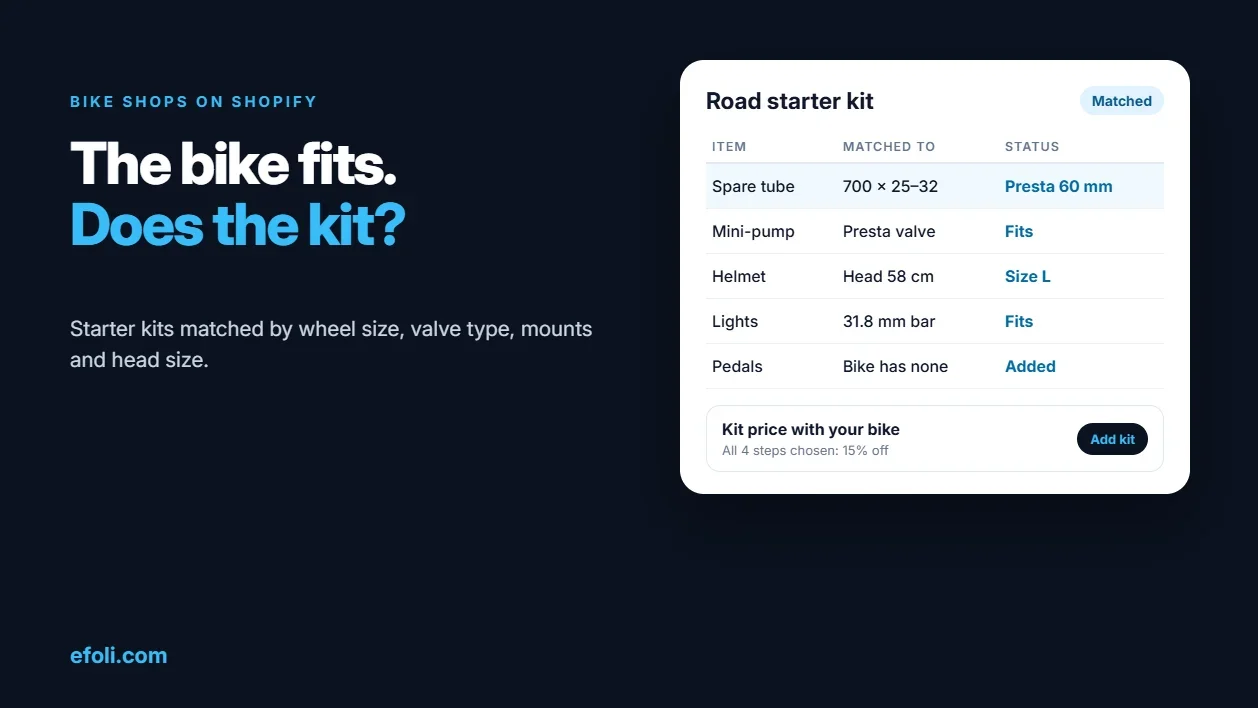
- Step 4: Show the kit on the bike page, already matched
- Step 5: Size helmets by head, not by bike
- Step 6: Get lights right for where your riders live
- Step 7: Price the kit as a reason to buy now
- Step 8: Handle stock and substitutions by family
- Step 9: Write a returns policy that makes sense for kits
- Kids' kits are a separate project
- Give riders a first-ride checklist
- Measure whether the kit is working
- Agency notes: what to ask a bike shop before quoting
- A 14-point QA list before launch
- What changed for Northgate
- FAQ
Short answer: A cycling starter kit on Shopify only helps a new rider if every item fits their bike and their head. That means matching spare tubes to wheel size, tyre width and valve type (Presta or Schrader), matching the pump head to the valve, matching light and bottle mounts to the frame and handlebar, adding pedals when the bike comes without them, and sizing the helmet by head circumference rather than by bike size. Build a small number of kit families around those compatibility groups, let the rider choose sizes and colours inside each step, price the kit as a reward for buying with the bike, and test every combination before launch.
Key takeaways
The biggest risk in a bike starter kit isn't the price. It's an accessory that doesn't fit.
Compatibility comes from a few properties: wheel diameter, tyre width, valve type and length, handlebar and seatpost shape, pedal threads and head size.
Build kits by compatibility family (road 700c Presta, mountain 29 inch, kids 20 inch Schrader), not one kit per bike model.
Helmet sizes are about the rider's head. Ask for a head measurement, show the size chart and link to fit guidance.
In the US, bike helmets must meet the CPSC safety standard. In the UK, bikes ridden at night need lights and reflectors.
Price the kit so buying with the bike feels like a clear win, and keep returns rules clear for helmets.
The new rider who bought three wrong things
Northgate Cycles is a fictional independent bike shop with a growing Shopify store. Last spring it launched a "Starter Kit": helmet, lights, lock, spare tube, pump and bottle, 15% off when bought with any bike. It sold well. Then the returns started.
A typical one: a customer bought a gravel bike with 700 x 40 mm tyres and the starter kit. The kit's spare tube was a 700 x 23–25 mm road tube, far too narrow for a 40 mm tyre. The tube had a Presta valve, which was right, but the pump in the kit only fitted Schrader valves without an adapter. The helmet was a size M because the bike was a medium frame, but the rider's head measured 59 cm and needed a large. The bottle cage fitted, at least.
Three of six items were wrong. The shop refunded them, sent replacements, and spent an hour on the phone explaining valve types to someone who just wanted to ride to work.
The bundle wasn't badly priced or badly designed. It just treated "bike accessories" as one thing, when in cycling, fit is everything.
Why cycling kits are different from other starter kits
In many starter kits, the items are independent. A hiking kit's head torch works with any backpack. A coffee starter kit's grinder works with any beans.
Bike accessories are connected to the bike in specific, measurable ways. Here are the properties that decide whether an accessory fits:
Property | Examples | What it affects |
|---|---|---|
Wheel diameter | 700c (622 mm) road and gravel; 29 inch (also 622 mm) and 27.5 inch mountain; 20 inch, 16 inch kids | Spare tubes, tyres |
Tyre width | 25 mm road; 40 mm gravel; 2.4 inch mountain | Spare tube width range |
Valve type | Presta (thin, common on road and many newer bikes); Schrader (car-style, common on kids and many hybrids) | Tubes, pump head |
Valve length | 40 to 80 mm Presta | Deep rims need longer valves |
Handlebar diameter | 31.8 mm common on adult bikes; 22.2 mm at the grips; 35 mm on some mountain bikes | Light, bell and phone mounts |
Seatpost shape | Round (27.2, 30.9, 31.6 mm); aero shapes | Rear light mounts, saddle bags |
Frame mounts | Bottle bosses: two, one or none on small and full suspension frames | Bottle cages |
Pedals | Many road and higher-end bikes are sold without pedals | Pedals, shoes, cleats |
Head size | Measured in cm around the head | Helmet size |
Two notes that catch even experienced shops: 700c and 29 inch wheels share the same 622 mm bead seat diameter, so the tube choice comes down to tyre width rather than the name. And bike frame size has nothing to do with helmet size.

Which bike properties decide whether each starter kit item fits.
The playbook
Step 1: Group your bikes into kit families
You don't need a kit for every bike model. You need a kit for every group of bikes that share the same compatibility properties.
Northgate's 60 bike models fell into five families:
Kit family | Bikes in it | Tube | Valve | Pedals included? |
|---|---|---|---|---|
Road | Road bikes, 700 x 25–32 mm | 700 x 25–32 | Presta 60 mm | No, add pedals step |
Gravel and touring | 700 x 35–45 mm | 700 x 35–45 | Presta 48 mm | Some models, check |
Hybrid and commuter | 700 x 35–45 mm, city bikes | 700 x 35–45 | Schrader or Presta by model | Yes |
Mountain 29 | 29 x 2.2–2.6 inch | 29 x 2.1–2.6 | Presta 48 mm | Often no |
Kids 16 and 20 inch | 16 inch, 20 inch | Matched to wheel | Schrader | Yes |
Adding a "kit family" field to each bike, using a product metafield or simply a tag, makes the rest of this playbook easier. The product page knows which kit to show, the bundle knows which tube to include, and staff don't have to look up valve types under pressure.
A note on e-bikes. Electric bikes usually deserve their own family even when the wheels match another group. They're heavier, often ridden faster and further, and many riders want a stronger lock, brighter lights and a helmet with better coverage. Some e-bikes have integrated lights powered by the main battery, in which case the lights step should become optional or switch to a backup set. E-bike tyres are often wider and tougher, so check the tube size rather than assuming it matches the standard hybrid. Treat "e-bike commuter" and "e-bike mountain" as two more families if you sell both, and keep the kit focused on what the rider can't already get from the bike.
Step 2: Decide what's fixed and what the rider chooses
Within a family, some items are fixed because there's only one right answer. Others need the rider's choice.
Fixed by the family: spare tube (size and valve), tyre levers, a pump or CO2 inflator that fits the valve type, a bottle cage if the frame has bosses.
Chosen by the rider: helmet size and colour, lights (a basic or brighter set), lock type (cable for short stops, D-lock or U-lock for leaving the bike), pedals if the bike needs them (flat or clipless), and optional extras such as a bell or mudguards.
This split is what makes a build-a-box or multi-step bundle a better fit than a fixed bundle. A fixed bundle forces one helmet size on everyone. A multi-step builder lets the family decide the fixed parts and the rider decide the rest.
Step 3: Build each family as a multi-step bundle
Northgate's road kit has four steps:
Helmet. Choose size (S, M, L with cm ranges) and colour. One required.
Lights. Choose "Commuter set" or "Bright set". One required.
Lock. Choose cable lock, D-lock or none. Up to one.
Pedals. Flat pedals, SPD (2-bolt) or road (3-bolt) pedals. One required, because road bikes in this family come without pedals.
The tube, levers, mini-pump and bottle cage are added automatically as the fixed part of the kit.
PushBundle, a Shopify mix and match bundle app, supports this with a multi-step build-a-box: each step has its own products and minimum and maximum picks, and the finished kit goes to the cart as one bundle line while stock comes off each real item. The Growth plan, which includes build-a-box and mix and match, is $14 a month with a 14-day trial.

A multi-step builder lets riders pick helmet, lights, lock and pedals while fixed items are added automatically. Source: PushBundle App Store listing.
Northgate also sells most bikes in the shop. PushBundle bundles can be sold through Shopify POS, so the same kit and price work at the counter, and the counter staff stop working out kit discounts on a calculator. The PushBundle guide to selling product bundles on Shopify POS shows the setup.
Step 4: Show the kit on the bike page, already matched
The kit should appear on each bike's product page, already set to the right family. A rider looking at a gravel bike should see "Gravel starter kit: tube, valve and pump matched to this bike", not a generic "Bike accessories" carousel.
Two small touches reduce returns:
Say what's been matched. "Includes a 700 x 35–45 Presta tube (48 mm valve) and a pump that fits Presta." Riders who know their stuff will trust it. Beginners will learn something.
Show what isn't included. "This bike comes without pedals. Choose pedals in step 4." This avoids the surprise of a road bike arriving with no pedals.
Step 5: Size helmets by head, not by bike
Helmet sizes are measured in centimetres around the head, roughly one inch (2.5 cm) above the eyebrows. Each brand's S, M and L cover slightly different ranges, so the helmet step should show the cm range for each size, with a one-line instruction on measuring.
NHTSA's fitting guide gives the basics that are worth repeating in the helmet step or a short pop-up: the helmet should sit level on the head and low on the forehead, the side straps should form a V under each ear, and the buckled chin strap should be snug.
In the US, any helmet marketed for cycling must meet the CPSC bicycle helmet standard (16 CFR 1203). The rule also requires fit instructions and warnings, including that a helmet that has taken an impact may be damaged even if it doesn't look it and should be replaced. If you sell in the US, only include certified bike helmets in the kit, and keep the certification visible on the product page. Helmets marketed only for skateboarding or other single activities aren't covered by the bike helmet standard, so don't substitute them into a cycling kit.

Helmet sizing by head measurement, with the three fit checks riders should do at home.
Step 6: Get lights right for where your riders live
Lights are a safety item and, in some places, a legal one. In the UK, the Highway Code says that at night a bike must have a white front light and a red rear light lit, plus a red rear reflector, and amber pedal reflectors if the bike was made after 1 October 1985. Many new bikes come with reflectors but no lights.
Commuter riders in winter are the people most likely to need lights immediately, so Northgate makes lights a required step in its hybrid and commuter kits. On road kits it's still required, but riders choose between a "commuter" set and a brighter set.
Check that the light mounts fit the bike: most lights fit a 31.8 mm bar, but some aero handlebars and aero seatposts need specific mounts. If a bike in the family has an aero seatpost, offer a rear light with a compatible mount or a saddle-rail mount.
This is general information. Lighting rules differ by country and region, so check the rules where your customers ride.
Step 7: Price the kit as a reason to buy now
The point of a starter kit is to get the rider out on day one with everything they need. Price it so buying with the bike is clearly the better deal.
Approach | Example | Works well for |
|---|---|---|
Kit discount | 15% off kit items when bought with a bike | Simple to explain; strong reason to add the kit |
Fixed kit price | Road starter kit $149 (worth $185) | Easy to compare; best with fixed parts |
Tier by kit size | 10% off 3 steps, 15% off all 4 | Encourages riders to add the lock or better lights |
Spend milestone | Free bottle and cage over $1,200 | Higher-priced bikes |
Illustrative prices.
Northgate uses a fixed kit price for the fixed items plus a tiered discount for the chosen items. DiscountRay, a Shopify tiered discount app, can show quantity tiers and a discount table on the free Starter plan, and its Growth plan ($14 a month) adds scheduling, which Northgate uses for a spring "back on the bike" promotion. If you combine a bundle discount with an order discount, test that they stack the way you intend. Anika's post on Shopify milestone discounts explains how spend thresholds work alongside other offers.

Fixed parts at a set price, chosen parts on a tier, and the saving shown before checkout.
For a wider view of bundle pricing models, Anika's bundle pricing guide on the PushBundle blog covers fixed, percentage and tiered models with examples.
Step 8: Handle stock and substitutions by family
A kit is only as available as its least available item. If the 48 mm Presta tube sells out, every gravel and mountain kit is stuck.
Track the fixed items closely. Tubes and pumps are cheap and easy to forget, but they block whole kits.
Set substitution rules in advance. A 60 mm valve tube can replace a 48 mm one on a shallow rim, but not the other way round on a deep rim. Write these rules down so staff don't guess.
Hide unavailable choices. If one helmet size is out of stock, show it as unavailable in the helmet step, rather than letting riders pick it.
Step 9: Write a returns policy that makes sense for kits
Kit returns have two awkward cases.
Helmets. Many shops accept unworn helmets in original packaging but not worn ones, for hygiene and safety reasons, since a helmet that has been dropped may be damaged. State this in the kit and on the helmet product page.
Partial returns. If the rider returns only the lock, how much do they get back: the discounted price or the full price? Decide this before launch. The most common approach is to refund the discounted price of the returned item. Anika's post on Shopify bundle returns covers partial returns and stock in more detail.
Kids' kits are a separate project
It's tempting to shrink the adult kit and call it a kids' kit. Children's bikes need their own thinking.
Wheel size, not age, decides the tube. Kids' bikes are sold by wheel diameter, commonly 12, 14, 16, 20 and 24 inch. A 20 inch BMX-style bike and a 20 inch kids' mountain bike can use different tyre widths, so the tube still needs checking within the family.
Schrader is more common. Many children's bikes use Schrader valves, which means a different pump head from the adult road kit. Make sure the pump in the kids' kit fits, or include a dual-head pump.
Helmets need a child's size range and a parent-friendly fit guide. Children's heads grow, and parents often buy "room to grow". A helmet that's too big doesn't protect properly, so the helmet step should explain that the fit should be snug today, not next year. Children's helmets sold for cycling in the US are covered by the same CPSC bicycle helmet standard.
Locks and lights are often optional. A six-year-old riding in the park doesn't need a D-lock. A twelve-year-old cycling to school might need lights and a lock. Northgate's kids' kit makes both optional and adds a bell, which parents ask for more than anything else.
Give riders a first-ride checklist
A starter kit is for people who are new, or new again. Many will not know how to use what's in the box. A short first-ride guide, sent by email after purchase and printed on a card in the kit, does a surprising amount of work:
Check tyre pressure against the number printed on the tyre sidewall, and pump up before every ride for the first few weeks.
Practise removing and refitting a wheel at home, so a puncture on the road isn't the first time.
Fit the helmet using the three checks: level, V under the ears, snug strap.
Charge the lights and set them to steady or flash, depending on local rules and conditions.
Learn to lock the frame and the front wheel to something solid, not just the wheel.
Book the free first service, if you offer one, after the cables have bedded in.
Riders who use their kit come back for the next upgrade. Riders who never open the spare tube don't remember where they bought it.
Measure whether the kit is working
Three numbers tell you whether the starter kits are doing their job:
Kit attach rate: the share of bike orders that include a kit. If it's low, the kit may be buried on the bike page, or the saving may not be clear.
Return rate on kit items: this should fall sharply once kits are matched by family. If one item still comes back often, it's usually a sign that a family needs splitting.
Questions to the shop about fit: count the "will this tube fit?" emails and calls. They should drop as the matched details appear on each page.
Check these monthly for the first season and adjust the families as you add new bikes.
Agency notes: what to ask a bike shop before quoting
If you're building this for a bike retailer, these questions shape the project:
How many bike models, and how many kit families do they reduce to?
Is compatibility data (wheel size, tyre width, valve type and length, handlebar diameter, pedals included) already in the product data, or does someone need to collect it?
Does the shop sell kids' bikes? Kids' kits need their own helmet sizes and usually Schrader valves.
Online only, or also in-store through Shopify POS?
Which countries do they ship to? Helmet certification and lighting rules differ.
Who will check the compatibility rules: a mechanic, not the developer.
Collecting compatibility data is often the biggest task. Once it's in place, the bundles themselves are mostly configuration.
A 14-point QA list before launch
# | Test | Pass when |
|---|---|---|
1 | Open each bike page | Correct kit family shows |
2 | Check the fixed tube in each family | Size and valve match the bike's tyres |
3 | Check the pump | Fits the valve type, or includes an adapter |
4 | Deep-rim bikes | Valve length is long enough |
5 | Road bikes without pedals | Pedals step is required |
6 | Helmet step | Sizes show cm ranges and a fit note |
7 | US store | Helmets show CPSC compliance |
8 | Lights step | Mounts fit the bar and seatpost |
9 | Small or full suspension frames | Bottle cage fits, or step is optional |
10 | Kit in cart | One bundle line; stock comes off each item |
11 | Kit with bike | Correct discount; stacks only as intended |
12 | Item out of stock | Shown as unavailable in the step |
13 | POS | Same kit and price at the counter |
14 | Return one item | Refund matches your policy |

The 14 checks Northgate runs before a kit family goes live.
What changed for Northgate
After rebuilding its starter kits into five families, Northgate stopped getting the same three returns. Tubes matched the tyres, pumps matched the valves and helmets matched heads. The product pages started answering questions that used to come by phone. And counter staff stopped improvising kit prices, because the same kits existed in POS.
The bigger change was in the shop's confidence: staff could recommend a kit to a nervous first-time rider without worrying about what would come back next week.
The kit didn't get cheaper or flashier. It got correct, which for a new rider is what "starter kit" should mean.
If you're building kits for hiking and camping rather than cycling, the eFoli guide to outdoor starter kits covers layering, sizing and seasonal kits. And for accessory bundles in tech, where compatibility is about ports and models, see electronics accessory bundles.
Northgate Cycles is a fictional shop used for illustration. Helmet and lighting notes summarise CPSC, NHTSA and UK Highway Code guidance for information, not legal advice. Prices are illustrative.
FAQ
What should a cycling starter kit include?
How do I make sure bike accessories in a bundle fit the bike?
What is the difference between Presta and Schrader valves?
How should helmets be sized in a bike bundle?
Do bike helmets sold in the US need certification?
Can I sell bike starter kits in-store and online with the same price?

Anika Anamta Mehnaz
This article is written by Anika Anamta Mehnaz, a Content Writer and Content Marketing Strategist specializing in Shopify, eCommerce, and SaaS. With over four years of content writing experience, she creates SEO and AI search-optimized content that helps Shopify merchants make better business decisions through practical, research-backed insights. Her work covers Shopify apps, product variants, bundles, discounts, B2B commerce, and conversion-focused strategies. Outside of work, Anika enjoys watching anime, reading John Grisham novels, and discovering new ideas in digital marketing and e-commerce. If you enjoy discussing Shopify, content marketing, or online growth, feel free to connect with her. Twitter: https://x.com/mehnaz2201 Medium: https://medium.com/@mehnaz_78932
Keep reading
View all articles →
"Can You Make It in Oak?" Shouldn't End the Shopping Journey
November 23, 2026 • 17 min read
Same Headphones, Three Reseller Tiers: Why One Price Makes No Sense
November 20, 2026 • 17 min read
Shopify Subscriptions, Bundle Apps and Custom Code: Check Compatibility First
November 20, 2026 • 17 min read