On this page
- Key takeaways
- The shopper who almost bought a sideboard
- Three kinds of "custom", three different paths
- Level 1: Make the common choices buyable
- Level 2: Capture the spec in one go
- Level 3: Slow down on purpose
- Lead times are a promise, not a guess
- Capacity: the store doesn't know when the workshop is full
- Deposits, cancellations and returns: say it before they pay
- Deposits
- Cancellations
- Returns
- When the customer changes their mind mid-build
- Keep the customer in the loop while you build
- A good made-to-order product page, top to bottom
- What the current setup costs a small workshop
- The merchant checklist
- Where to start this week
- FAQ
Short answer: Made-to-order home goods stall on Shopify when every custom request, from "can I have it in oak?" to "can you make it 20 cm narrower?", ends up in the same contact form and the same email thread. The shopper gets no price, no lead time and no idea whether the answer will be yes. The fix is to sort requests into three levels. Finishes and sizes you always offer become product options with their own price and lead time. Spec changes you can usually do become a quote request with the details captured up front. Fully bespoke pieces go to a consultation. Then promise lead times your workshop can keep, cap orders to your real capacity, and explain deposits and cancellations before the shopper pays.
Key takeaways
"Custom" means three different things: choosing from your set options, changing the spec, or a one-off design. Each needs a different path.
Standard finishes belong on the product page with a price and a lead time. They should never need an email.
Spec changes need a quote request that captures dimensions, photos and a delivery postcode in one go.
Lead times are a promise. In the US, the FTC expects a reasonable basis for any shipping time you state.
A workshop has a weekly limit. If the store keeps selling past it, every lead time on the site becomes wrong.
Deposits, cancellation and returns for custom pieces must be clear before payment, not explained afterwards.
The shopper who almost bought a sideboard
Here is a scenario that will sound familiar to anyone who sells handmade furniture or home goods online. Ashby & Vale, a fictional small workshop, sells a walnut sideboard for $2,400. It's their best-seller.
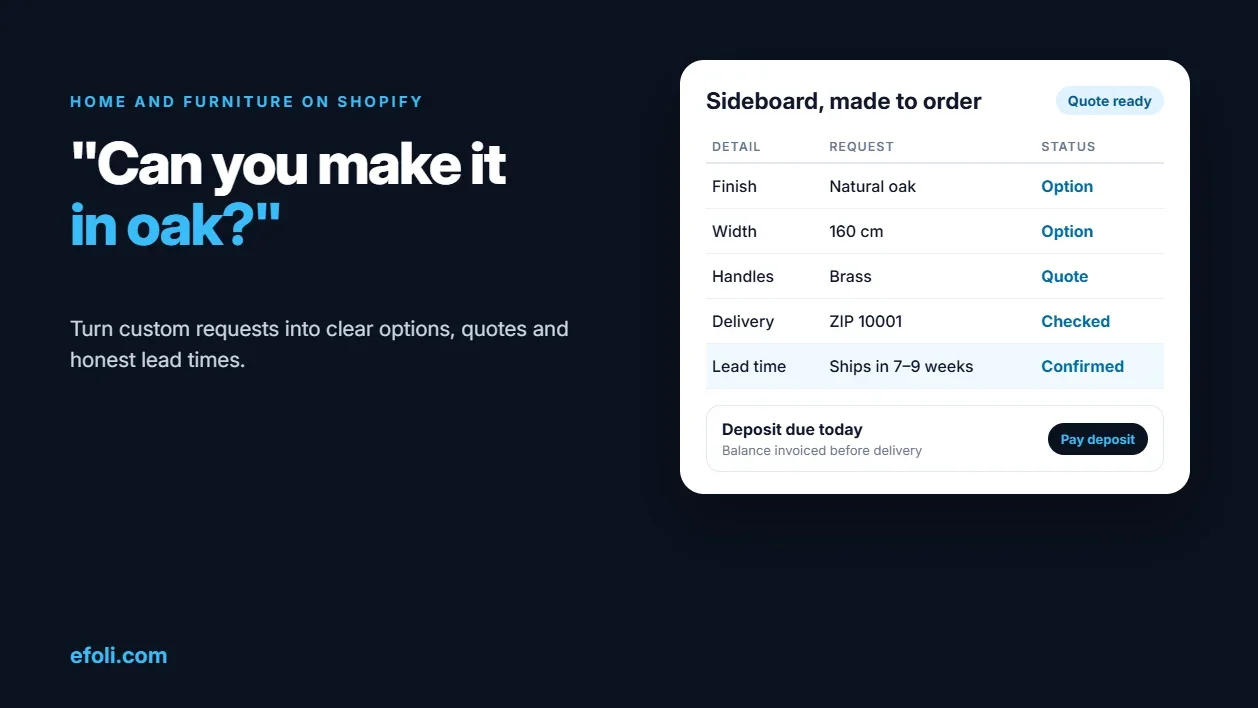
On a Sunday evening, a shopper called Priya lands on the product page from Pinterest. She loves it. Two problems: her floors are pale oak, so walnut will look heavy, and the alcove it needs to fit is 160 cm, not 180.
She looks for an option. There is a "Finish" dropdown with "Walnut" as the only choice. There's no size option. She scrolls to the bottom and finds "Custom requests? Get in touch."
She fills in the contact form: "Hi, can you make this in oak and 160 cm wide? How much and how long?"
Monday morning, the maker reads it between two jobs. Oak is fine. 160 cm is fine, but the doors will need to be narrower, and he isn't sure about the price until he works out the timber. He replies on Tuesday asking what height she needs and whether she wants the same handles. Priya replies on Thursday. He sends a price on Friday by email with a bank transfer request. She's not keen on paying $1,000 by bank transfer to a shop she found last Sunday. She doesn't reply.
Nobody did anything wrong. The workshop just had no structure for the most common question it gets.

How one custom request turns into five days of email and a lost sale.
Three kinds of "custom", three different paths
The biggest single fix is to stop treating every custom request the same way. In most home and furniture businesses, requests fall into three levels.
Level | What the shopper asks | Example | Right path on Shopify |
|---|---|---|---|
1. Option | Something you always offer | "Oak instead of walnut." "The 160 cm size." | Product options with their own price and lead time. Add to cart as normal. |
2. Spec change | A change you can usually do, but need to check | "165 cm wide." "Brass handles instead of black." "Two drawers, not three." | Quote request on the product page that captures the details. You reply with a price, lead time and a checkout link. |
3. Bespoke | A new piece or a major redesign | "A matching TV unit with a cable hatch." | Consultation booking or a longer brief, then a quote. |
Ashby & Vale found that about two-thirds of their "custom" emails were really Level 1: other woods and the two or three sizes they made anyway. Those were losing sales simply because the options weren't on the page.
Level 1: Make the common choices buyable
If you make a piece in walnut, oak and ash, and in 140, 160 and 180 cm, that's nine combinations. Put them on the page as options, each with its correct price. Shopify allows up to three options and 2,048 variants per product, which is plenty for finishes and sizes.
Two details matter more than the dropdowns:
Show lead time per option. Walnut in stock might ship in two weeks. Oak made to order might take eight. If the page shows one lead time for all of them, one of them is wrong. A line under the option selector that changes with the choice ("Oak: made to order, ships in 7 to 9 weeks") prevents most "where is my order?" emails before they start.
Show what the finish actually looks like. Photos of the finish in daylight, plus a sample service if you offer one. Most returns on custom-finish furniture come from colour expectations, not damage.
Level 2: Capture the spec in one go
Level 2 is where Priya's request sat. The workshop could say yes, but needed to check. The problem wasn't the check. It was the five days of email needed to get the details.
A quote request button on the product page fixes that. Instead of a generic contact form, the request lives on the sideboard page, already knows which product it's about, and asks the questions the maker always ends up asking:
Width, depth and height needed (with a note on minimum and maximum sizes).
Finish and any changes to handles, legs or drawers.
A photo of the space, if they want to share one.
Delivery postcode or ZIP code (for delivery cost and access).
When they need it by.
QuotWay, a Shopify quote request app, adds a request-a-quote button to product pages and turns an accepted quote into a Shopify draft order the shopper can pay through normal checkout. The free Lite plan covers up to ten quotes a month with the quote button and one-click draft orders. Custom fields and file attachments, which you need for dimensions and room photos, are on the Starter plan at $29 a month.

A quote request on the product page captures sizes, finish and delivery details in one step. Source: QuotWay App Store listing.
The difference for Priya would have been simple. She fills in one form on Sunday. On Monday, the maker replies with a price, a lead time and a link to pay through the shop's normal checkout, with the card and wallet options she already trusts. No bank transfer.
If your custom requests come mainly from interior designers and trade buyers rather than homeowners, the eFoli guide to furniture quote requests on Shopify covers trade pricing, project quotes and multi-piece orders. This post stays with the retail shopper.
Level 3: Slow down on purpose
Fully bespoke work, a new design or a matched set for a whole room, shouldn't be rushed into a form. Here the best path is a short brief and a booked call or showroom visit. Be honest on the page: "Bespoke pieces start from $X and take 12 to 16 weeks. Tell us about your project and we'll arrange a call." Setting a starting price filters out people with a very different budget, which saves everyone time.
Lead times are a promise, not a guess
The most expensive mistake in made-to-order selling is a lead time that's too optimistic. It feels like a sales tool. It turns into refunds and bad reviews.
In the US, the FTC's Mail, Internet, or Telephone Order Merchandise Rule applies to most goods ordered online. In plain terms:
If you state or imply a shipping time, you need a reasonable basis for it.
If you don't state one, you need a reasonable basis for believing you can ship within 30 days.
If you can't ship on time, you must tell the customer and get their consent to the delay, or cancel and refund. The FTC's guide explains what the delay notice must say.
Required refunds have deadlines: within seven working days for most payment methods, or within one billing cycle if you extended the credit yourself.
For made-to-order work, that means "ships in 7 to 9 weeks" needs to be based on your real queue, not on how long the piece takes to make in an empty workshop. A piece that takes four days at the bench can easily ship in eight weeks once you add timber delivery, finishing, curing and every order ahead of it.
Quick way to set a defensible lead time: take your current queue in bench days, divide by the bench days you complete per week, add the build time for the new piece and your finishing and curing time, then add a buffer for one bad week. Review it every Monday.
This is a summary for information, not legal advice. Rules differ by country, so check the ones that apply to you.
Capacity: the store doesn't know when the workshop is full
Most made-to-order shops have a hard limit: a certain number of pieces a week, set by people, bench space and finishing time. The online store has no idea. It will happily sell twenty sideboards in a week because a magazine featured you, then every lead time on the site is wrong.
There are three practical ways to bring the store in line with the workshop:
Cap orders per week for made-to-order products. When the week's slots are sold, the store moves the shopper to the next available week or stops new orders for that product until a slot frees up.
Cap by product or collection. Large pieces use more bench time than side tables. Cap the large pieces separately so they can't crowd out everything else.
Close dates. Workshop holidays, timber delivery gaps and trade show weeks should block new orders that would land in them.
OrderRules, a Shopify order limit app, sets daily, weekly or monthly order caps for the whole store or for specific products, variants and collections, and blocks closed dates. Its Advanced plan adds delivery-date capacity with lead times and cut-offs. It checks the rules at checkout, including express wallets. One limitation to know: orders created in Shopify POS aren't checked, so showroom sales need to be counted manually against the week.

Weekly and monthly order caps keep online sales inside real workshop capacity. Source: OrderRules App Store listing.
For businesses where capacity planning is the main headache, such as contract manufacturers taking B2B orders, the eFoli post on manufacturing order capacity goes deeper into production slots and quote approval.
Deposits, cancellations and returns: say it before they pay
Custom work changes the money conversation. If a customer cancels a $2,400 oak sideboard after you've cut the timber, someone has to absorb that cost. Shoppers generally accept that, as long as you told them before they paid.
Deposits
Many workshops take a deposit, often a fixed percentage, when the order is placed and the balance before delivery. On Shopify you have a few options:
Full payment at checkout. Simplest, and fine for smaller pieces with short lead times.
Deposit through a pre-order or deposit app. Shopify's selling plans let apps charge part of the price at checkout and the rest later. Check that the app handles balance reminders and failed payments.
Deposit by draft order invoice. For Level 2 and 3 quotes, you can send an invoice for the agreed amount through a draft order and invoice the balance separately.
Whichever you use, show the deposit amount, when the balance is due and what happens if it fails before the shopper commits.
Cancellations
In the UK, consumers usually get 14 days to cancel an online purchase. The Consumer Contracts Regulations exclude goods made to the consumer's specifications or clearly personalised. A piece built to Priya's 160 cm alcove is very likely in that category. Whether choosing a standard finish from your menu counts as "made to the consumer's specifications" is less clear-cut, so many makers treat Level 1 options as normal stock for cancellation purposes and apply the custom terms only to Level 2 and Level 3 work. Get advice on your own terms.
In the US, there's no general federal right to cancel online purchases, but your own published policy and state laws apply, and the FTC's shipping rule above still gives customers the right to cancel when you can't ship on time.
Returns
Be specific about what can and can't come back. "Custom pieces can't be returned unless faulty" is clear. "Some items may be non-returnable" is not. Put the policy next to the option selector and in the quote, not just in the footer.
When the customer changes their mind mid-build
Custom orders rarely stay still. Two weeks after paying, Priya might email to ask whether the handles could be brass after all, or whether the sideboard could be 2 cm deeper because her skirting board sticks out. Some changes are free. Some are impossible because the carcass is already glued up. Some cost money.
Workshops that handle this well treat changes as a small, written process rather than a chat:
Set a change cut-off. For example, "Changes to size and timber are possible until we cut your timber, usually two weeks after ordering. Hardware and finish changes are possible until finishing starts." Put it in the order confirmation.
Price changes like a mini quote. If the change costs more, send a new quote or an invoice for the difference. Don't absorb it informally, because the next customer will hear about it.
Update the lead time when the change adds work. A change that adds a week should come with a new date in writing. That keeps you on the right side of the delay rules mentioned above.
Record the final spec in one place. The order notes or a note attached to the order should hold the final spec, not the fifth email in a thread. The person sanding the piece shouldn't need to read the whole conversation.
Keep the customer in the loop while you build
Eight weeks is a long time to wait for a $2,400 purchase with no news. Most "where is my order?" emails in made-to-order businesses don't come from late orders. They come from silence.
A few simple updates fix most of it:
Order confirmation with the final spec, the deposit taken, the balance date and the estimated ship week.
"Your piece is in the workshop" when building starts, ideally with a photo of the timber or the joinery. Customers love this, and it's free marketing when they share it.
Balance reminder a week before the balance is due, if you take deposits.
Ready to ship with the delivery booking process, access questions (stairs, lift, narrow hallways) and what to expect on the day.
These can be manual emails at first. As volume grows, tag made-to-order orders so they are easy to filter, and use Shopify's notification templates or a flow app to send the routine ones. What matters is that the customer never has to ask.
A good made-to-order product page, top to bottom
Pulling it together, this is what the Ashby & Vale sideboard page looks like after the changes. It's not fancy. It just answers the questions in the order shoppers ask them.
Photos of the piece in each finish, in daylight, plus one shot of the joinery and one of the piece in a real room.
Finish and size options with the price updating as they change.
A lead time line that changes with the option: "Walnut 180 cm: in stock, ships in 1 to 2 weeks" or "Oak 160 cm: made to order, ships in 7 to 9 weeks."
Add to cart, with the deposit explained underneath if one applies.
"Need a different size or detail?" opening the quote request for Level 2 changes, with the size limits stated.
Terms in plain words: what can be changed after ordering, cancellation for custom work, returns.
Care and materials: timber source, finish type, how to look after it.
"Planning a bespoke piece?" linking to a consultation for Level 3.
Shoppers who just want the standard piece never notice the custom paths. Shoppers like Priya find them in seconds.
What the current setup costs a small workshop
It's easy to dismiss this as admin. It adds up.
Cost | How it shows up | Rough scale for a small workshop |
|---|---|---|
Lost custom sales | Shoppers drop out during the email back-and-forth | Every abandoned thread is a lost high-value order |
Maker time | Answering the same five questions by email | Hours a week away from the bench |
Mis-specs | Details lost across emails ("I said 160 including legs") | Remakes, the most expensive mistake in furniture |
Late deliveries | Lead times based on hope, not the queue | Refunds, delay notices and reviews |
Payment risk | Bank transfers and off-platform invoices | Less trust and no chargeback protection for the shopper |
Cancellation disputes | Terms explained after payment | Refunds of work already started |
None of these costs show up in your Shopify analytics, which is why they persist. The order that never happened leaves no trace.
The merchant checklist
Use this to review your own made-to-order pages. Each item is small. Together they change how custom requests feel to the shopper.

A 14-point checklist covering options, quotes, lead times, capacity and terms.
Options
Every finish and size you make regularly is a product option with its own price.
Each option shows its own lead time.
Finish photos are taken in daylight, and you offer samples if colour is critical.
Quotes
Spec changes go through a quote request on the product page, not a general contact form.
The request asks for dimensions, finish changes, a room photo, delivery postcode and the date needed.
You reply to quote requests within one working day, even if only to say when the full quote will come.
Accepted quotes are paid through your store's checkout, not by bank transfer.
Lead times and capacity
Lead times are worked out from your current queue and reviewed weekly.
Made-to-order products have a weekly or monthly order cap that matches your workshop.
Holidays and closed weeks are blocked in advance.
You have a delay notice template ready, and you send it as soon as you know.
Terms
Deposit amount and balance timing are shown before checkout.
Cancellation terms for custom work are on the product page and in the quote.
Returns for custom pieces are stated plainly.
Where to start this week
If you only do one thing, look at your last twenty custom request emails and sort them into the three levels. In most workshops, a big share turns out to be Level 1. Add those options to the product pages with honest lead times. You'll get fewer emails, and the ones you do get will be real custom work.
Then add a quote request to your best-selling made-to-order products, and set a weekly cap that matches what your workshop can really deliver. Your lead times will start being true, which is the most persuasive thing a made-to-order business can show.
If your custom work is mostly names, engraving and monograms rather than dimensions and materials, the eFoli guide to personalised keepsake gifts covers proofs, personalisation fields and the "no returns on personalised items" conversation.
Ashby & Vale and Priya are fictional, used to illustrate a common situation. The FTC and UK points are plain-language summaries for information, not legal advice.
FAQ
How do I sell made-to-order furniture on Shopify?
How should I show lead times for made-to-order products?
Can customers cancel a made-to-order item?
How do I take a deposit for custom furniture on Shopify?
What should a custom furniture quote request ask for?
How do I stop overselling made-to-order products?

Anika Anamta Mehnaz
This article is written by Anika Anamta Mehnaz, a Content Writer and Content Marketing Strategist specializing in Shopify, eCommerce, and SaaS. With over four years of content writing experience, she creates SEO and AI search-optimized content that helps Shopify merchants make better business decisions through practical, research-backed insights. Her work covers Shopify apps, product variants, bundles, discounts, B2B commerce, and conversion-focused strategies. Outside of work, Anika enjoys watching anime, reading John Grisham novels, and discovering new ideas in digital marketing and e-commerce. If you enjoy discussing Shopify, content marketing, or online growth, feel free to connect with her. Twitter: https://x.com/mehnaz2201 Medium: https://medium.com/@mehnaz_78932
Keep reading
View all articles →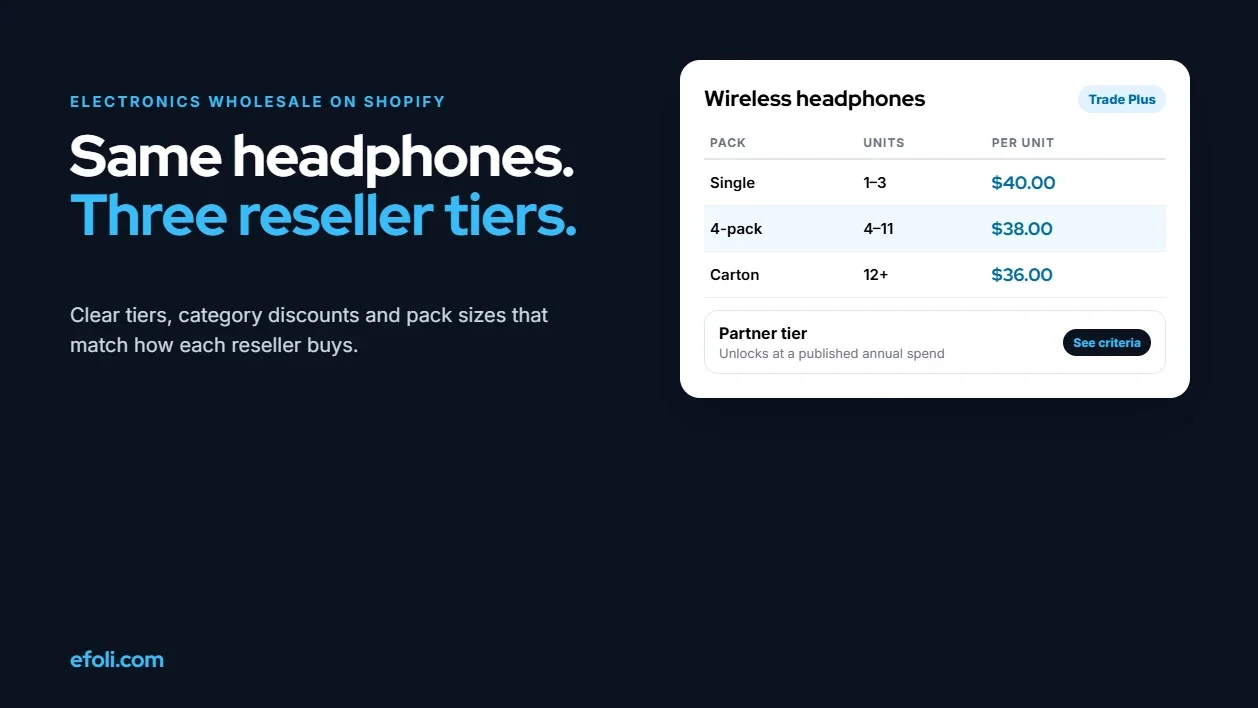
Same Headphones, Three Reseller Tiers: Why One Price Makes No Sense
November 20, 2026 • 17 min read
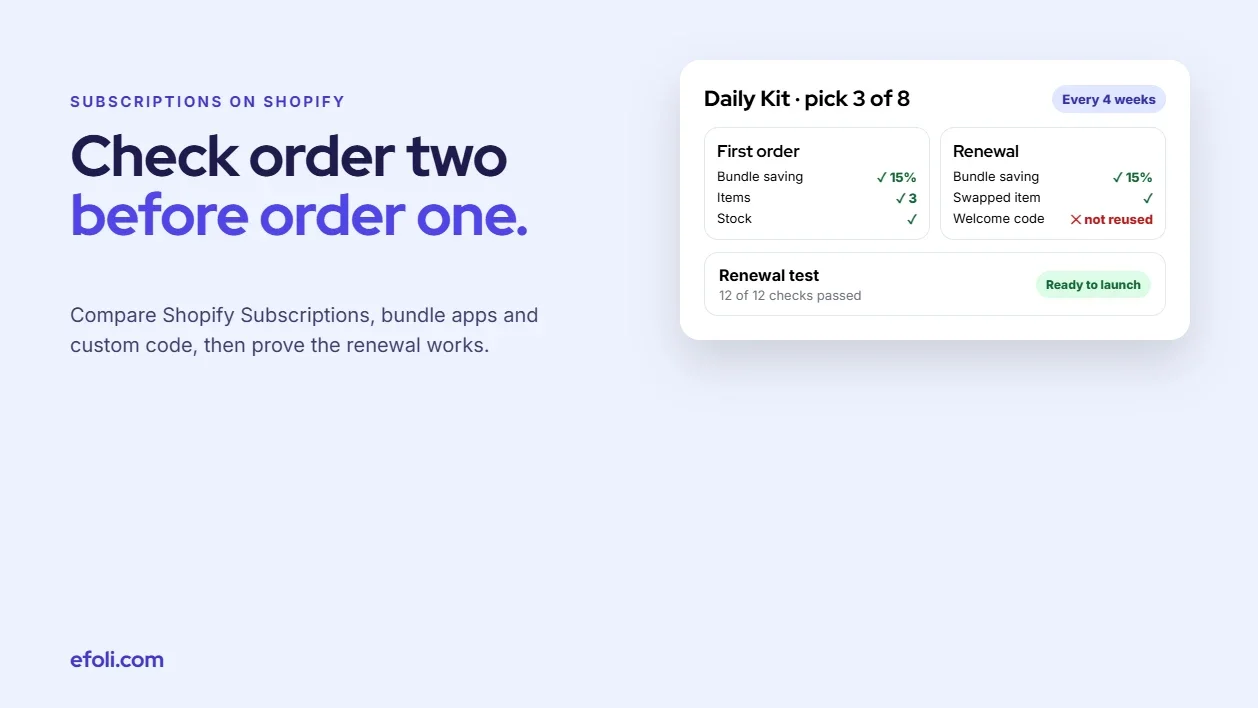
Shopify Subscriptions, Bundle Apps and Custom Code: Check Compatibility First
November 20, 2026 • 17 min read
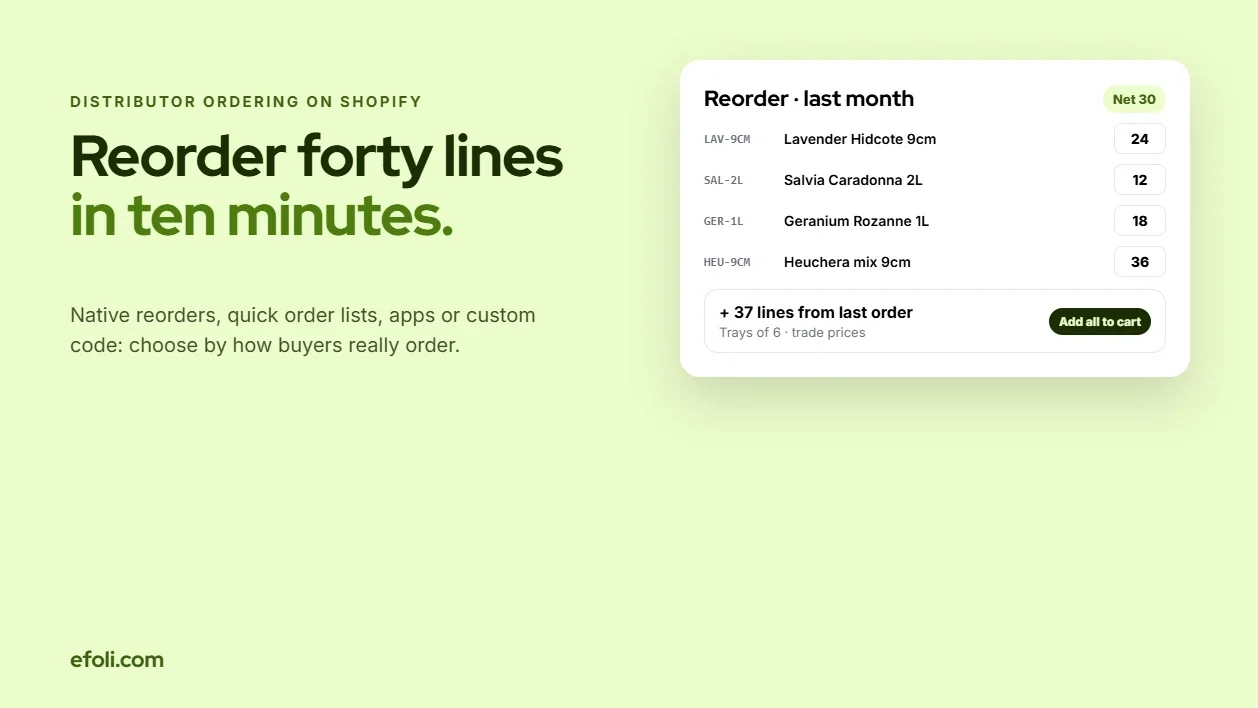
MultiVariants vs Custom Quick-Order Forms for Repeat Distributor Orders
November 20, 2026 • 17 min read