Fragrance Discovery Sets on Shopify: They Loved the Samples. Why Didn't They Buy the Bottle?
Discovery sets sell well. The full bottle often doesn't follow. Here's where the journey from fragrance discovery set to full size breaks on Shopify, and how to fix it.
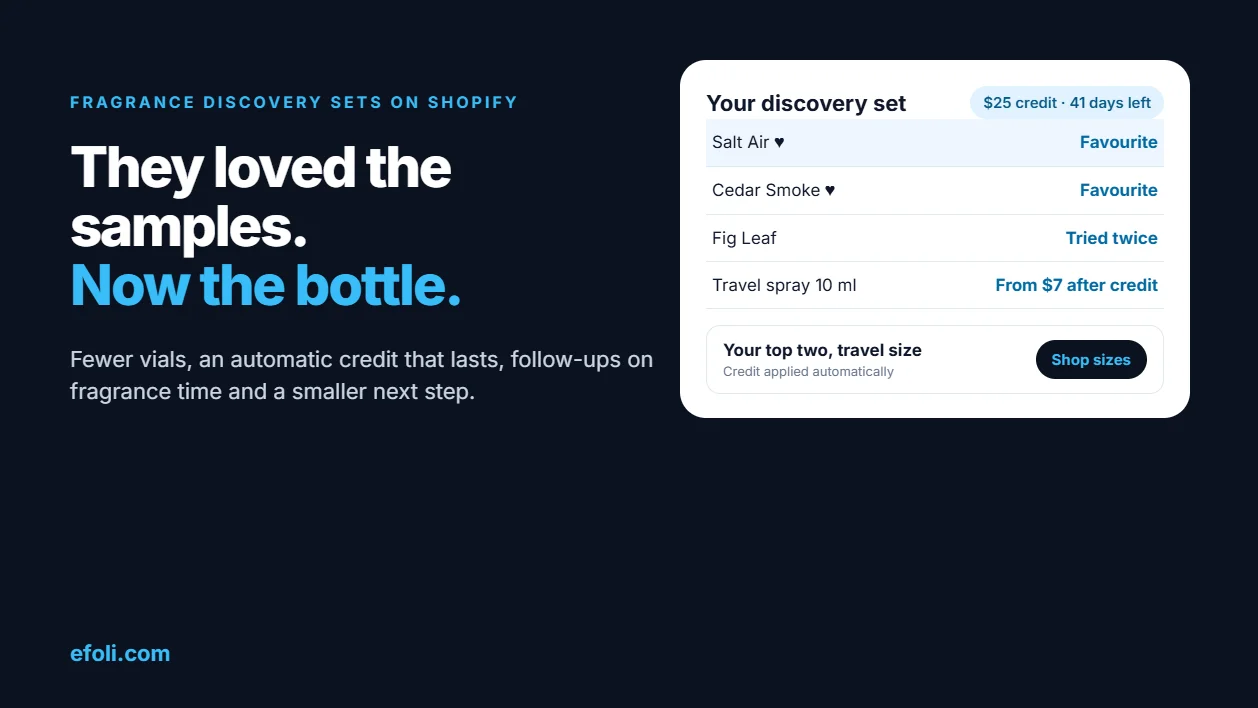
On this page
- Key takeaways
- The set that sold, and the bottles that didn't
- The journey from sample to bottle
- Where sample buyers drop off
- 1. Too many samples, not enough guidance
- 2. The box doesn't say what to do next
- 3. People judge too fast
- 4. The credit is hidden, or expires too soon
- 5. The full bottle feels like a big jump
- 6. The store doesn't remember what they tried
- Fix the credit first
- Follow up on fragrance time
- Make the next step smaller
- Product pages for people who've already sampled
- Help the store remember
- A note on shipping perfume
- Designing the set to lead somewhere
- Gift buyers and self-buyers need different paths
- What to measure
- What Maison Ondine changed
- Mistakes we see often
- Questions to ask your set buyers
- Yeah, but…: what fragrance brands worry about
- The checklist
- The bottom line
- FAQ
Who this is for: fragrance brands selling discovery sets on Shopify. Last checked: 25 November 2026.
Short answer: Discovery set buyers often skip the full bottle because they get too many vials, lose or outlive the credit, and hear from you before they've worn the scents. Offer fewer samples, make the credit automatic and long enough, follow up on fragrance time and add a smaller size between vial and bottle.
Key takeaways
A discovery set is a means, not an end. Judge it by how many buyers go on to a full bottle, not by how many sets you sell.
Choice overload is real. Eight vials can be fun; fifteen is homework.
Fragrance takes days to judge. Follow-ups timed for a skincare product will arrive too early.
A credit only works if the shopper remembers it, can find it and has time to use it.
The step between a 2 ml vial and a 100 ml bottle is big. A travel size or smaller bottle can bridge it.
The set that sold, and the bottles that didn't
Maison Ondine (a fictional niche perfume house, used here to illustrate) launched a discovery set of 12 vials. It became its best-selling product within two months. Reviews were glowing. Social posts showed the box on dressing tables.
Then the team checked how many discovery set buyers had bought a full bottle within 60 days. It was far lower than they'd hoped. Most set buyers never bought anything else.
They emailed a sample of set buyers who hadn't come back and asked why. The answers were remarkably consistent:
"I liked three of them and couldn't decide."
"I forgot about the credit until it had expired."
"I only wore them once each. I need longer with a scent."
"The full bottle was a lot more than I expected."
"I didn't realise I could get a smaller size."
None of these say "I didn't like the perfume". They say the journey from sample to bottle had holes in it. If you've seen the same pattern, here's where the holes usually are. (For the setup side, building the set, the credit and the tests, see our guide on how to build a fragrance discovery set.)
The journey from sample to bottle

Six steps between the sample box and the full bottle, and where shoppers drop off.
There are six steps between "buys discovery set" and "buys full bottle". Shoppers drop out at each one.
Choosing the set. Picking a set, or picking samples to go in it.
Unboxing. The first impression, and the first chance to explain what to do next.
Testing. Wearing the scents, ideally more than once, over days.
Deciding. Narrowing to one or two favourites.
Remembering. Finding the credit, the scent name and the store again.
Buying. Choosing a size and checking out.
Most brands put their effort into step 1 and step 6. Steps 2 to 5 are where Maison Ondine lost people.
Where sample buyers drop off
1. Too many samples, not enough guidance
Twelve vials is a lot. Without some direction, people spray them all on day one, mix them up, and can't remember which they liked. Bigger isn't always better. A set of five to eight well-chosen vials, grouped by mood or family, is easier to judge.
If you let shoppers pick their own samples, guide them. A short quiz ("Fresh or warm? Day or evening?") or a step-by-step builder that narrows the choice can turn a list of 30 scents into a set of six that suits them.
A sample box builder such as Push Bundle supports build-a-box, sample pack and multi-step bundles with min and max limits on its Growth plan ($14 a month at the time of writing). Shopify's free Bundles app handles fixed bundles only, so a "choose your own samples" set needs an app.

A step builder can guide shoppers to a short list of samples. Source: Push Bundle App Store listing.
2. The box doesn't say what to do next
Many discovery sets arrive beautifully packed, with nothing to tell the customer how to test or what happens next. A simple card changes that: how to test (one scent per day, on skin, wait for the dry-down), a space to note favourites, and a clear line about the credit: "Your $25 is waiting. It's already on your account and lasts 60 days."
3. People judge too fast
Fragrance changes over hours. A scent that feels sharp at first can be lovely four hours later. Most perfume lovers will tell you they need a few wears to know. If your follow-up email arrives two days after delivery, many customers haven't even tried half the vials.
4. The credit is hidden, or expires too soon
Credits toward the full bottle are common and they work, when people use them. They fail when:
The code is printed on a card that gets thrown away with the box.
The code expires in 14 or 30 days, before the customer has finished testing.
The code doesn't work on the size or scent they want.
The customer has to remember to enter it at checkout.
5. The full bottle feels like a big jump
A discovery set might cost $30. A full bottle of niche perfume can cost $150 or more. Even with a $25 credit, that's a big step for someone who's only worn a scent twice. A smaller size (a 10 ml travel spray or a 30 ml bottle) gives them somewhere to land.
6. The store doesn't remember what they tried
When the customer comes back, the site greets them like a stranger. They have to remember the scent name, find it in the collection and work out whether their credit applies. Every step is a chance to give up.
Fix the credit first

Four ways to reward the sample buyer, and what each costs you.
The credit is the strongest tool you have, so it's worth getting right. There are four common ways to reward a discovery set buyer:
Option | How it works | Pros | Watch out for |
|---|---|---|---|
Discount code | A code worth the set price, used at checkout | Simple to set up | Gets lost; easy to share publicly |
Automatic discount | Applied at checkout for set buyers | Nothing to remember | Needs a way to target only set buyers |
Gift card | Issued after the set is bought | Feels like money; works on anything | Treated as a liability in your accounts |
Partial refund | Refund the set price when they buy a bottle | Very clear promise | Manual work; delays |
Whichever you choose, three rules matter more than the mechanism:
Make it long enough. If testing properly takes two to three weeks, a 14-day credit is too short. Sixty days is a common choice.
Make it visible. Show it on the customer's account page, in every follow-up email and, if you can, on the product pages they visit.
Make it work on the sizes they want. If the credit only works on 100 ml bottles, many will never use it.
Showing the offer on collection pages helps too. A collection page discount display such as DiscountRay (collection display is on its Growth plan) can show a badge like "Your $25 credit applies" on each product card, so the shopper sees it while comparing bottles, not only at checkout.

Showing the sample credit on product cards, where shoppers compare bottles. Source: DiscountRay App Store listing.
Follow up on fragrance time

A follow-up timeline that matches how long fragrance takes to judge.
Here's the follow-up timeline Maison Ondine moved to. It assumes delivery takes three to five days.
Day 0 (delivery): "It's arrived. Here's how to test." One scent per day, on skin, wait at least an hour before judging. Link to a short testing guide.
Day 7: "Which ones are you wearing again?" A light check-in with the scent names and a link to note favourites on their account.
Day 14: "Found a favourite?" Show the scents with the sizes available and the credit amount.
Day 30: "Your credit is still here." Reminder with the expiry date.
Day 50: "Ten days left on your credit." Final reminder.
No discount escalations, no pressure. Just reminders that match how people actually test fragrance. If someone buys a full bottle, all later emails stop.
Make the next step smaller
Adding a middle size made more difference for Maison Ondine than any email.
They introduced a 10 ml travel spray for every scent in the set, priced so the credit covered most of it. Some customers bought one travel spray. Others bought two of their favourites. Plenty of those later bought the full bottle, because by then they'd worn it for a month and knew.
You can also bundle the next step:
"Your top two" set. Two travel sprays of the customer's favourites, with the credit applied.
Full bottle plus matching product. A body lotion or candle in the same scent, at a small bundle discount.
"Bottle and refill" for loyal customers. If you sell refills, include the first one.
If you're building beauty bundles more generally, the logic in our holiday beauty gift sets and custom makeup kits posts applies here too.
Be careful with threshold offers. "Free 10 ml with any 100 ml bottle" can work. "Spend $200 for a gift" may push some people away. Our post on discount thresholds covers how to set them so they help, not hurt.
Product pages for people who've already sampled
A shopper coming back after a discovery set is not a new shopper. They know the scent, they've worn it and they want reassurance, not an introduction. Product pages can serve both groups with a few additions.
A "Tried it in the discovery set?" block near the top of each fragrance page, with the credit amount and a direct link to the sizes. Signed-in set buyers see their own credit; everyone else sees how the set works.
Size options side by side, with price per ml, so the step from travel size to full bottle feels reasonable. A 10 ml spray at $32 and a 50 ml bottle at $110 look very different when the per-ml prices are shown next to each other.
How it wears over a day, in plain language: "Bright and citrusy for the first hour, settles into soft cedar by the afternoon." Sample buyers recognise this from their own experience, which builds confidence.
Pairing suggestions from the same set: "If you liked Salt Air, try Driftwood." That helps the customer who liked two scents choose between them, or buy both in travel sizes.
Real reviews from set buyers. Reviews that say "I tried this in the discovery set and wore it every day for a week" carry far more weight with returning samplers than generic five-star ratings.
Help the store remember
When a set buyer comes back, make it easy:
Save their set on their account. "You tried: Fig Leaf, Salt Air, Cedar Smoke..." with a link to each.
Let them mark favourites. A heart on each scent in their account, or a reply to the day 7 email that saves their picks.
Show the credit everywhere. Account page, emails and product cards.
Link straight to sizes. From any email, link to the scent with the sizes and the credit visible.
You don't need complicated personalisation for this. Even a simple "Your discovery set" page in the customer account, with the scents and the credit, removes most of the "I couldn't remember which one" problem.
Video helps too. Short clips of people describing how a scent wears over a day can help someone decide between two favourites. If you publish fragrance content on a blog or partner sites, embedding the scents directly makes it shoppable; see shoppable beauty tutorials for the idea in practice.
A note on shipping perfume
Perfume that contains alcohol is treated as a flammable liquid by carriers, which affects how you ship both discovery sets and full bottles. USPS allows perfume containing alcohol to be shipped within the US by ground transport. Air transport of ethanol-based products is limited and, according to USPS PostalPro, requires prior written authorization. Private carriers have their own hazardous materials rules, usually under limited quantity provisions.
For discovery sets, small vials help, but they're still perfume. Check your carrier's current rules, label packages correctly and set expectations on delivery times if you can only ship by ground. This isn't legal advice; your carrier is the authority here.
Designing the set to lead somewhere
A discovery set designed for conversion looks a little different from one designed only to sell.
Group scents so favourites are obvious. Arrange vials by family (fresh, floral, woody, warm) and label the groups on the insert. When a customer likes two woody scents, they can see that woody is their family and go straight to the full-size woody range.
Include enough to wear more than once. A vial that's empty after one wear can't support a decision. Check that each vial holds enough for several applications, and say so on the card: "Each vial holds enough for about a week of wear."
Match the set to the range you want to sell. If the set includes scents you rarely stock in full size, you're sampling something people can't buy. Every vial in the set should lead to a bottle that's in stock.
Put the scent name on the vial itself. Not just on the box or the insert. Vials travel to handbags, gym bags and bathroom shelves, and a vial without a name is a favourite nobody can find again.
Add a reason to come back to the store. "Scan to see your scents" on the card, linking to the customer's discovery set page, usually does more than a slogan.
Gift buyers and self-buyers need different paths
A large share of discovery sets are bought as gifts, especially in the fourth quarter. That creates a split journey: the buyer pays, but the recipient tests and decides.
For self-buyers, the follow-up sequence above works well. For gifts, the recipient usually isn't on your email list, so the box has to do all the work. Three things help:
Print the credit inside the box, not on the receipt. The receipt stays with the buyer; the box goes to the recipient.
Let recipients register the set. A simple page where the recipient enters a code from the card, gives an email address and gets the credit and the follow-up sequence.
Ask buyers at checkout whether it's a gift. If it is, leave out anything price-related from the packing slip and send the buyer a single "Here's how your gift works" email instead of the full sequence.
Gift recipients who register often become some of your most valuable customers, because they've come to the brand through a personal recommendation.
What to measure
Set sales are the easiest number to see and the least useful on their own. Track these instead:
Measure | What it tells you |
|---|---|
Share of set buyers who buy anything else within 60 and 120 days | The real job of the set |
Share who use the credit, and when | Whether the credit is visible and long enough |
First purchase after the set: travel size or full bottle | Whether a smaller step is needed |
Which scents become first purchases | What to feature and restock |
Gift recipients who register | Whether the box explains itself |
Time from delivery to first follow-up click | Whether emails are timed for fragrance |
Review these by set version. If you change the set from 12 vials to 8, you want to know whether conversion moved, not just whether set sales held up.
What Maison Ondine changed
Over a quarter, Maison Ondine made six changes:
Cut the set from 12 vials to 8, grouped into four families, with a "build your own 6" option guided by a short quiz.
Added a testing card to the box, with a favourites tracker and the credit printed clearly.
Made the credit automatic. Set buyers get a gift card worth the set price, valid for 60 days, shown on their account.
Moved follow-ups to fragrance time. Day 0, 7, 14, 30 and 50, stopped on purchase.
Introduced 10 ml travel sprays for every scent, with the credit applicable.
Built a "Your discovery set" page in the customer account, with favourites and direct links to sizes.
The share of set buyers who went on to buy something else rose clearly over the next two quarters, and much of the growth came through travel sprays first. (Maison Ondine's figures are fictional, but the pattern is common among fragrance brands we've talked to.)
Mistakes we see often
Judging the set by set sales. A best-selling set that never leads to bottles is a sampling cost, not a product success.
Short credits. A credit that expires before the customer has worn every scent is worse than no credit, because it feels like a trick.
Pushing the 100 ml straight away. Give people a smaller step.
Sending a discount on day 2. It trains people to wait for discounts and arrives before they've judged.
Forgetting gift buyers. Many discovery sets are gifts. The recipient, not the buyer, needs the credit. Offer a way to transfer it, or print it inside the box.
Questions to ask your set buyers
If your conversion from set to bottle is low, ask ten set buyers who didn't come back:
How many scents did you try more than once?
Did you find a favourite? Which one?
Did you know about the credit? Did you try to use it?
What stopped you buying a full bottle?
Would a smaller size have helped?
Five calls will usually tell you which fix matters most.
Yeah, but…: what fragrance brands worry about
Each fix above has a cost, and it's fair to ask about it.
What you might be thinking | A fair answer |
|---|---|
"Cutting the set from 12 vials will look less generous." | Fewer vials, chosen well, are easier to judge. Say why on the box: "Eight scents, so you can wear each one properly." |
"A 60-day credit costs us margin." | It costs you only when it's used, and then it's attached to a travel-size or full-size order that might not have happened otherwise. |
"Travel sizes will cannibalise full bottles." | Some will. Track how many travel-size buyers go on to a full bottle within 90 days before you decide. |
The checklist

Fourteen checks to turn sample buyers into full-size buyers.
The set
Five to eight vials, grouped by family or mood.
A guided option (quiz or step builder) if shoppers choose their own.
A testing card in the box with a favourites tracker.
The credit
The credit lasts long enough to test properly (often 60 days).
It's shown on the account, in emails and on product cards.
It works on all sizes, including travel sizes.
Gift recipients can use it.
Follow-up
Emails follow fragrance time: day 0, 7, 14, 30 and near expiry.
Emails stop once a bottle is bought.
The next step
A smaller size exists for every scent in the set.
"Your favourites" bundles or matching products are available.
A "Your discovery set" page shows what they tried.
Shipping
Carrier rules for perfume are checked and packages labelled correctly.
Delivery times reflect ground-only shipping where it applies.
The bottom line
A discovery set's job is to lead to a bottle. When it doesn't, the problem is rarely the perfume. It's the gap between sample and bottle: too many choices, a credit that's hard to use, follow-ups that come too early and a big jump in price. Close those gaps, give people time to wear the scent, and make the next step smaller. That's how you turn a best-selling set into a best-selling range.
Maison Ondine, its products and its figures are fictional, used to illustrate a common situation. Shipping points are general information; check your carrier's current rules.
FAQ
Why don't fragrance discovery set buyers buy the full bottle?
How long should a discovery set credit last?
Can I let shoppers choose their own fragrance samples on Shopify?
When should I send follow-up emails after a discovery set?
Should I offer smaller sizes between samples and full bottles?
Can I ship perfume samples by air?
How many vials should a fragrance discovery set include?

Anika Anamta Mehnaz
This article is written by Anika Anamta Mehnaz, a Content Writer and Content Marketing Strategist specializing in Shopify, eCommerce, and SaaS. With over four years of content writing experience, she creates SEO and AI search-optimized content that helps Shopify merchants make better business decisions through practical, research-backed insights. Her work covers Shopify apps, product variants, bundles, discounts, B2B commerce, and conversion-focused strategies. Outside of work, Anika enjoys watching anime, reading John Grisham novels, and discovering new ideas in digital marketing and e-commerce. If you enjoy discussing Shopify, content marketing, or online growth, feel free to connect with her. Twitter: https://x.com/mehnaz2201 Medium: https://medium.com/@mehnaz_78932
Keep reading
View all articles →
Distributor Quote Requests on Shopify: Where Negotiated Deals Stall
November 25, 2026 • 18 min read
Replenishment Bundles on Shopify: Your Refill Customers Didn't Cancel. They Ran Out.
November 25, 2026 • 18 min read
Staff Uniform Ordering on Shopify: One Order, Four People, Three Weeks of Emails
November 25, 2026 • 18 min read