On this page
- Key takeaways
- A quote that took five weeks
- The lifecycle of a distributor quote
- Where distributor quotes stall
- Stall 1: The request doesn't capture what you need
- Stall 2: The proposal is a PDF
- Stall 3: Counter-offers happen in email threads
- Stall 4: Your own approvals aren't planned
- Stall 5: The distributor's approvals take time
- Stall 6: Partial acceptance needs a new quote
- Stall 7: The agreed price disappears after the first order
- Fixes that work
- Fix 1: Ask distributor questions on the request form
- Fix 2: Keep every version of the quote in one place
- Fix 3: Set your approval rules before the quote goes out
- Fix 4: Give every quote a validity date
- Fix 5: Let distributors accept part of a quote
- Fix 6: Lock the price on the draft order
- Fix 7: Turn the agreed price into a reorder price
- Fix 8: Follow up on a schedule, not on a feeling
- What a good distributor proposal includes
- When your costs change mid-agreement
- Territory, exclusivity and other non-price terms
- Make it easy to approve on their side
- Native Shopify, an app or a custom build?
- Before and after: Corvane's autumn quote
- What to measure
- Common mistakes
- Yeah, but…: what sales teams push back on
- The checklist
- The bottom line
- FAQ
Who this is for: brands that sell to distributors through negotiated quotes on Shopify. Last checked: 25 November 2026.
Short answer: Distributor quote requests stall on Shopify after the first price goes out, when counter-offers, approvals and partial acceptance move into email. Give each quote a validity date, save every version, let distributors accept some lines, and store the agreed price so they can reorder without asking again.
Key takeaways
The request form is the easy part. Deals stall after the first quote is sent.
Distributors counter. If counters happen by email, you lose track of which price was agreed.
Partial acceptance is normal. "We'll take lines 1 to 6 now" shouldn't need a new quote.
Approvals happen on both sides, and each adds days. Plan for them.
The real prize is the second order. An agreed price that disappears after one order trains distributors to renegotiate every time.
A quote that took five weeks
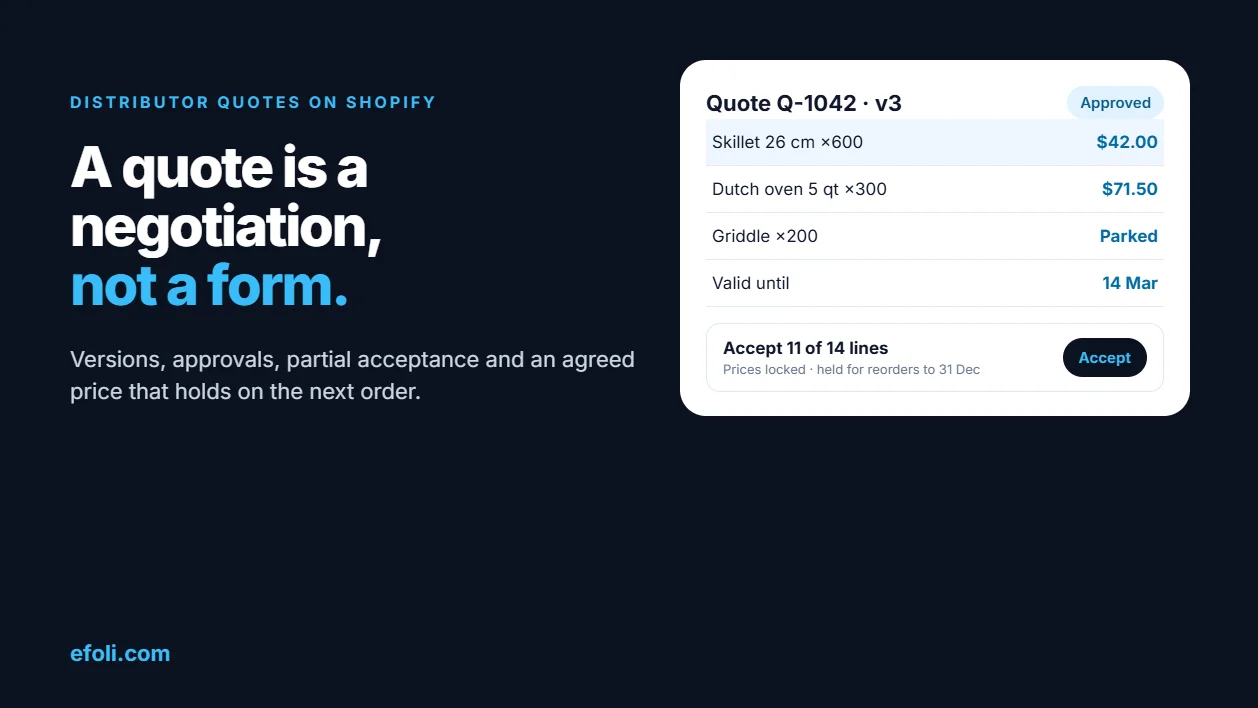
Corvane Kitchenware (fictional, like its distributors) makes cast-iron cookware and sells to restaurants directly and to retailers through regional distributors. In spring, a distributor in the Midwest asked for a quote: 14 products, roughly 2,000 units, for the autumn season.
Here's how it went.
Week 1: The distributor filled in Corvane's "Request a quote" form. Corvane's sales lead replied by email with a PDF.
Week 2: The distributor replied asking for a better price on four lines if they committed to a larger quantity. The sales lead checked with the finance director, who wanted a minimum on the whole order. A revised PDF went out.
Week 3: The distributor's buyer needed approval from their category manager, who was on holiday.
Week 4: The distributor accepted 10 of the 14 lines. The sales lead built a draft order by hand, copying prices from the second PDF. One price was copied from the first PDF by mistake.
Week 5: The distributor spotted the wrong price on the invoice. Another round of emails. The order was finally placed.
In September, the distributor reordered three of the products through Corvane's B2B store and was charged the standard trade price, not the negotiated one. More emails.
Every step of this was reasonable. The problem was that the store only handled the first step. Everything else lived in inboxes and PDFs.
The lifecycle of a distributor quote

The seven stages of a distributor quote, and where each one stalls.
A distributor quote moves through seven stages. Most stores only support the first.
Request. The distributor asks for prices on a list of products and quantities.
Proposal. You send prices, terms, lead times and a validity date.
Counter. The distributor asks for changes: price, quantity, terms.
Revision. You respond, sometimes after internal approval.
Approval. The distributor gets sign-off internally.
Acceptance. The distributor accepts all or part of the quote, and it becomes an order.
Repeat. The distributor reorders at the agreed price for the agreed period.
Stages 3 to 7 are where deals stall.
Where distributor quotes stall

Where distributor quotes go quiet, and why.
Stall 1: The request doesn't capture what you need
A form with "Product, quantity, message" gets you a starting point, and then a round of questions. For distributors, you usually need more: expected annual volume, delivery schedule (one drop or several), region, whether they want exclusivity, and payment terms. Ask the questions up front and you save a round trip.
Stall 2: The proposal is a PDF
PDFs are fine to read. They're terrible for negotiating. Each revision is a new file, and nobody is sure which one is current. When someone builds the order later, they copy prices from whichever PDF they open first. That's how Corvane got the wrong price on the invoice.
Stall 3: Counter-offers happen in email threads
"Could you do $42 on the skillets if we take 600?" is a normal question. When it arrives in an email reply, the answer goes into another email, and the quote itself doesn't change. Three rounds later, the real deal is spread across nine messages.
Stall 4: Your own approvals aren't planned
Discounts above a certain level usually need someone senior to sign off. If that's a quick message to the finance director, fine. If it's ad hoc, the quote sits. Worse, a salesperson may agree a price that finance later rejects.
Stall 5: The distributor's approvals take time
Your quote may need sign-off from the distributor's category manager, their finance team, or both. You can't control that, but you can make it easier: a clear summary, a validity date and a link they can forward, instead of a PDF attachment buried in a thread.
Stall 6: Partial acceptance needs a new quote
Distributors often accept some lines and park others. If your process can only accept a whole quote, the sales team rebuilds it. That's extra work and another chance for errors.
Stall 7: The agreed price disappears after the first order
This is the stall that costs the most over time. If the negotiated price only exists in one draft order, the next order defaults to the standard trade price. The distributor either renegotiates or, eventually, stops bothering.
Fixes that work
Fix 1: Ask distributor questions on the request form
Add the fields that shape a distributor price: annual volume estimate, delivery schedule, region, payment terms requested and whether this is a one-off or ongoing. Keep the form short for one-off requests and longer for distributor applications. QuotWay's free plan includes a request-a-quote button, form and drawer with built-in fields, and you can add custom ones.
Fix 2: Keep every version of the quote in one place
A quote that's edited in place loses history. A quote that's copied into a new file loses the thread. The better pattern is versions: each proposal and counter is saved as a locked version, so you can see exactly what was offered when. We've written about why that matters in immutable quote versions.
A B2B quote negotiation app such as QuotWay handles this as round-by-round negotiation, with each counter-offer saved as a locked version. Native Shopify doesn't have quote versions; teams that stay native usually keep the negotiation in email and only create a draft order at the end.
Fix 3: Set your approval rules before the quote goes out

Approvals on both sides before a proposal goes out. Source: QuotWay App Store listing.
Write down who approves what. For example: discounts up to 10% off trade, the sales lead decides; 10 to 20%, the sales manager; more than 20% or extended payment terms, the finance director. Then make the approval part of the quote workflow, so nothing goes out without it.
QuotWay supports multi-step approvals on both the merchant side and the buyer side. If you're on native Shopify, you can still keep the rule simple and visible: no draft order is sent to a distributor until the approver has replied "approved" on the quote record.
Fix 4: Give every quote a validity date
A quote without a validity date stays "live" forever in the distributor's mind. A quote with a date gives both sides a reason to move. How long depends on how stable your costs are.

How long to hold a quote, and what to do with the price afterwards.
Deal type | Typical validity | After acceptance |
|---|---|---|
One-off order, stable costs | 30 days | Price for this order only |
Seasonal order, stable costs | 30 to 60 days | Price for the season's orders |
Annual distributor agreement | 14 to 30 days to accept | Price held for the agreed period |
Volatile materials or freight | 7 to 14 days | Price for this order, or index-linked |
These are common ranges, not rules. Our sister blog has a longer guide on how long a B2B quote should be valid.
Fix 5: Let distributors accept part of a quote
When a distributor says "lines 1 to 10 now, the rest later", the quote should allow it. QuotWay lets buyers accept all or some line items and converts the accepted lines into a native Shopify draft order with prices locked. If you're working natively, create the draft order with only the accepted lines and record the rest as "parked" with their validity date.
Fix 6: Lock the price on the draft order
Shopify draft orders support price locks. According to Shopify's help center, a locked price stays fixed even if catalog prices change, which is exactly what you want when a distributor accepts a quote but pays a week later. Invoices and checkout links are locked by default. Two things to know: price locks don't apply to product bundles, and if you need a deposit on a B2B draft order, deposits are available only on Shopify Plus.
Fix 7: Turn the agreed price into a reorder price
This is the fix that pays off for years. When a distributor accepts a seasonal or annual price, store that price where their next order will find it.
You have two main options:
Shopify B2B catalogs. Assign a catalog with the negotiated prices to the distributor's company location. Plans below Plus can have up to three active catalog assignments across B2B markets, and direct assignment to company locations is a Plus feature, so check your plan before you build distributor-specific catalogs.
Company-specific pricing with an app. DiscountRay's Pro plan (company and customer list pricing, $29 a month at the time of writing) lets you set prices for specific companies or customers without changing base prices.
Either way, set an end date that matches the agreement. Then the distributor can reorder through a quick order form at the agreed price, without asking for a new quote. This is where the apps work as a set: quote in QuotWay, reorder through a MultiVariants B2B reorder form, and keep the agreed price in DiscountRay. For the bigger picture on distributor price structures, see distributor pricing on Shopify.
Fix 8: Follow up on a schedule, not on a feeling
Quotes go quiet. Sometimes the distributor is waiting for approval; sometimes they've gone elsewhere. A simple follow-up rhythm helps: a check-in three working days after sending, another a week before the validity date, and a final note on the day it expires. Keep each one short and useful ("Your quote is valid until Friday; the skillet lead time is now four weeks"). There's more on this in how to follow up on a B2B quote.
What a good distributor proposal includes
A proposal that answers the distributor's questions before they ask them saves a round of emails. A good one covers:
Products and quantities, with SKUs that match your catalogue, so the draft order can be built without retyping.
Unit prices and the basis for them, for example "price at 500+ units per drop" or "price for annual volume of 5,000 units".
Delivery schedule: one drop or several, lead times and the earliest ship date.
Payment terms: card, invoice on net 30, or a deposit with the balance on shipment.
Freight: who pays, from where, and whether it's quoted separately.
Validity date, in plain words: "Prices valid until 14 March."
What happens after acceptance: "Agreed prices apply to reorders until 31 December."
Who to contact, with a name, not a shared inbox.
The last two are the ones most often missing, and they're the ones that prevent most of the follow-up questions.
When your costs change mid-agreement
Distributor agreements often run for a season or a year. Your costs might not stay still that long. Raw materials, freight and exchange rates move, and sooner or later you'll face a choice: honour the agreed price and take the hit, or ask for a change.
There's no single right answer, but a few habits keep relationships intact:
Agree the rule up front. "Prices are fixed for the season" and "prices can be reviewed with 60 days' notice if material costs move by more than 8%" are both fair. Surprising a distributor mid-season isn't.
Honour open quotes. If a quote is within its validity date, honour it. That's what the date is for.
Give notice in writing, with reasons. A short note explaining what changed and when the new price applies is far better than a new price appearing on an invoice.
Update stored prices on the right date. If agreed prices live in a catalog or a pricing app, schedule the change so it applies from the agreed date, not the day someone remembers.
If you're planning a broader increase, our sister blog's guide on handling a wholesale price increase covers timing and communication in more detail.
Territory, exclusivity and other non-price terms
Distributor negotiations aren't only about price. Distributors often ask for a protected region, exclusivity on certain products, marketing support or first access to new lines. These terms change what a "good price" means, so record them alongside the quote, not in a separate email.
A simple way to do this is a "terms" note on every distributor quote: region, any exclusivity, marketing commitments and volume commitments. When the deal is accepted, the note travels with it. When the agreement comes up for renewal, you can see what was promised and whether both sides delivered.
Volume commitments deserve special care. If a distributor gets a lower price for committing to 5,000 units a year, decide in advance what happens if they buy 3,000. Many brands simply move them to the next price band at renewal rather than clawing back discounts. Whatever you choose, write it down.
Make it easy to approve on their side
You can't control the distributor's internal approvals, but you can make them faster. The person who asked for the quote usually has to persuade someone else, often a category manager or finance lead, who wasn't part of the conversation. Help them do that.
Lead with a one-paragraph summary. "14 products, 2,000 units, two drops in August and October, net 30, prices held to 31 December." The approver may read nothing else.
Show the saving against your standard trade price. Approvers want to know the deal is better than the default, and by how much.
Make it forwardable. A link to a quote page that anyone can open is easier to share than an attachment buried in a thread. If you use a quote app, check whether the buyer can share the quote internally or add colleagues.
Say what happens if they're late. "If we receive approval by 1 June, we can confirm the August drop." That gives your contact a reason to chase their own colleagues.
Offer a call. Some approvers want to ask one question. A fifteen-minute call can save two weeks of emails.
Buyer-side approval in a quote app helps here too. When the distributor's approver can see the quote, the history and the counter-offers in one place, they don't need to reconstruct the deal from a forwarded email chain.
Native Shopify, an app or a custom build?
You can run distributor quotes on native Shopify: request form, email negotiation, a draft order with custom prices and a price lock, then a B2B catalog for repeat pricing. Many brands with a handful of distributors do exactly that.
The point where an app starts to pay for itself is usually the counter-offer. Once you have several distributors negotiating at once, keeping versions and approvals in email gets risky. QuotWay's plans run from free (10 quotes a month) to $29, $79 and $199 a month at the time of writing. It's a new app, launched in June 2026, so trial it with one or two real distributor quotes before rolling it out.
A custom build makes sense when your quoting is tied deeply into an ERP or a pricing engine. We compared these routes in detail in QuotWay vs a custom RFQ, and looked at engineered-part quotes in manufacturing RFQs.
Before and after: Corvane's autumn quote
The following spring, the same Midwest distributor asks for a quote for the autumn season again.
The request form now asks for annual volume, delivery drops and payment terms. Corvane's sales lead builds the proposal in the quote app and sets a 30-day validity date. The discount on four lines needs the finance director's approval; the app routes it, and she approves the same afternoon. The distributor counters on two lines. The sales lead responds with a revised version; both versions are saved. The distributor's category manager approves on their side.
The distributor accepts 11 of 14 lines. The accepted lines become a draft order with the prices locked. The other three are parked until July.
Corvane then adds the agreed prices to the distributor's company pricing with an end date of 31 December. In September, the distributor reorders through the quick order form and pays the agreed price automatically.
Total time from request to order: nine working days.
What to measure
Five numbers tell you whether your distributor quoting is healthy:
Time from request to first proposal. Distributors notice speed.
Rounds per quote. If most quotes take four or more rounds, your first proposal may be off, or your request form isn't capturing enough.
Time waiting for internal approval. Your part of the delay.
Win rate by distributor and by product. Shows where your price isn't landing.
Repeat orders at agreed prices. The real measure of whether the deal stuck.
Common mistakes
Sending a price without a validity date. It's a commitment you didn't mean to make.
Negotiating in one place, ordering in another. That's how wrong prices reach invoices.
Approving after sending. Approve first, every time.
Forgetting the second order. If the agreed price isn't stored, it's lost.
Treating every distributor the same. A regional distributor buying twice a year needs a different deal from one buying weekly.
Yeah, but…: what sales teams push back on
Changing how quotes work can feel risky when deals are already moving. These are the usual concerns.
What you might be thinking | A fair answer |
|---|---|
"Our distributors prefer email." | Keep email for the conversation. Put the prices and versions on the quote, and send the link in the email. |
"A quote app is too much for a few deals a year." | Then stay native: draft orders with price locks, and a B2B catalog for agreed prices. Move to an app when several negotiations run at once. |
"Validity dates will put buyers off." | Often it's the opposite. A date gives your contact a reason to chase their own approvals. |
The checklist

Fourteen checks to keep distributor quotes moving.
Request
The form asks for volume, delivery schedule, region and payment terms.
One-off and distributor requests are separated.
Proposal and negotiation
Every quote has a validity date.
Each version is saved and can't be edited after sending.
Counter-offers are handled on the quote, not in separate emails.
Approvals
Discount and terms thresholds are written down.
Nothing goes out without the required approval.
The proposal is easy for the distributor to forward internally.
Acceptance
Distributors can accept part of a quote.
Accepted lines become a draft order with prices locked.
Parked lines keep their validity date.
Repeat
Agreed prices are stored for the distributor with an end date.
Distributors can reorder at the agreed price without a new quote.
Follow-ups are scheduled before the validity date.
The bottom line
A distributor quote isn't finished when you send the price. It's finished when the distributor reorders at that price without having to ask. Treat the quote as a negotiation with versions, approvals and partial acceptance, lock the price when they say yes, and store it where their next order will find it. That's how a five-week back-and-forth becomes a nine-day deal, and how one deal becomes a season of orders.
Corvane Kitchenware and its distributors are fictional, used to illustrate a common situation. Validity ranges are typical examples, not rules.
FAQ
How do I handle distributor quote requests on Shopify?
Can Shopify handle counter-offers on quotes natively?
Can a distributor accept only part of a quote?
What is a price lock on a Shopify draft order?
How long should a distributor quote be valid?
How do I keep negotiated prices for repeat orders?
Should I hide prices from distributors until they request a quote?

Anika Anamta Mehnaz
This article is written by Anika Anamta Mehnaz, a Content Writer and Content Marketing Strategist specializing in Shopify, eCommerce, and SaaS. With over four years of content writing experience, she creates SEO and AI search-optimized content that helps Shopify merchants make better business decisions through practical, research-backed insights. Her work covers Shopify apps, product variants, bundles, discounts, B2B commerce, and conversion-focused strategies. Outside of work, Anika enjoys watching anime, reading John Grisham novels, and discovering new ideas in digital marketing and e-commerce. If you enjoy discussing Shopify, content marketing, or online growth, feel free to connect with her. Twitter: https://x.com/mehnaz2201 Medium: https://medium.com/@mehnaz_78932
Keep reading
View all articles →
Replenishment Bundles on Shopify: Your Refill Customers Didn't Cancel. They Ran Out.
November 25, 2026 • 18 min read
Staff Uniform Ordering on Shopify: One Order, Four People, Three Weeks of Emails
November 25, 2026 • 18 min read
Auto Workshop Parts Ordering on Shopify: The Car Is on the Lift. Why Is the Technician on the Phone?
November 25, 2026 • 18 min read