Replenishment Bundles on Shopify: Your Refill Customers Didn't Cancel. They Ran Out.
Most wellness customers don't cancel. They just run out at the wrong time and buy elsewhere. Here's where replenishment breaks on Shopify and how bundles fix it.
On this page
- Key takeaways
- The customer who didn't cancel
- Why refill customers drift: four reasons
- Timing: the run-out gap
- Pack size: the quiet lever
- The refill ladder
- Bundles: the refill option most brands miss
- A refill page that does the selling
- Reminders: the cheapest fix
- Subscriptions: keep them easy to change
- Give them a reason to reorder from you
- Shipping speed is part of the product
- What Quietwood changed
- Work out days of supply in an afternoon
- When customers use more than one product
- What to measure
- Mistakes we see often
- How this connects to your other bundles
- "I hate subscriptions" and other objections
- The checklist
- The bottom line
- FAQ
Who this is for: wellness and consumable brands selling refills on Shopify. Last checked: 25 November 2026.
Short answer: Most refill customers don't cancel; they run out at an awkward moment and buy something nearby. Match pack sizes to real use, send reminders before run-out, make a longer-lasting refill bundle the default and keep subscriptions easy to change.
Key takeaways
The enemy of replenishment isn't cancellation. It's the gap between "almost empty" and "remembered to reorder".
Pack sizes are timing tools. A 30-day jar and a 45-day jar create very different reorder patterns.
Not everyone wants a subscription. Offer a refill bundle and a reminder too.
Price per day, not price per pack, is what makes bigger refills feel worth it.
Subscriptions that are hard to change get cancelled. Skip and swap should be one click.
The customer who didn't cancel
Quietwood Wellness (fictional, like its numbers) sells a magnesium body spray, a sleep tea and bath salts. Each product comes as a starter (a glass bottle, a tin, a jar) and a refill pouch.
Quietwood's first-order numbers were great. Repeat orders weren't. When the team called twenty customers who had bought once and not returned, they expected complaints. They didn't get many. Most people liked the products. They'd simply run out on a Sunday night, picked up something similar at a pharmacy on Monday, and never got round to ordering from Quietwood again.
"I meant to reorder," one customer said. "Then I had the other one, so I used that up first."
That's the replenishment problem in one sentence. Here's how it happens, and what you can do about it.
Why refill customers drift: four reasons

Four reasons refill customers drift, and the fix for each.
When repeat purchases are weaker than they should be, it's usually one of four reasons. Each has a different fix, so it's worth knowing which one you're dealing with.
Reason | What it looks like | Fix |
|---|---|---|
Timing | Customers run out before they reorder | Reminders before run-out, faster shipping on refills |
Pack size | The pack runs out too fast, or lasts so long they forget the brand | Pack sizes matched to real usage, plus a longer-lasting refill bundle |
Price | Refills don't feel cheaper than buying new elsewhere | Clear price per day, refill bundles with a real saving |
Forgetting | No prompt, no habit, no reason to come back | Reminders, subscriptions, a reason to reorder from you specifically |
Most brands have a bit of all four. But one usually dominates. Quietwood's was timing.
Timing: the run-out gap

When each pack size runs out, and when the reminder should arrive. Figures are illustrative.
Think about the moment a customer realises they need more. They pick up the bottle, it feels light, and they think "I should order more". If they order then, how long until it arrives? Three days? Five? And how many days does the bottle actually have left?
If the answer to the second question is shorter than the first, they'll run out. And once they've run out, the most convenient option wins, which usually isn't you.
Here's the basic maths Quietwood worked through for its sleep tea:
A tin holds 30 servings. Most customers drink one a night, so it lasts about 30 days.
Customers usually notice "running low" with about five servings left.
Standard shipping takes three to five working days. Order on a Friday and it might be eight calendar days.
So customers who noticed on a Friday had five days of tea and an eight-day wait. They ran out. The fix was partly reminders (sent at day 22, not day 30) and partly pack size, which we'll come to.
Your numbers will be different. Work them out for your top three products. You need three numbers: days of supply per pack, how many days before run-out customers notice, and your real delivery time including weekends.
Pack size: the quiet lever
Pack sizes are usually set by manufacturing or packaging costs. They should also be set by timing.
A 30-day pack reorders monthly, which is easy to remember and easy to put on a subscription. But it also means twelve chances a year to run out. A 90-day refill bundle reorders four times a year, which means four chances to run out and fewer shipping costs for you.
There's a catch. Packs that last too long make customers forget you. If someone buys a six-month supply, by the time they need more, they might not remember where it came from. Two or three months is often the sweet spot for wellness consumables: long enough to cut the run-outs, short enough to stay familiar.
The refill ladder

A refill ladder: each step lasts longer and costs less per day.
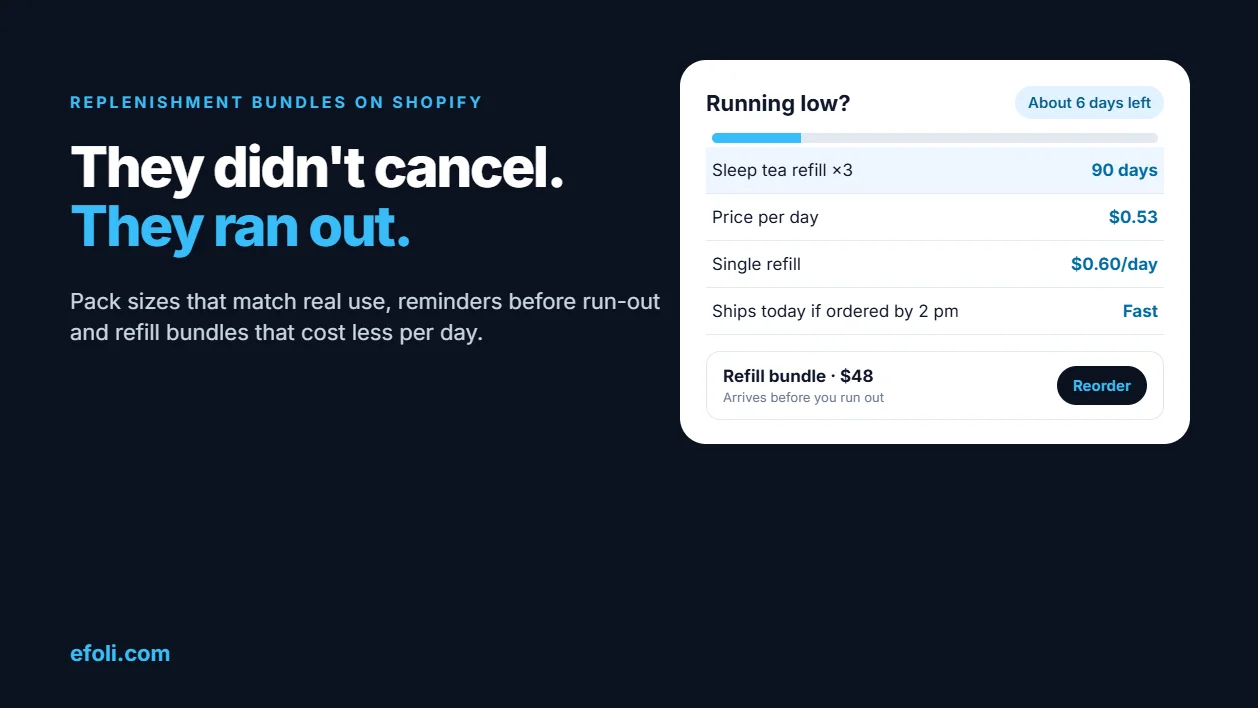
The most useful thing Quietwood did was design a refill ladder: a set of steps that each last longer and cost less per day.
Step | What's in it | Lasts | Price | Price per day |
|---|---|---|---|---|
Starter | Tin + 30 servings | 30 days | $24 | $0.80 |
Single refill | Pouch, 30 servings | 30 days | $18 | $0.60 |
Refill bundle | 3 pouches, 90 servings | 90 days | $48 | $0.53 |
Refill subscription | 3 pouches every 90 days | Ongoing | $45.60 (5% off) | $0.51 |
(Prices are illustrative.)
Three things make the ladder work:
The starter is the entry point, not the main product. People buy the tin once. Every order after that is a refill.
The bundle is the default refill. On the refill page, the 3-pouch bundle is shown first, with the price per day under each option.
The subscription is an option, not a gate. The subscription saves a little more, but the bundle already solves most of the timing problem on its own.
Bundles: the refill option most brands miss
When people talk about replenishment, they jump to subscriptions. But many customers don't want a subscription. They've been burned by ones that were hard to cancel, or they don't like committing. For them, a refill bundle is the right answer: buy three now, run out less, save a bit.
There are two kinds of refill bundles worth offering:
Same-product multipacks. "3 sleep tea refills". Simple and easy to understand. Shopify's own Bundles app can do fixed bundles and multipacks, so this one doesn't necessarily need an app. Note that Shopify Bundles isn't compatible with subscriptions, which matters if you later want to sell the bundle on a subscription too.
Mix-and-match refill bundles. "Any 3 refills". The customer picks a sleep tea, a body spray refill and bath salts. This suits brands where customers use several products at different rates. It needs a bundle app that supports mix-and-match. A refill bundle builder such as Push Bundle handles build-a-box and mix-and-match bundles with min and max limits on its Growth plan ($14 a month at the time of writing).

A build-a-box refill bundle with pack sizes and selection limits. Source: Push Bundle App Store listing.
Show the saving clearly. A tiered pricing app such as DiscountRay can show a tier table on the product page ("2 refills: 5% off, 3 refills: 10% off"), so the saving is visible before the customer decides. Quantity tiers are on DiscountRay's free plan.

A tier table shows the saving for two or three refills before checkout. Source: DiscountRay App Store listing.
For more on why tiered pricing helps bring people back, see Shopify tiered discounts for customer retention.
A refill page that does the selling
Most brands bury refills inside product pages. A dedicated refill page, linked from the main navigation and every reminder email, does far more work. Quietwood's refill page has five parts, in this order:
"Running low?" in the headline, with a one-line promise about delivery: "Order by 2 pm for dispatch today."
Product cards for each refill, showing which starter it fits, how long it lasts and price per day.
The 3-pouch bundle as the first option on each card, with single refills and subscriptions underneath.
A mix-and-match "any 3 refills" option for customers who use several products.
A short "how refilling works" section with a 20-second video of a pouch being emptied into the tin, because some customers simply weren't sure the refill would fit.
Two small details made a noticeable difference. First, showing "Lasts about 90 days" in larger type than the price. Second, adding the customer's last order date when they're signed in ("You last ordered sleep tea on 3 March"), which nudges people to check their shelf.
None of this needs a custom build. It's a collection page, a bundle app for the multi-pack and mix-and-match options, and a little theme work.
Reminders: the cheapest fix
A well-timed email or text is the cheapest replenishment tool you have, and most brands send it at the wrong time.
The reminder should arrive before the customer notices they're running low, not after. For Quietwood's 30-day tin, that meant day 22. For the 90-day bundle, day 75. The message is simple: "Your sleep tea should be running low in about a week. Reorder now and it'll arrive before you run out." Link straight to a pre-filled cart if your setup allows it.
A few rules that help:
Time it by product, not by order. If someone ordered tea and bath salts together, they won't run out of both on the same day.
Adjust for what they actually bought. Someone who bought a 3-pouch bundle doesn't need a reminder at day 22.
Stop when they reorder. Few things annoy people more than a "running low?" email after they've already reordered.
Don't lead with a discount. Leading with a discount every time trains people to wait for one. Lead with timing.
Most email platforms that connect to Shopify can trigger messages a set number of days after a purchase of a specific product. Start simple: one reminder per top product.
Subscriptions: keep them easy to change
Subscriptions work beautifully for some customers and badly for others. The difference is usually how easy they are to adjust.
Shopify's free Subscriptions app supports weekly, monthly or yearly renewals and several discount types. According to Shopify's help center, customers can skip, resume or cancel from their customer account, and merchants can modify, skip, pause and cancel contracts. If your customers need to swap products or change frequency themselves, check whether your subscription app supports that before you launch, because it's one of the main reasons people cancel rather than adjust.
What tends to make subscriptions stick:
Frequency that matches usage. If the product lasts 30 days, don't default to a 4-week cycle; 28 days becomes a stockpile over time.
One-click skip. People go on holiday. If skipping is hard, they cancel.
Easy swaps. "Swap this month's sleep tea for bath salts" keeps people subscribed through phases.
A reminder before each charge. No surprises.
A clear way to cancel. Hiding the cancel button doesn't keep customers; it creates chargebacks and bad reviews.
A note on the law, because it changed recently. In July 2025, a US federal appeals court (the 8th Circuit) vacated the FTC's "click-to-cancel" amendments to its Negative Option Rule. That doesn't mean anything goes. Several states have their own automatic renewal laws, and the FTC can still act against deceptive practices. This isn't legal advice, but easy cancellation is good practice regardless, and it's simply better business.
If you want to sell bundles on a subscription, check compatibility first. Not every bundle app works with every subscription app. Our post on checking subscription bundle compatibility walks through how to test it, and Mix & Match bundles sold as subscriptions covers one way to set it up.
Give them a reason to reorder from you
Timing, pack size and price get customers to reorder. They don't stop customers from reordering somewhere else. For that, you need a reason that's specific to you:
Refills that fit your container. If your pouch fits your tin, the tin becomes the reason to come back.
Something you can't buy at the pharmacy. A flavour, a size or a blend only available online.
A small reward for loyalty. Not a discount every time, but something at the third or fourth reorder: a free sample, a new flavour to try.
Being reliably fast. If your refills arrive in two days and the alternative is a trip to a shop, many people will wait for yours.
Shipping speed is part of the product
For replenishment, delivery speed matters more than for almost anything else you sell, because the customer is racing their own empty bottle. Two habits help. First, prioritise refill orders in the warehouse: if refills ship the same day, the reminder window can be shorter and fewer people run out.
Second, say it clearly. "Order by 2 pm, ships today" on the refill page and in reminder emails turns speed into a reason to reorder from you rather than pick something up locally. If you can't ship that fast, send reminders earlier instead.
What Quietwood changed
Over two months, Quietwood made five changes:
Moved refills to the front. The navigation now has "Refills" as a top-level link, with the refill ladder on one page.
Made the 3-pouch bundle the default refill. With price per day shown under each option.
Added mix-and-match refills. "Any 3 refills" for customers who use more than one product.
Sent reminders at the right time. Day 22 for single refills, day 75 for bundles, per product, stopped on reorder.
Made subscription changes simple. Skip and cancel in the customer account, with a reminder before each charge.
The biggest single shift was the bundle. Customers who bought a 3-pouch bundle ran out a third as often and were far more likely to buy a second bundle than single-refill customers were to buy a second single. (Quietwood's figures are fictional, but the pattern is one we hear often from consumable brands.)
Work out days of supply in an afternoon
You don't need a data team to find out how long your products really last. Three quick methods, used together, are enough.
Look at your own order history. For each top product, find customers who bought it at least twice and work out the median number of days between their orders. That's your real reorder cycle, which is often different from the "30 servings" on the label. Some people use a product daily; others use it three times a week.
Ask customers. A one-question email to recent buyers ("How long does a tin of sleep tea usually last you?") with four answer options gets a surprising number of replies. It also tells customers you care about their routine, which does no harm.
Use it yourself. Ask three people in your team to use the product as directed and note when they run low. It's a small sample, but it catches label claims that don't match reality, such as a "30-day" spray that most people finish in three weeks.
Put the three answers side by side. Where they agree, you have your number. Where they don't, trust the order history most, because it's what customers actually did.
When customers use more than one product
Many wellness customers buy two or three products that run out at different rates: a tea that lasts a month, bath salts that last six weeks, a spray that lasts three weeks. That creates a constant trickle of small reorders, each with its own shipping cost and each a chance to drift.
Two approaches help:
Sync the cycle. Offer refill sizes that line up. If the tea lasts 30 days and the spray lasts 20, a 3-pouch tea bundle (90 days) and a 4-pack spray refill (80 days) arrive close enough to ship together.
Let the customer build the box. A mix-and-match refill bundle ("any 4 refills") lets each customer balance products to their own use. Someone who uses more spray than tea simply picks more spray.
Either way, send one reminder for the bundle, not separate reminders for each product. Three emails in a fortnight about three products feels like spam, even when each one is well timed.
What to measure
Replenishment is easy to measure and easy to measure badly. Overall repeat rate hides most of what's happening. These numbers tell you much more:
Measure | What it tells you |
|---|---|
Repeat purchase rate by product at 45, 90 and 180 days | Which products bring people back, and how fast |
Median days between orders, by product and pack size | Whether pack sizes match real use |
Share of refills bought as bundles | Whether the bundle is doing its job |
Reminder email to order rate | Whether timing is right |
Subscription skips vs cancellations | Whether people adjust or leave |
Time from "out of stock" to back in stock on refills | Whether your own stock causes drift |
That last one is easy to forget. If your refill pouches sell out for two weeks, every customer who runs out in that window is a customer you're sending to the pharmacy. Refills deserve priority in your stock planning, because they're what keeps the business running between new-customer campaigns.
Mistakes we see often
Treating the starter as the hero product forever. After the first order, the refill is the hero.
Only offering subscriptions. Plenty of loyal customers will never subscribe.
Reminders after run-out. By then, they've bought something else.
Discounts that make the single refill look bad. If the bundle is 40% off, the single refill looks like a rip-off. Keep the gaps sensible.
Ignoring the container. If the refill doesn't fit the starter easily, people stop refilling.
How this connects to your other bundles
Refill bundles sit alongside the other bundles a wellness brand might offer. A daily routine pack, like the ones in our vitamin pack builder post, is about choosing what goes together. A routine bundle, like those in haircare routine bundles, is about selling the system. Refill bundles are about what happens after: keeping customers supplied once they've chosen. If you're thinking of turning refills into a box programme, running a subscription box business on Shopify is worth a read first.
"I hate subscriptions" and other objections
Your customers have their reasons for not reordering. So do brands for not fixing replenishment. Here are three, with answers.
What you might be thinking | A fair answer |
|---|---|
"Our customers say they hate subscriptions." | Then don't lead with one. Offer the refill bundle and a reminder, and say it plainly: "No subscription needed. Buy three refills now and we'll remind you before you run low." |
"Bigger bundles will cut our order count." | You'll get fewer, larger orders and fewer run-outs. Compare revenue per customer over six months, not orders per month. |
"Reminder emails feel pushy." | They feel pushy when they arrive after the customer has reordered, or when every one has a discount. Timed to run-out and stopped on reorder, they read as a service. |
The checklist

Fourteen checks for a refill offer customers keep using.
Timing
You know days of supply for your top three products.
You know your real delivery time, including weekends.
Reminders arrive several days before run-out.
Pack sizes
Refills come in at least one size that lasts two to three months.
Refills fit the starter container easily.
Bundles
A refill bundle is the default refill option.
Price per day is shown for each option.
A mix-and-match refill bundle exists if customers use several products.
Subscriptions
Frequency matches real usage.
Skip and cancel are easy to find.
A reminder goes out before each charge.
Bundle and subscription apps are tested together.
Loyalty
There's a reason to reorder from you specifically.
Repeat rate is tracked by product, not just overall.
The bottom line
Replenishment isn't about locking customers in. It's about making sure they never hit the moment where your product runs out and someone else's is closer. Match pack sizes to real use, remind people before they run low, make the longer-lasting refill the obvious choice and keep subscriptions easy to change. The customers who like your product will do the rest.
Quietwood Wellness and its figures are fictional, used to illustrate a common situation. Prices are illustrative. Subscription law points are general information, not legal advice.
FAQ
What are replenishment bundles on Shopify?
Do I need a subscription to sell refills?
When should I send a reorder reminder?
Can I sell a refill bundle on a subscription?
What can customers do in Shopify Subscriptions?
How do I price refill bundles?
Should refill bundles be cheaper than subscriptions?

Anika Anamta Mehnaz
This article is written by Anika Anamta Mehnaz, a Content Writer and Content Marketing Strategist specializing in Shopify, eCommerce, and SaaS. With over four years of content writing experience, she creates SEO and AI search-optimized content that helps Shopify merchants make better business decisions through practical, research-backed insights. Her work covers Shopify apps, product variants, bundles, discounts, B2B commerce, and conversion-focused strategies. Outside of work, Anika enjoys watching anime, reading John Grisham novels, and discovering new ideas in digital marketing and e-commerce. If you enjoy discussing Shopify, content marketing, or online growth, feel free to connect with her. Twitter: https://x.com/mehnaz2201 Medium: https://medium.com/@mehnaz_78932
Keep reading
View all articles →
Distributor Quote Requests on Shopify: Where Negotiated Deals Stall
November 25, 2026 • 18 min read
Staff Uniform Ordering on Shopify: One Order, Four People, Three Weeks of Emails
November 25, 2026 • 18 min read
Auto Workshop Parts Ordering on Shopify: The Car Is on the Lift. Why Is the Technician on the Phone?
November 25, 2026 • 18 min read