On this page
- Key takeaways
- Three buyers, one kit
- Where the kit falls apart
- Finding: the list lives in the email, not the store
- Choosing: too many options for someone who doesn't know yet
- Sizing: the same question, asked several times
- Pricing: the code that doesn't quite work
- Branding: the club shirt is somewhere else
- Timing: the kit arrives after it's needed
- Who pays for the friction
- What a joining-ready kit looks like
- A fixed core with a few choices
- Sizes asked once, in one place
- Member pricing that just works
- Gym-branded items inside the kit
- Delivery timed for the first visit
- Bulk kits for gyms
- Selling kits at the front desk
- A note on claims
- Worked example: Ironbark Athletic
- The problem, as the team saw it
- What Ironbark changed
- What happened
- Merchant checklist: decisions before the next intake
- Habits that send members elsewhere
- Summing Up...
- FAQ
Short answer: New gym members tend to need the same handful of items in their first week: something to carry water or a shake, a towel, a lock, grip or support gear, and often a club T-shirt. Most fitness stores on Shopify sell those as separate products, with separate size choices, separate shipping and a member discount that may not work on all of them. So the member places several orders or gives up halfway, the kit arrives after their first sessions, and the gym fields questions it can't answer. The fix is to sell the starter kit as one product built around the joining moment: a fixed core with a few choices, sizes chosen once, member pricing that's easy to apply, delivery or club pickup timed for the first visit, and a simple way for partner gyms to order kits in bulk.
Sam joined a gym on a Saturday. The welcome email had a list of what new members usually bring: a lock for the lockers, a towel, a water bottle or shaker, lifting straps or gloves, and the club's own T-shirt for the free intro class on Thursday. It also had a 15% code for the gym's retail partner.
Sam opened the partner's Shopify store on their phone. The lock was in "Accessories". The towel was in "Recovery". The shaker had seven colours and two sizes. The gloves needed a size, and the size chart was a PDF. The club T-shirt lived in a separate "Partner Clubs" collection that took two searches to find, and the 15% code didn't apply to it. Shipping was free over a threshold Sam didn't reach after the code. By the time everything was in the cart, it was late, and Sam bought the T-shirt and the gloves and meant to come back for the rest.
On Thursday, Sam turned up without a lock, borrowed a towel from the front desk, and asked the staff why the code hadn't worked on the shirt. Nobody on the desk knew.
None of that is anyone's fault in particular. The store is organised by product type. The member is shopping for a moment. This article is for fitness retail brands, gym and club retail teams, and the agencies that build their stores. It follows the problem from the buyer's side, maps the friction, looks at what it costs, and ends with a checklist.
Key takeaways
A starter kit is bought for a moment, joining a gym, not for a product category.
Three buyers are involved: the member, the gym that recommends or buys the kit, and often the front desk.
The main friction points are finding the items, choosing sizes, applying member pricing, delivery timing and gym-branded items sitting outside the normal range.
The costs show up as split shipments, size exchanges, code support, manual partner orders and gyms losing trust in the recommendation.
Sell one kit with a fixed core and a few choices, ask for sizes once, make member pricing automatic where possible, and offer club pickup or delivery timed for the first visit.
Don't make performance or results claims in the kit copy, especially if it includes supplements.
Three buyers, one kit
The first thing to get right is who's actually buying. A gym starter kit usually has three buyers, and each sees the problem differently.
The new member wants to be ready for their first sessions without thinking too hard. They don't know what they need yet, and they're often a little nervous about getting it wrong. They'll follow the gym's list if it's easy.
The gym or club wants new members to turn up equipped, feel looked after and keep coming. Some gyms only recommend a kit. Others buy kits in bulk and hand them over at joining, include them in a premium membership, or sell them at the front desk. Many want their own branding on some items.
The front desk is where everything that goes wrong online ends up. Staff answer "what size gloves?", "why didn't my code work?" and "when will my order arrive?", usually without access to the store.
A store designed only for the member misses what the gym needs. A store designed only for bulk orders misses the member who wants to buy their own. Most fitness brands that work with gyms need to serve both.
Where the kit falls apart
Here's what happens at each step of Sam's experience, set against what the store does today.

Moment | What the member expects | What the store does | What happens |
|---|---|---|---|
Welcome email | One link to "what I need" | Links to the homepage or a collection | The member searches |
Finding items | Everything on one page | Items spread across categories | Items get missed |
Choosing | A sensible default | Every colour and size of every item | Decision fatigue |
Sizes | Choose once | A size choice on each product, different charts | Wrong sizes |
Member pricing | Price applies to the kit | A code that excludes some items | Confusion, support emails |
Gym-branded items | Part of the kit | A separate collection or a separate store | Missed or bought separately |
Delivery | Before the first session | Standard shipping, split parcels | Arrives late |
First visit | Ready to train | Partly equipped | Borrowed towel, a question at the desk |
Finding: the list lives in the email, not the store
The gym's welcome email has the list. The store doesn't. So the member has to turn a list into searches. Each search is a chance to get distracted, find the wrong product or give up. Brands often link to "Accessories" and assume members will find their way, but a new member doesn't know which of 40 accessories the gym meant.
Choosing: too many options for someone who doesn't know yet
A regular customer knows which shaker they like. A new member doesn't. When every item shows every option, the member is asked to make five decisions they aren't ready for. Most of them would happily take a sensible default, as long as they can change the one thing they care about, such as colour.
Sizing: the same question, asked several times
Gloves, wrist wraps, a T-shirt and sometimes shorts or socks all need sizes, and they often use different charts. Asking for each size on a different product page, with charts in different formats, is where most wrong sizes come from. A member who orders a medium tee and large gloves may be right, but they're more likely to be guessing.
Pricing: the code that doesn't quite work
A member discount is usually a code. Codes are easy to send in an email but easy to get wrong in the store. They may exclude gym-branded items, sale items or bundles, or not combine with free shipping. The member doesn't know the rules. They just see that the price isn't what the email promised.
Branding: the club shirt is somewhere else
Gym-branded items are often set up as a special collection, a hidden product or a separate store. That makes sense for the brand, but it splits the kit in two from the member's point of view.
Timing: the kit arrives after it's needed
Members usually join just before they start. If the kit ships in several parcels, or with standard delivery, it often arrives after the first few sessions. By then the member has borrowed a towel, bought a lock somewhere else and decided they don't need the shaker.
Who pays for the friction
The costs aren't only lost sales. Most of them land on operations, and many land on the gym rather than the store.
Split orders and split parcels. A kit bought as three orders costs three lots of picking, packing and shipping. If the member stops halfway, the brand has paid to acquire a customer for a partial order.
Size exchanges. Every wrong size is a return label, a restock and a second shipment, plus a member who trains in borrowed gear in the meantime. Apparel and gloves are the usual culprits.
Discount support. Codes that don't apply as expected create emails to customer service and questions at the gym's front desk. The front desk can't fix them, so the member gets passed around.
Manual partner orders. Gyms that buy kits in bulk often email a spreadsheet of sizes. Someone at the brand turns that into a draft order by hand, line by line. Mistakes in the spreadsheet become mistakes in the shipment.
Stock that doesn't match the kit. If the kit isn't a product, there's no clear view of how many complete kits can be sold. The brand discovers it's out of medium tees when a gym's bulk order comes in.
The gym's trust. A gym that recommends a partner brand is lending its reputation. If members complain about codes, late deliveries or wrong sizes, the gym stops recommending the brand, or starts sourcing its own kit. That's the most expensive cost of all, and the hardest to see in store reports.
We won't put a number on how much any of this costs a typical brand. It depends on order volumes, margins and how many gyms you work with. The point is to recognise where the costs land, so you know what to fix first.
What a joining-ready kit looks like
The fix isn't a new collection. It's one product, built around the moment, that works for both the member and the gym.
A fixed core with a few choices
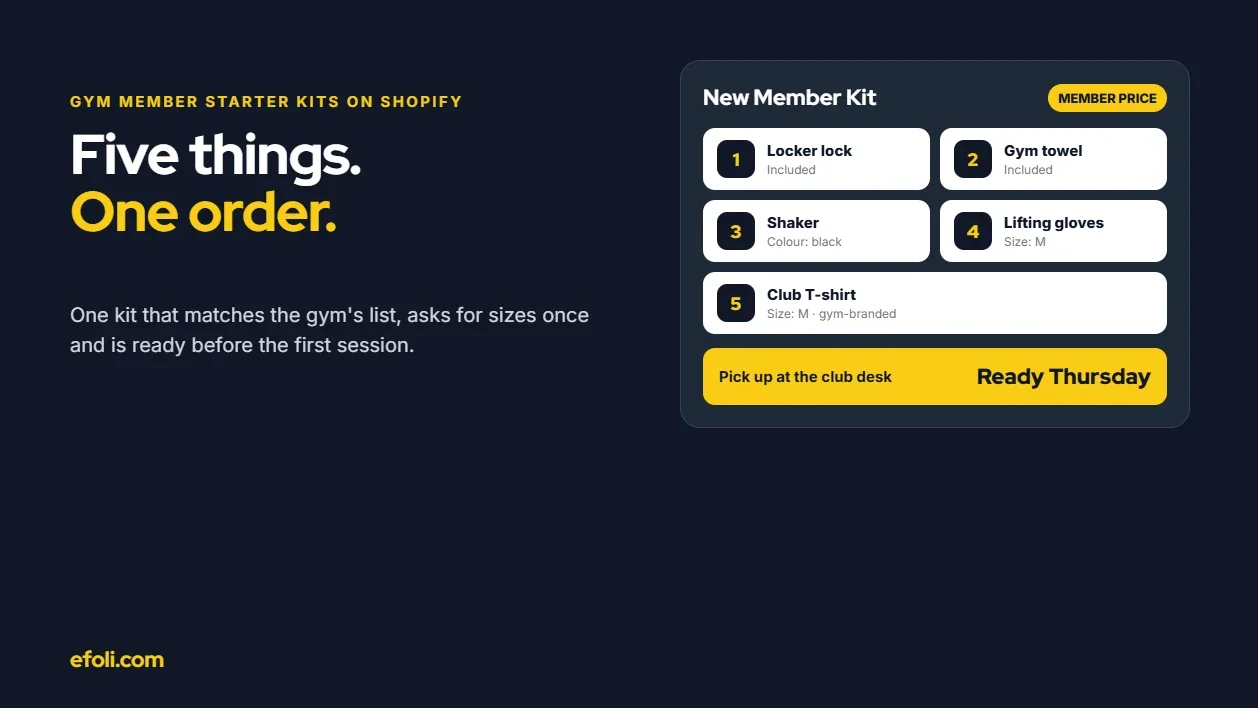
Start with what every new member needs, then allow a small number of choices. A typical kit might be:
Fixed: lock, gym towel, shaker or bottle
Choose a colour: shaker or bottle
Choose a size: gloves or wrist wraps, club T-shirt
Optional add-on: a resistance band or a second tee
Keep the choices to things the member cares about. Don't ask a new member to choose between two lock models. If the gym has a list, the kit should match it exactly.
In Shopify, a kit like this is a bundle. Push Bundle, a Shopify mix and match bundle app, can build it as a build-a-box or Mix & Match bundle on its Growth plan ($14 a month), with minimum, maximum and variant limits to keep the kit to the agreed contents. The kit appears as a single product in the cart and keeps stock in sync for each component, so selling a kit reduces stock of the towel, lock and the size of tee chosen. If you're new to bundle types, Push Bundle's guide to the best Shopify bundle apps explains the options.
Sizes asked once, in one place
Put the size choices together in the kit, with one size guide that covers every sized item. If the gloves and tee use different charts, show both on the same panel. Use plain words alongside the chart: "most people who wear a medium tee take a medium glove" is more useful than two separate tables, if it's true for your products. Check that with your own returns data before writing it.
Member pricing that just works
There are a few ways to make member pricing easier than a code that may or may not apply:
Price the kit for members. If the kit only exists for gym members, its price can already include the member saving.
Use customer tags. If members create an account with the gym's referral, a tag can unlock member pricing automatically. DiscountRay, a Shopify member discount app, offers pricing by customer group and tag on its Growth plan ($14 a month) and personalised discounts on its Pro plan ($29 a month).
Use unique codes per member. DiscountRay's Growth plan includes bulk and personalised codes, so a gym can send each new member their own code instead of sharing one code that ends up on discount sites.
Use email domains for corporate gyms. If a workplace gym or corporate wellness scheme is involved, DiscountRay's Pro plan can price by email domain.
Whichever you choose, decide in advance whether gym-branded items, sale items and the kit itself are included, and say so in the welcome email. DiscountRay's guide to personalised discounts covers how targeted offers work.
Gym-branded items inside the kit
If the gym's T-shirt is part of the kit, put it in the kit. If it's a separate product for stock or licensing reasons, it can still be a component of the bundle. The member shouldn't have to find a second collection.
Delivery timed for the first visit
Two options help the kit arrive on time:
Delivery promise. Show an honest delivery estimate on the kit page and in the welcome email, and send the kit as one parcel.
Pickup at the club. If the gym has stock on site or receives a regular delivery, Shopify's pickup option lets members collect from a location. Shopify's pickup in store guide explains that pickup needs a location that fulfils online orders, and by default it's only offered when the whole order is in stock at that location. You can add pickup instructions and set an expected pickup time, and the customer gets a notification when the order is ready.
Club pickup also gives the gym a reason to greet the new member by name on their first visit, which is a better start than a borrowed towel.
Bulk kits for gyms
For gyms that buy kits for members, replace the emailed spreadsheet with something structured. A bulk order form that lets the gym choose quantities by size in one view saves a lot of re-keying. MultiVariants, a Shopify bulk order form app, adds list, grid and matrix order forms, with quantity rules and B2B catalog pricing on its paid plans. MultiVariants' post on Shopify apps for fitness accessories covers ordering setups for this kind of range, and its guide to corporate gift orders is close to how gyms order kits in bulk.
Selling kits at the front desk
If the gym sells kits at the desk using Shopify POS, the same kit can be sold there. Push Bundle's bundles work in POS, with staff using a PushBundle tile, prices matching the online store, and component stock deducted at the POS location. Some setups aren't available on POS yet, including bundles limited to specific customers, so check the current list in Push Bundle's POS bundles guide before you plan member-only kits at the desk.
A note on claims
Starter kits often come with copy about results: "everything you need to transform", "hit your goals faster". Be careful. Unless you can back up a claim about results, leave it out. If the kit includes supplements such as protein powder, take more care still. In the US, dietary supplement claims about the body's structure or function come with specific rules, including a disclaimer and a notification to the FDA, as the FDA explains on its structure/function claims page. Other countries have their own rules. A kit page that sticks to what's in the box, why new members find each item useful and how to choose sizes is both safer and more helpful.
If supplements are a big part of your range, see our separate guide to sports nutrition bundles on Shopify. For beginner kits in other sports, where the challenge is choosing the right gear rather than joining a club, see outdoor starter kits on Shopify.
Worked example: Ironbark Athletic
Ironbark Athletic is a fictional fitness accessories brand that supplies gloves, wraps, towels, shakers and apparel. It partners with 14 independent gyms, which send new members a 15% code and a list of recommended items. Three of the gyms also buy kits for their premium members.
The problem, as the team saw it
Ironbark's customer service lead pulled a month of emails tagged "gym partner". Most fell into four groups: the code not applying to gym-branded shirts, wrong glove sizes, kits arriving after the member's intro session, and bulk-order corrections from the three gyms that bought kits. Two gyms had stopped sending the code in their welcome emails.
What Ironbark changed
One kit per gym. Ironbark built a "New Member Kit" for each partner gym using a Push Bundle bundle: lock, towel and shaker fixed, a colour choice for the shaker, a size choice for gloves and the gym's own tee. The gym-branded tee became a component of that gym's kit, not a separate product in a hidden collection.
One size panel. The kit page had a single size guide covering gloves and tees, with a short line on how to measure a hand.
Member pricing built in. Instead of a shared code, the kit was priced at the member rate. For members buying other items, the gyms sent unique codes generated in DiscountRay, which also stopped the shared code turning up on coupon sites.
Club pickup. Five gyms with front-desk storage became pickup locations. Ironbark sent a weekly stock delivery of kits to each, so pickup could be offered when the whole order was in stock there. Members collected on their first visit.
Bulk orders by form. The three gyms that bought kits switched from emailed spreadsheets to a matrix order form showing sizes in one grid.
What happened
Ironbark didn't run a controlled test, so we won't claim a conversion change. What the team could see was in the inbox. Code complaints from partner members mostly stopped once the kit was priced for members. Bulk-order corrections dropped because gyms entered sizes in a grid instead of a spreadsheet. And both gyms that had stopped sending the code started again after seeing the new kit page.
Merchant checklist: decisions before the next intake
Use this list to work through the decisions. Each item is a decision for your team, not a feature to switch on.

Kit contents
Have we agreed the kit contents with each partner gym, matching their welcome list?
Which items are fixed, which have a choice, and which are optional?
Are gym-branded items part of the kit, not a separate collection?
Is there one kit per gym, or one general kit with a gym choice?
Sizes
Are all size choices in one place in the kit?
Is there one size guide that covers every sized item?
Do our returns data support any sizing advice we give?
Pricing
Does the kit price already include the member saving, or does it need a code?
If we use codes, are they unique per member or per gym?
Have we decided whether member pricing applies to branded items, sale items and the kit itself?
Have we tested the kit with every active discount in the same cart?
Delivery
Do we show an honest delivery estimate on the kit page and in the welcome email?
Does the kit ship as one parcel?
Can partner gyms act as pickup locations, and can we keep kit stock there?
Partner gyms
Can gyms order kits in bulk by size without a spreadsheet?
Do gyms that sell at the front desk have the kit on POS, at the same price?
Does the front desk know who to contact when a member has a problem?
After joining
Is there a follow-up for members who bought the kit, such as a second towel or a replacement shaker?
Do we review partner emails and returns every month to see what's still going wrong?
Copy and claims
Does the kit page avoid results claims we can't support?
If the kit includes supplements, have the claims been checked against local rules?
Habits that send members elsewhere
Linking the welcome email to the homepage. Link to the kit, or at least to a page that matches the gym's list.
Putting every colour of every item in the kit. A new member wants a sensible default and one or two choices.
One code for everyone. A shared code is hard to control and easy to leak. Unique codes or built-in member pricing work better.
Treating gym-branded items as a different store. If it's on the gym's list, it belongs in the kit.
Ignoring the front desk. Give gym staff a one-page guide with the kit link, pickup instructions and a support contact.
Writing about results. Describe what's in the kit and why it's useful. Leave transformation claims out.
Summing Up...
A new gym member doesn't need five orders. They need one kit that matches the gym's list, asks for sizes once, prices correctly for members, includes the gym's own shirt and arrives before the first session, or waits for them at the front desk. Build that, give partner gyms a proper way to order in bulk, keep results claims out of the copy, and Sam turns up on Thursday with a lock.
FAQ
What should a gym member starter kit include?
How do I sell a gym starter kit as one product on Shopify?
How can I give gym members a discount on Shopify without shared codes?
Can members pick up their starter kit at the gym?
How can gyms order starter kits in bulk?
Should a gym starter kit include supplements?

Anika Anamta Mehnaz
This article is written by Anika Anamta Mehnaz, a Content Writer and Content Marketing Strategist specializing in Shopify, eCommerce, and SaaS. With over four years of content writing experience, she creates SEO and AI search-optimized content that helps Shopify merchants make better business decisions through practical, research-backed insights. Her work covers Shopify apps, product variants, bundles, discounts, B2B commerce, and conversion-focused strategies. Outside of work, Anika enjoys watching anime, reading John Grisham novels, and discovering new ideas in digital marketing and e-commerce. If you enjoy discussing Shopify, content marketing, or online growth, feel free to connect with her. Twitter: https://x.com/mehnaz2201 Medium: https://medium.com/@mehnaz_78932
Keep reading
View all articles →
Build Your Own Makeup Kit Without Turning Checkout Into a Shade Test
November 18, 2026 • 20 min read
Native Shopify B2B or DiscountRay for Complex Catalogue and Price Rules?
November 18, 2026 • 19 min read
The Dog Needs Sensitive Food. The Cat Needs Everything Else.
November 18, 2026 • 18 min read