Shopify Fall '26 Edition: What It Changes for How You Sell in 2026
Shopify's Fall '26 Edition brings 150+ updates, but only a few change how most stores sell. Here's what's live, what's coming, and what to do before and after BFCM.
On this page
- Shopify Fall '26 Edition: what's live and what's still coming
- Which Fall '26 updates matter for your store
- Selling through AI shopping agents
- What changes for bundles
- What changes for discounts
- What changes for variants and wholesale
- What changes for content and the Shop app
- What changes for checkout and delivery
- App changes due in 2027
- Other updates worth knowing
- What to do this week, and what can wait
- Conclusion
You're three weeks from Black Friday, your offers are set, and Shopify has just released 150+ updates. Some of them touch the exact things you sell with: bundles, discounts, variants and checkout. Others won't matter to your store for months. Reading the whole list to work out which is which takes time you don't have in November.
That matters because a few of these changes affect sales right away. Shoppers can now buy from your store inside AI agents, but not every product type works there. Discounts can now be scheduled and tested with rollouts, but there are limits. And two app deadlines in early 2027 could break parts of your storefront if nobody acts on them.
This guide sorts the Shopify Fall '26 Edition by what you sell and what you do, not by Shopify's own categories. For each area, you'll see what changed, who gets it, what it doesn't do, and what to do about it. Where it matters, we've also added what we found when we checked these features against our own Shopify apps.
Short answer
Shopify released its Fall '26 Edition, named "Exponential", on October 28, 2026. It includes more than 150 updates, and most of them are already live. For most merchants, the updates that matter most are selling through AI shopping agents, scheduling and testing discounts with rollouts, multiple barcodes and package dimensions per variant, new checkout and delivery options, and two app deadlines in January and March 2027. Some features are still rolling out, in early access, or marked coming soon, so check the status before you plan around one.
TL;DR
The Shopify Fall '26 Edition launched on October 28, 2026, with 150+ updates across selling, checkout, operations and apps.
Your products can now be bought inside Google AI Mode, the Gemini app and several personal AI agents, but bundles, subscription-only products and local delivery don't work in Google's agent checkout yet.
Shopify rollouts can now launch, schedule and test discounts together with theme changes, but app discounts depend on the app supporting rollouts.
Variants get up to 20 barcodes each and their own package dimensions, and the new variant editor reaches stores in December.
Custom checkout fields are rolling out, and returns can now be set by market.
Script tags stop loading on March 1, 2027, so ask your app vendors now whether they still use them.
Shopify Fall '26 Edition: what's live and what's still coming
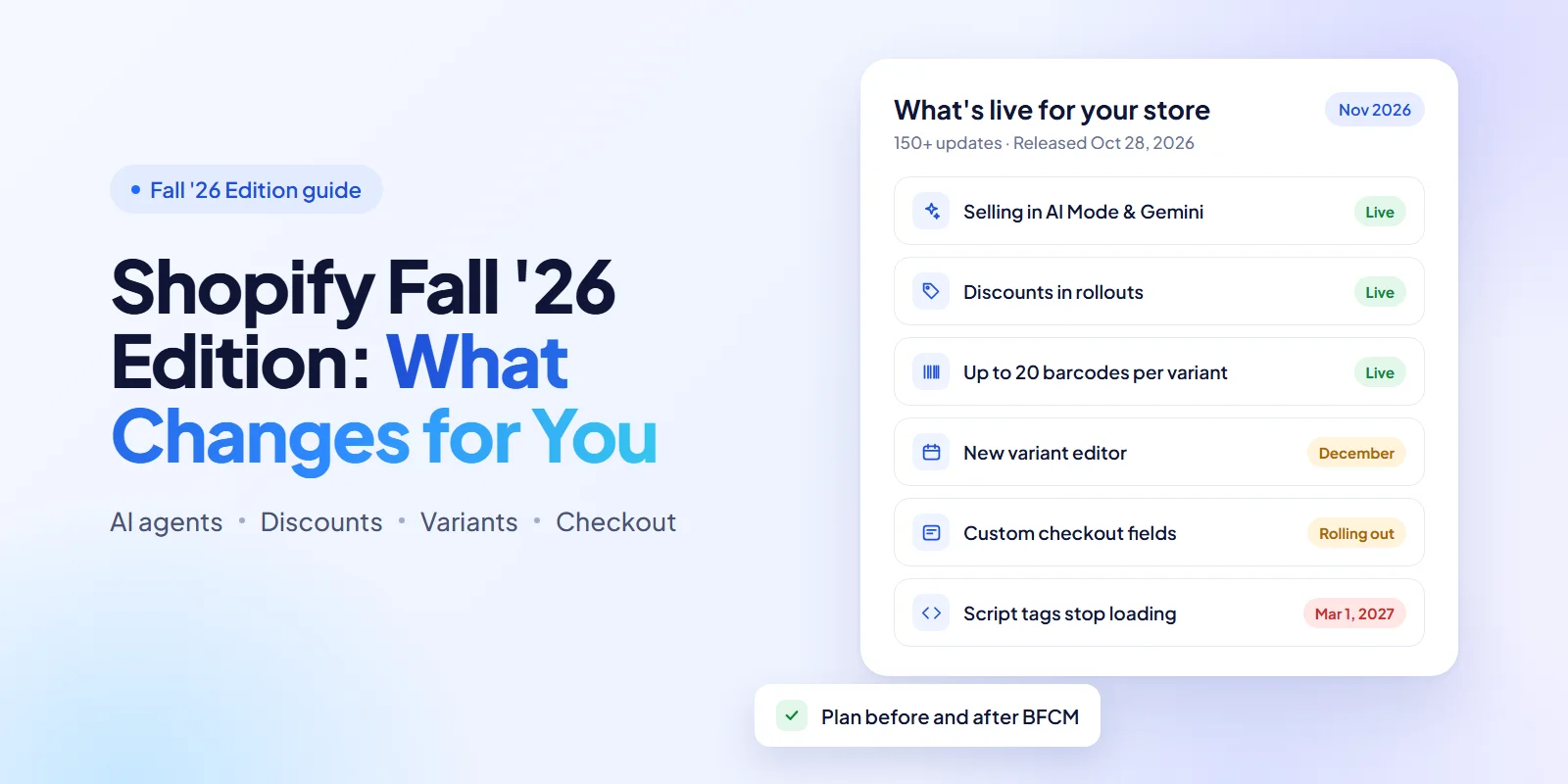
Shopify labels each update as live, rolling out, early access or coming soon. This table covers the updates that change how most stores sell. "Live" means Shopify's Fall '26 Edition page shows no other label for it.
Update | Area | Status (Nov 10, 2026) | Who gets it |
|---|---|---|---|
Selling in Google Search, AI Mode and the Gemini app | AI agents | Live | Stores anywhere, selling to buyers in the US, Canada or Australia |
Shop Pay in personal AI agents | AI agents | Live | Stores using Shop Pay |
Compare-at prices sent to AI agents | AI agents, discounts | Live | Stores in Shopify Catalog |
Discounts in rollouts (Launch, Event, Experiment) | Discounts | Live | Stores with rollouts in their admin |
Adding a discount to an existing order | Discounts | Live | All stores |
Unused discount codes shown in Shop accounts | Discounts | Live | Stores selling in Shop |
Multi-source collections | Merchandising | Live | All stores |
Up to 20 barcodes per variant | Variants | Live | All stores |
Variants on the product page, with package dimensions per variant | Variants | Rolling out in December | All stores, gradually |
B2B catalog CSVs with a vendor column | Wholesale | Live | Stores using Shopify B2B |
Instagram sync to the Shop app | Content | Live | Stores selling in Shop |
Shop Promise badge | Delivery | Live | Eligible US stores |
Custom checkout fields | Checkout | Rolling out | Gradually |
Tiled payment methods | Checkout | Rolling out | Gradually |
Stacked checkout form | Checkout | Coming soon | Not yet available |
Canvas (whole-store editing with Sidekick) | Admin | Early access | Selected stores |
Checkout metaobjects in Shopify Functions | Apps | Coming soon | Not yet available |
If a feature marked live or rolling out isn't in your admin yet, it most likely hasn't reached your store, or it depends on your plan or country. Statuses change often. We update this table at the start of each month.
Which Fall '26 updates matter for your store
Most stores only need to act on four or five updates. Find the row that sounds most like your store, and start there.
If you mainly... | Focus on | Main thing to watch |
|---|---|---|
Sell bundles, gift boxes or kits | Multi-source collections, rollouts for launches | Bundles can't be bought in Google AI Mode and Gemini checkout yet |
Run frequent sales and discounts | Discounts in rollouts, compare-at prices for agents, discounts on existing orders | App discounts and storefront badges may not follow a rollout |
Sell wholesale or many variants | Multiple barcodes, B2B catalog CSVs, the new variant editor | Sales channels read only the first barcode |
Sell through blogs, creators or partner sites | Instagram sync, shop.com, the agentic knowledge base | Shop app content lives on Shopify's surface, not yours |
Sell in person and online | Local delivery at POS checkout, returns by market | Local delivery and pickup don't work in agent checkout |
Rely on many storefront apps | Script tag and access token deadlines | Apps still on script tags stop showing on March 1, 2027 |
Selling through AI shopping agents
The headline of the Shopify Fall '26 Edition is agentic commerce. In plain terms, a shopper can ask an AI assistant for a product and buy it without visiting your store.
What changed:
Eligible stores can sell in Google Search, AI Mode and the Gemini app, with Shopify handling checkout. Your store can be based anywhere, but buyers must be in the US, Canada or Australia. Shoppers elsewhere are sent to your online store.
Shop Pay now works inside personal AI agents, starting with Muse from Meta, Claude Duet and Instinct. More than 400 million people already use Shop Pay, so many shoppers can pay without typing card details.
Shopify connectors now work with nine AI agents, including ChatGPT, Claude, Gemini, Copilot and Perplexity.
A new knowledge base under Sales channels > Agentic shows the store facts agents use, such as your return policy, shipping and gift services. You can review and correct them.
Your admin now shows whether your store is eligible for Shopify Catalog.
What it doesn't do yet: Agent checkout doesn't support everything your store sells. Google AI Mode and Gemini checkout don't support bundles, customizable products, B2B-only products, subscription-only products, local delivery, store pickup, pickup points or stores that require customers to sign in. Google Analytics and custom pixels also won't fire on these orders, so expect these sales to look low in your usual reports. Some checkout blocks, such as custom fields, upsells and add-ons, may not appear. Discount codes and automatic discounts do work there.
What to do: In your admin, go to Sales channels > Agentic. Check that your products are eligible for Shopify Catalog, turn on Google AI Mode and Gemini if it fits your store, and read through the knowledge base for anything out of date, such as an old return window. Clean product titles, accurate variant data and clear policies are what agents read, which is why the basics of optimizing a Shopify store for ChatGPT, Gemini and AI shopping matter more now than they did in the summer.
What changes for bundles
Nothing in the Shopify Fall '26 Edition adds a new native bundle type. The changes are about where bundles can sell and how you can merchandise them.
What changed:
Multi-source collections (Live): one collection can now combine products, variants and items from apps. That makes it easier to build a gift page that mixes single products, specific variants and bundles.
Rollouts for launches (Live): you can schedule a bundle's homepage placement, theme changes and discount to go live together, then revert when the sale ends.
Checkout metaobjects in Shopify Functions (Coming soon): this will let apps read structured data for bundle, delivery and eligibility rules at checkout. Shopify hasn't published full details yet.
What it doesn't do: Bundles are still not supported in Google AI Mode and Gemini checkout, as listed above. Universal Checkout on Shop also arrived in this Edition, but it creates one cart across several brands. It isn't a bundling tool.
What to do: Keep your bundles selling on your own store, the Shop app and POS, where they work today. Make your best single products agent-ready too, so AI shoppers still find you. The reasons AI agents can't fully recognize Shopify bundles yet come down to how product data is shared with agents, not to any one bundle app.
If you sell build-your-own boxes or mix-and-match packs, PushBundle handles those on your storefront, including in-store sales through POS.
What changes for discounts
Discounts got more updates in the Shopify Fall '26 Edition than any other merchant tool.
What changed:
Discounts in rollouts (Live): since October 2, you can add discounts to a rollout. A Launch publishes changes at a set time, an Event runs them for a set period and then reverts, and an Experiment shows them to part of your traffic so you can compare results. You'll find rollouts under Markets > Rollouts, and the details are in Shopify's rollouts changelog.
Catalog scheduling with automatic rollback (Live): price and publishing changes can be scheduled by market and rolled back when a promotion ends.
Discounts on existing orders (Live): you can add a discount to an order that's already placed, and the totals recalculate.
Unused codes in Shop (Live): shoppers see unused discount codes from your lead forms or emails in their Shop account.
Compare-at prices for AI agents (Live): your markdowns now reach shopping agents through Shopify Catalog with no setup.
Checkout links (Live): cart and checkout permalinks can now carry products, customer details, discounts and attribution.
What it doesn't do: Rollouts include app-made discounts only when the app supports rollouts, and each app has to add that support itself.
What we found with our own discount app: we checked how DiscountRay behaves while a rollout runs. Checkout always charged the correct price. But the discount's status in the app didn't match what the rollout was doing, and the storefront badge could advertise an offer that some shoppers wouldn't get at checkout. DiscountRay doesn't support rollouts yet, so we recommend native Shopify discounts for rollout tests for now. If you use any discount app, open your store in a private window while a rollout runs, and compare what the badge promises with what checkout charges.
Testing a sale with rollouts has limits of its own too.
What to do: Before Black Friday, set compare-at prices on sale items so agents show the markdown. Keep discount codes simple, and test one at checkout. After BFCM, adding a discount to an existing order is a cleaner way to fix a problem than a partial refund.
Fall '26 builds on discount stacking and market-based eligibility, which came in earlier. The Shopify Spring '26 discount changes explain how those work. DiscountRay covers tiered, wholesale and customer-specific pricing. In our checks, its discounts applied in Google AI Mode and Gemini checkout.
What changes for variants and wholesale
What changed:
Up to 20 barcodes per variant (Live): each barcode has a type (UPC, EAN, ISBN, GTIN, ASIN or Custom), and POS finds the variant from any of them.
Variants on the product page (Rolling out in December): you edit product and variant details in one place, with bulk controls. The same update adds package dimensions and default packaging for each variant.
B2B updates (Live): B2B catalog CSV exports now include a vendor column, Algolia's B2B search shows each buyer only their catalog at negotiated prices, and draft orders can now include subscriptions.
What it doesn't do: Sales channels read only the first barcode on a variant, so put your main GTIN first. Algolia is a separate app, not a built-in Shopify search.
What to do: If your suppliers or wholesale buyers use different codes for the same item, add them as extra barcodes now. Wait for the new variant editor before you redo package dimensions. The new Shopify variant editor changes where these settings live, and it reaches most stores in December.
Wholesale stores that set up B2B this year can keep the same structure. The full Shopify wholesale setup still applies, and the CSV vendor column makes price updates faster. For buyers who order many sizes and colors at once, MultiVariants adds a bulk order table to the product page.
What changes for content and the Shop app
What changed:
Instagram sync (Live): your Reels, images and carousels can become shoppable content in the Shop app.
New shop.com (Live): it adds shoppable posts, curations, personalized sections and package tracking.
Shop Pay in other apps (Live): developers can add one-tap Shop Pay and cross-brand checkout to their own apps.
What it doesn't do: Content in the Shop app lives on Shopify's surface, not yours. It doesn't replace your blog, partner sites or affiliate pages, where you choose what appears and can track it.
What to do: Turn on Instagram sync if social is already a strong channel for you. Keep publishing on your own site and on partner sites too. AI shopping hasn't made content commerce on Shopify less useful, because those are the placements you control. EmbedUp lets you sell Shopify products inside blogs and websites outside your store.
What changes for checkout and delivery
What changed:
Custom checkout fields (Rolling out): collect text, dates, checkboxes or choices at checkout, such as delivery notes or gift messages.
Shop Promise (Live, eligible US stores): a free program that shows a delivery and returns badge on qualifying products and helps ranking in Shop and Catalog. Shopify says merchant eligibility has grown 20x.
Local delivery at POS checkout (Live): offer local delivery from the register and manage it in POS.
Returns by market (Live): set return and cancellation rules per market, and override the return window for specific products or collections.
Address changes (Live): editing a shipping address now recalculates line-item taxes.
Royal Mail pickup points (Live, UK): ship orders to a pickup location.
Checkout layout: tiled payment methods are rolling out, and a stacked checkout form is coming soon.
What it doesn't do: Local delivery and pickup options don't carry over to Google's agent checkout yet, and custom checkout fields may not appear there either. If a gift message or delivery note is essential to an order, don't rely on it being collected in agent checkout.
What to do: Don't change checkout layout during BFCM. Set up return windows by market before the holiday return season, and look at custom checkout fields in December once they reach your store. Clear holiday delivery dates you can actually keep matter more than any new delivery badge.
App changes due in 2027
Two developer deadlines in this Edition will affect merchants, even though they're aimed at app makers.
Script tags: since October 1, 2026, apps can't create or update script tags. On March 1, 2027, script tags stop loading on storefronts. Apps need to move to theme app extensions or web pixels. The details are in Shopify's script tag deprecation notice.
Access tokens: from January 1, 2027, all public apps must use expiring offline access tokens, according to Shopify's developer changelog.
What to do: Make a list of the apps that add anything to your storefront, such as reviews, pop-ups, tracking or widgets. Ask each vendor whether they still use script tags and when they'll move off them. An app that hasn't moved by March may simply stop showing on your store.
Other updates worth knowing
These matter to some stores but don't change how most merchants sell:
Shopify Protect: blocks high-risk orders before payment is authorized, explains the risk, and drafts chargeback responses.
Payments: seven new local payment methods, including Alipay, WeChat Pay and OXXO.
Sidekick: rebuilt to make several approved changes at once, and it can now create draft orders and checkout customizations. Canvas, for editing the whole store with Sidekick, is in early access.
POS: better customer recognition, abandoned online carts at the register, and saved carts across devices.
Marketing: Campaign Autopilot adds more ad channels, and WhatsApp messages can now recover abandoned carts.
What to do this week, and what can wait
Do before BFCM | Wait until December or Q1 |
|---|---|
Check Catalog eligibility and review your agentic knowledge base | Redo package dimensions once the new variant editor reaches your store |
Set compare-at prices on sale items | Set up custom checkout fields once they're live in your admin |
Test discount codes at checkout | Test discounts with rollouts after the sale, using native discounts |
Add extra barcodes if suppliers use different codes | Plan around checkout metaobjects once Shopify publishes details |
Ask app vendors about script tags | Review return windows by market for the new year |
A short Shopify BFCM checklist covers the tests to run before your sale goes live. Most Fall '26 changes can wait until after it. Changing checkout or theme layout in the week before Black Friday adds risk without much gain.
Conclusion
The Shopify Fall '26 Edition is large, but only a handful of updates change how most stores sell this season. AI agents are a real new channel, with clear limits for bundles, subscriptions and local delivery. Discounts gained the most practical new tools, and variants and wholesale got overdue fixes. The 2027 app deadlines are the item most likely to cause problems if nobody checks them.
Start with what's live and safe before BFCM, then come back in December for the rest. We'll keep the status table above up to date as features roll out.
When was the Shopify Fall '26 Edition released?
Which countries can buy through Google AI Mode and Gemini checkout?
Are all Fall '26 features available to every store right now?
Can customers buy bundles through Google AI Mode or Gemini?
Do discount apps work with Shopify rollouts?
Should I turn on new Fall '26 features before Black Friday?
Do I need to do anything about the script tag deadline?

Syeda Rehnoma Tanzom
This article is written by Syeda Rehnoma Tanzom, an SEO content writer with 3+ years of experience specializing in eCommerce content. What makes the work here a little different? A close collaboration with support teams to understand what merchants are actually going through, their frustrations, their questions, and their wins. The goal is simple: write content that speaks to real problems, not just search engines. When not buried in keywords and content briefs, you'll find her nose-deep in a good book, binge-watching true crime documentaries or psychological thrillers, and occasionally switching gears with a feel-good rom-com.
Keep reading
View all articles →
Managing Holiday Delivery Expectations on Shopify: Dates You Can Keep
November 9, 2026 • 26 min read
Shopify Wholesale Setup: The Full B2B Journey, From First Quote to Reorder (2026)
November 6, 2026 • 17 min read
22 Shopify Experts on 7 Most Expensive Q4 Mistakes (How to Avoid These)
November 3, 2026 • 23 min read