On this page
- Key takeaways
- Ana's first order
- Three professional buyers, not one
- Where pro pricing breaks for estheticians
- 1. The application is built for businesses with storefronts
- 2. Verification takes too long
- 3. One discount for everything
- 4. Backbar sizes are hidden or missing
- 5. Minimums built for spas
- 6. Training-gated products without a path
- 7. Reordering is harder than retail
- Fixes that work
- Fix 1: An application that fits independents
- Fix 2: Check licences in a day
- Fix 3: Separate the price layers
- Fix 4: Make backbar sizes visible to the right people
- Fix 5: Set minimums an independent can meet
- Pricing the starter kit
- Fix 6: Give training-gated products a clear path
- Fix 7: Make reordering quick
- Fix 8: Offer samples and education
- Student pricing: building loyalty early
- Spas with several buyers on one account
- When estheticians sell online too
- What to measure
- Before and after: Ana's second try
- What it's worth to the brand
- A note on agencies and in-house teams
- Common mistakes
- Yeah, but…: concerns pro skincare brands raise
- The checklist
- The bottom line
- FAQ
Who this is for: professional skincare brands selling to estheticians on Shopify. Last checked: 25 November 2026.
Short answer: Professional esthetician pricing breaks on Shopify when a pro programme built for spas is handed to solo estheticians, who buy small, need treatment and resale prices, and can't wait a week for approval. Check licences within a day, separate backbar and resale prices, set minimums an independent can meet and give training-only products a clear path.
Key takeaways
An esthetician is not a small salon. Their buying pattern, cash flow and space are different.
Licence checks should be quick. A week-long approval loses people to brands that answer in a day.
Estheticians usually need two prices: one for products used in treatments, and one for products they resell.
Minimums that make sense for a spa can lock out the solo esthetician completely.
Training-gated products need a clear rule and a clear path, not a "contact us".
Ana's first order
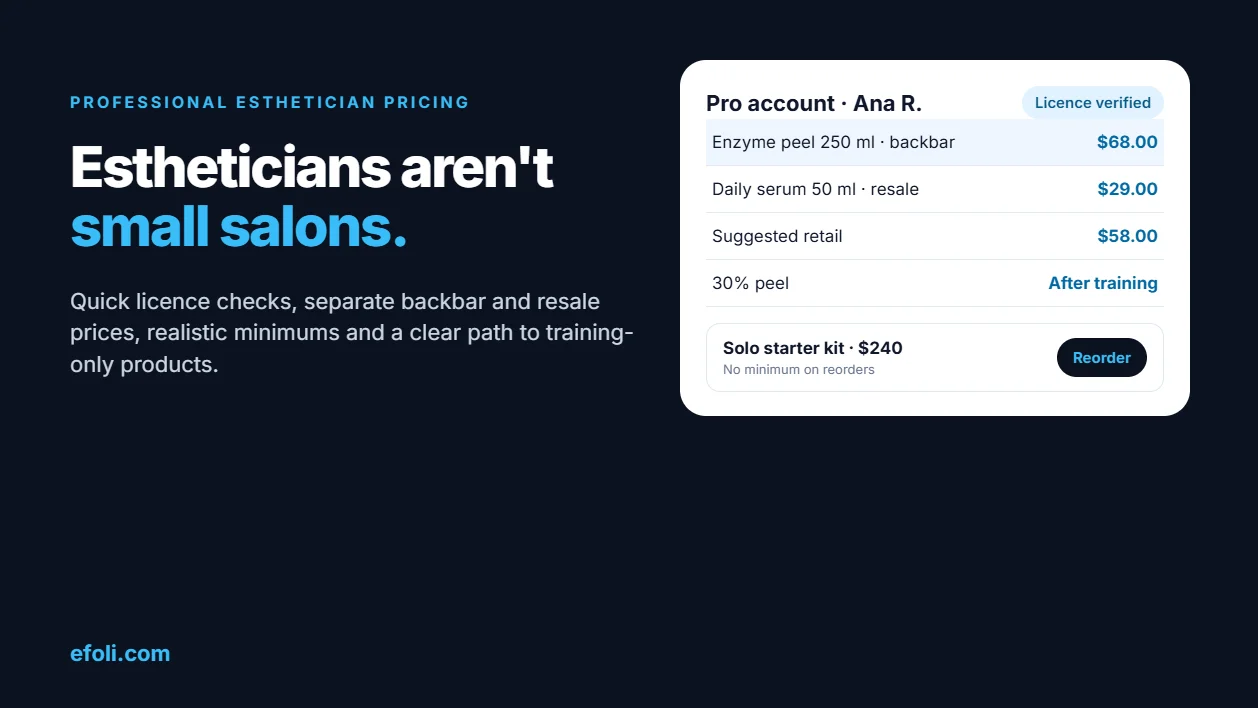
Ana Reyes (fictional, like the brand in this post) is a licensed esthetician who rents a treatment room in a shared studio. She does facials, peels and lash lifts, six or seven clients a day. A client recommended Lumen Ridge Skin, a professional skincare brand that sells on Shopify, and Ana wanted to use its enzyme peel in treatments and sell its serum to clients.
Here's what happened when she tried to become a Lumen Ridge pro.
She filled in the "Professional account" form. It asked for a salon name, a business address and an expected monthly spend, with options starting at $1,000. She chose the lowest. It asked for a resale certificate, which she had, and a licence number. Then nothing happened for six days.
When the account was approved, she saw "pro" prices, which turned out to be one discount across everything. The enzyme peel was listed, but with "Available after training" and no link to training. The serum came in a 50 ml retail size only; the backbar size she'd seen on Instagram wasn't visible. The minimum opening order was $750.
Ana bought from a different brand that week.
Lumen Ridge didn't lose Ana because of price. It lost her because its pro programme was built for a different kind of professional. If your brand sells to estheticians, here's where the same thing tends to happen.
Three professional buyers, not one

Three professional buyers, three ways of buying.
Professional skincare brands often group everyone with a licence into one "pro" tier. In practice, there are at least three kinds of buyers.
Solo esthetician | Day spa or med spa | Hair salon with skin services | |
|---|---|---|---|
Typical setup | Rents a room, works alone | Several treatment rooms, staff | Mostly hair, some skin treatments |
Who buys | The esthetician | A manager or owner | The owner or a stylist |
Order size | Small, frequent | Larger, regular | Small, occasional for skin |
Space | A shelf and a small fridge | A stock room | Limited |
Price focus | Treatment cost per client and resale margin | Margins across many services | Mostly retail margin |
Main friction | Minimums, slow approval | Multiple buyers, invoicing | Finding the skin range among the hair range |
If your pro programme assumes everyone is a spa, the solo esthetician hits a minimum they can't meet. If it assumes everyone is a salon, the spa can't manage several buyers. If you want the bigger accounts, our post on salon wholesale pricing covers the salon side; here, we'll focus on the esthetician.
Where pro pricing breaks for estheticians
1. The application is built for businesses with storefronts
"Salon name", "business address" and "monthly spend" are reasonable fields for a salon. A solo esthetician may trade under their own name, work in a rented room and have no idea what they'll spend in a month. If the form makes them feel like they don't qualify, many won't finish it.
2. Verification takes too long
Licence checks matter, both for brand protection and because some products are meant only for trained professionals. But if checking takes a week, estheticians will buy elsewhere. Licensing also varies by state.
Connecticut, for example, now requires esthetician licences; its Department of Public Health asks for a certificate showing at least 600 hours of esthetics study, with an alternative route for people who had already been practising before 2021 and applied before 2025. Other states have their own hours and rules. Many state boards offer an online licence lookup, which makes quick checks possible.
3. One discount for everything
A single "20% off for pros" is easy to set up and wrong for most brands. Products used in treatments (backbar) and products for resale have different economics. Estheticians need the backbar price to work out their cost per treatment, and the resale price to know their margin.
4. Backbar sizes are hidden or missing
Professional sizes, often larger and more economical for treatment use, are sometimes hidden from everyone except a few accounts, or listed under a separate "pro" menu that solo estheticians never find. If they can't see them, they buy retail sizes for treatments and the maths stops working.
5. Minimums built for spas
A $750 opening order is easy for a spa and hard for someone with one room and a shelf. Minimums protect the brand from tiny, expensive orders, but if they're set too high, you lose a whole segment.
6. Training-gated products without a path
Some professional products, like stronger peels, are sensibly restricted to estheticians who've completed the brand's training. That's good practice. But "Available after training" with no link, no dates and no price is a dead end.
7. Reordering is harder than retail
Once an esthetician is set up, they'll reorder small quantities often: a backbar size every few weeks, resale stock when clients buy. If reordering means finding each product again, they'll do it less often.
Fixes that work
Fix 1: An application that fits independents

A pro account flow that checks the licence without making people wait a week.
Ask for what you actually need: name, licence number and state, business name if they have one, treatment address, whether they resell, and resale certificate if they do. Make "monthly spend" optional, or replace it with "How many clients a week?", which tells you more.
Shopify lets B2B customers request a company account, and Shopify Flow has a template that notifies you and sets up companies created from those requests, including sending B2B access emails. You can use that route, or a simple application form that tags the customer for review.
Fix 2: Check licences in a day
Set a target: approve or ask a follow-up question within one working day. Use the state board's online lookup where one exists. If a licence can't be checked online, ask for a photo of the licence and verify it later, approving the account for non-restricted products in the meantime.
Two-tier approval is the key idea here. A verified licence unlocks the full pro range; a pending one unlocks the basics. That way, nobody waits a week to buy a cleanser.
Fix 3: Separate the price layers

The price layers a professional skincare brand usually needs. Prices are illustrative.
Most professional skincare brands need four layers:
Layer | Who sees it | Example | Purpose |
|---|---|---|---|
Backbar | Verified pros | 250 ml enzyme peel at $68 | Products used in treatments |
Resale | Pros who resell | 50 ml serum at $29 (suggested retail $58) | Products sold on to clients |
Training-gated | Pros who completed training | 30% peel at $85 | Products that need specific training |
Student | Enrolled esthetics students | Starter kit at $60 | Building loyalty early |
(Prices are illustrative.)
Shopify B2B can handle layers with catalogs, but plans below Plus are limited to three active catalog assignments across B2B markets, and assigning catalogs directly to company locations is a Plus feature.
If you need more flexibility, a professional pricing app such as DiscountRay can price by customer tag on its Growth plan ($14 a month at the time of writing), or by specific company or customer list on its Pro plan ($29 a month). Tags like "pro-verified", "pro-resale" and "peel-trained" map neatly onto the layers above.

Prices set for specific approved customers or companies. Source: DiscountRay App Store listing.
Whatever you use, show the right price while browsing, not just at checkout, and show the suggested retail price next to resale products so the esthetician can see their margin at a glance. Our post on retail and wholesale pricing in one store covers how to show both without confusing your retail customers.
Fix 4: Make backbar sizes visible to the right people
List backbar sizes as variants or products visible to verified pros. Label them clearly: "Professional size, for treatment use. Not for resale." Put them in the same product page as the retail size if your theme supports it, so a pro looking at the serum sees both sizes.
If backbar sizes are packed in sets (say, a case of 6 bottles), match the quantity rules to the packing. A bulk order form for pro sizes such as MultiVariants can set per-variant minimums, maximums and quantity steps, and restrict who can see or order variants. Shopify B2B quantity rules can do minimums and increments for B2B catalogs too. If you already price pros with DiscountRay, MultiVariants can show those prices in its order table, since the two apps connect.

Quantity steps for pro sizes, so orders match how products are packed. Source: MultiVariants App Store listing.
Fix 5: Set minimums an independent can meet
Instead of one big opening minimum, consider:
A lower opening order for verified solo estheticians. For example, $250 instead of $750.
A starter kit as the opening order. A curated set of backbar and resale products at a fixed price, which also teaches the range.
Free shipping thresholds instead of hard minimums. Small orders are allowed, but bigger ones ship free.
Run the numbers. A small first order from an esthetician who reorders monthly for three years is worth far more than one spa order that never repeats.
Pricing the starter kit
The starter kit does two jobs: it replaces a high opening minimum and it teaches the range. Here's how Lumen Ridge priced its solo esthetician kit. (All figures are illustrative.)
Item | Type | Pro price |
|---|---|---|
Gentle cleanser, 500 ml | Backbar | $38 |
Hydrating mask, 250 ml | Backbar | $44 |
Daily serum, 50 ml × 6 | Resale | $174 (6 × $29) |
Client sample sachets × 50 | Samples | Included |
Treatment protocol cards | Education | Included |
Total value at pro prices | $256 | |
Starter kit price | $240 |
The kit is priced slightly below the sum of pro prices, so it feels like a good first step without becoming a discount estheticians expect on every order. The resale serums let the esthetician earn back part of the cost quickly: sold at the suggested retail price of $58, six serums bring in $348. The samples and protocol cards cost the brand little and make it far more likely that clients take a product home.
After the kit, there's no minimum on reorders, just a free shipping threshold at $150. Most solo estheticians cross it every second or third order.
Fix 6: Give training-gated products a clear path
On a training-gated product, show three things: what training is needed, when and how to take it (with a link and dates), and what it costs. When the esthetician completes training, tag their account so the product becomes available. Make that tagging part of the training process, not an afterthought.
If you run online training, you can tag the account automatically when the course is completed. If it's in person, have the trainer submit attendees the same day.
Fix 7: Make reordering quick
Estheticians reorder in small, frequent batches. Help them:
A "Your pro products" list on their account, with quick add.
A reorder button on past orders.
A one-page order form with backbar and resale sizes in one table.
Reminders based on how fast backbar sizes are used (if a 250 ml peel lasts about six weeks in a busy room, remind them at week five).
Fix 8: Offer samples and education
Estheticians recommend what they know. Free or low-cost samples for client take-home, product training and treatment protocols all help. If you send trade samples, our post on Shopify wholesale samples covers how to handle them without giving away your margin.
Student pricing: building loyalty early
Esthetics students are tomorrow's customers. A student programme with a verified school email or enrolment letter, a starter kit at a modest price and an automatic upgrade path ("Send us your licence when you're qualified and we'll move you to a pro account") can be one of the best long-term investments a pro brand makes. Keep student prices separate from pro prices, and set an end date so they expire after graduation.
Spas with several buyers on one account
Spas and multi-room studios bring a different set of needs. Several people may order: a spa manager for backbar, a front-desk lead for retail stock, the owner for big seasonal orders. If they all share one login, nobody can tell who ordered what, and resale stock ends up in the treatment room.
Shopify B2B handles this with companies and locations. Each spa is a company, each site is a location, and each person is a customer on that company with a role such as Ordering only or Location admin. That gives the owner visibility of every order while letting staff order for their own site. Payment terms and invoices can be set per location, which matters when a spa group has separate accounts for each site.
For the price layers above, keep the rule simple: the spa's account gets the backbar and resale layers; training-gated products unlock per person, because training belongs to the individual esthetician, not to the business. If a trained esthetician moves to a different spa, their access should go with them.
When estheticians sell online too
Many independent estheticians now sell retail products to clients online, through their own website, social media or a booking platform's shop. That's usually good for the brand, but it raises questions that are easier to answer up front.
Minimum advertised prices. If your brand has a pricing policy for resellers, share it at approval, not after the first listing appears.
Marketplaces. Many professional brands don't allow resale on large marketplaces, to protect authenticity and pricing. If that's your rule, say so in the pro terms.
Images and descriptions. Give approved pros a small pack of product images and approved descriptions. It keeps claims consistent and saves them time.
Linking back to you. Some brands offer estheticians an affiliate or referral link instead of resale stock, so clients buy directly and the esthetician earns a commission. It's worth offering as an option for pros who don't want to hold inventory.
None of this needs to be heavy-handed. A one-page "selling our products" guide, shared when the account is approved, prevents most problems.
What to measure
A pro programme is easy to judge on total wholesale revenue. These numbers tell you whether it's working for estheticians specifically:
Measure | What it tells you |
|---|---|
Time from application to approval | Whether verification is fast enough |
Share of applicants who place a first order within 30 days | Whether the opening order is realistic |
Average days between reorders | Whether reordering is easy |
Share of orders that include both backbar and resale | Whether both price layers are understood |
Training bookings and completions | Whether gated products have a clear path |
Accounts with no order in 90 days | Who to call before they drift |
Look at solo estheticians separately from spas and salons. If the averages are blended, the spas will hide what's happening with independents.
Before and after: Ana's second try
A year later, Lumen Ridge relaunches its pro programme. Ana tries again.
The application asks for her licence number and state, whether she resells, and how many clients she sees a week. She's approved for the basic pro range the same afternoon, after a licence lookup. She sees two prices on each product: backbar where available, and resale with the suggested retail price next to it.
The enzyme peel shows "Available after Lumen Ridge Peel Certification", with the next online session date and the fee. She books it.
Her opening order is a solo starter kit at $240, with backbar sizes of the cleanser and mask and six resale serums. Two weeks later, after her training, the peel appears on her account. She reorders from her "Your pro products" list every three to four weeks.
What it's worth to the brand
Solo estheticians don't place huge orders. But there are a lot of them, they reorder often, and they influence what their clients buy for home use. A brand that's easy for independents to buy from gets recommended in treatment rooms every day. A brand that isn't gets replaced by one that is.
A note on agencies and in-house teams
If you're scoping a pro programme rebuild, start with the questions in this post rather than the theme. How many estheticians, spas and salons do you sell to? Which products are backbar, resale or training-gated? How do you check licences today, and how long does it take?
The answers decide whether native B2B catalogs are enough or whether a tag-based pricing app is the simpler route. They also tell you where the effort should go: for most professional skincare brands, it's the application, the price layers and the reorder tools, not the homepage.
Common mistakes
One "pro" discount for everyone. Treatment and resale need different prices.
Asking for monthly spend. It's a bad proxy for a solo esthetician. Ask about clients instead.
Week-long approvals. Aim for one working day.
Hiding backbar sizes. If verified pros can't find them, they buy retail sizes and stop.
Training-gated dead ends. Always show the path to access.
No reorder tools. Estheticians reorder often; make it fast.
For a wider look at what goes wrong with trade pricing on Shopify, see the most common Shopify wholesale pricing problems, and for the rules behind B2B catalogs, Shopify B2B catalog pricing rules. If you're hiring help to build the pro storefront, our shortlist of Shopify agencies that understand skincare routines is a good place to start.
Yeah, but…: concerns pro skincare brands raise
Opening the programme to independents raises fair questions. Here are three.
What you might be thinking | A fair answer |
|---|---|
"Lower minimums mean tiny, costly orders." | Use a starter kit for the first order and a free shipping threshold after that, so small orders cover their own shipping. |
"Fast approval could let non-professionals in." | That's why approval is two-tier. Pending accounts can buy the basics; restricted products wait for a verified licence. |
"Two price layers will confuse people." | Label them where the price appears: "Backbar (treatment use)" and "Resale (suggested retail $58)". Estheticians who resell already work with both numbers. |
The checklist

Fifteen checks for a pro account estheticians want to use.
Application and verification
The application fits solo estheticians (no salon-only fields).
Licence number and state are collected.
Licences are checked within one working day.
Pending accounts can buy non-restricted products.
Prices
Backbar and resale prices are separate.
Suggested retail is shown next to resale products.
Prices show while browsing, not just at checkout.
Student pricing is separate and expires.
Products and minimums
Backbar sizes are visible to verified pros.
Quantity rules match how pro sizes are packed.
Opening minimums are realistic for independents, or a starter kit replaces them.
Training
Training-gated products show the training, dates and cost.
Completing training unlocks the products automatically.
Reordering
Pros have a reorder list or one-page order form.
Backbar reminders match real usage.
The bottom line
Estheticians are some of the most influential buyers a professional skincare brand can have, and some of the easiest to lose. They don't need the biggest discount. They need a quick yes, two clear prices, sizes that fit their room, minimums they can meet and a path to the products they're trained to use. Build the pro programme around them, and the spas and salons will be easy.
Lumen Ridge Skin, Ana Reyes and the figures in this post are fictional, used to illustrate a common situation. Licensing rules vary by state and change over time; check the board in each state you sell to.
FAQ
How do I offer professional esthetician pricing on Shopify?
How do I verify an esthetician's licence?
What's the difference between backbar and resale pricing?
Should I have minimum orders for estheticians?
How do I restrict products to trained professionals?
Do I need Shopify Plus for professional pricing?
Can I offer student pricing to esthetics students?

Anika Anamta Mehnaz
This article is written by Anika Anamta Mehnaz, a Content Writer and Content Marketing Strategist specializing in Shopify, eCommerce, and SaaS. With over four years of content writing experience, she creates SEO and AI search-optimized content that helps Shopify merchants make better business decisions through practical, research-backed insights. Her work covers Shopify apps, product variants, bundles, discounts, B2B commerce, and conversion-focused strategies. Outside of work, Anika enjoys watching anime, reading John Grisham novels, and discovering new ideas in digital marketing and e-commerce. If you enjoy discussing Shopify, content marketing, or online growth, feel free to connect with her. Twitter: https://x.com/mehnaz2201 Medium: https://medium.com/@mehnaz_78932
Keep reading
View all articles →
Fragrance Discovery Sets on Shopify: They Loved the Samples. Why Didn't They Buy the Bottle?
November 25, 2026 • 17 min read
Distributor Quote Requests on Shopify: Where Negotiated Deals Stall
November 25, 2026 • 18 min read
Replenishment Bundles on Shopify: Your Refill Customers Didn't Cancel. They Ran Out.
November 25, 2026 • 18 min read