On this page
- Key takeaways
- Three buyers, one inbox
- How the three buyers differ
- Where ordering breaks: the friction map
- 1. Signing up
- 2. Finding wholesale products
- 3. Ordering in the right quantities
- 4. Seeing the right price
- 5. Checking dates
- 6. Knowing what they can say
- 7. Paying
- 8. Reordering
- What this costs the brand
- Fixes that work
- Fix 1: Separate wholesale accounts by buyer type
- Fix 2: Show each buyer type the right range
- Fix 3: Sell in cases where cases matter
- Fix 4: Give practitioners a quick order form
- Fix 5: Show trade prices while browsing, by account
- Fix 6: Put dates on the product page
- Fix 7: Give stockists safe wording
- Fix 8: Offer payment terms to the right accounts
- Fix 9: Make reordering faster than an email
- One thing to watch: subscriptions
- Before and after
- Wellness wholesale checklist
- Onboarding a new stockist in the first week
- Samples and trial sizes
- What to measure once stockists order online
- Pricing for multi-site gyms and studio chains
- Suggested retail prices and resale
- Seasonal ordering for gyms and studios
- A note on international stockists
- The bottom line
- FAQ
Short answer: Wellness wholesale ordering breaks on Shopify when a brand treats every stockist like one big retail customer. Clinics, gyms and health stores buy different quantities, on different schedules, and need different things: practitioner verification, case packs, expiry dates on the product page, trade prices by account, and wording they can safely repeat to their own customers. Separate the buyer types, set case rules and account pricing, show dates and claims clearly, and make reordering faster than an email.
Key takeaways
"Wholesale" in wellness usually means three different buyers: practitioners, gyms and studios, and independent health stores.
Each buys in different packs and on a different rhythm. One wholesale price list rarely fits all three.
Stockists need best-before or expiry dates before they order, not after the box arrives.
Practitioner-only products need a way to check who's buying.
Your product claims travel with your products. Give stockists wording they can safely use.
Reordering should take a couple of minutes. If it takes longer, stockists email instead, or drift away.
Three buyers, one inbox
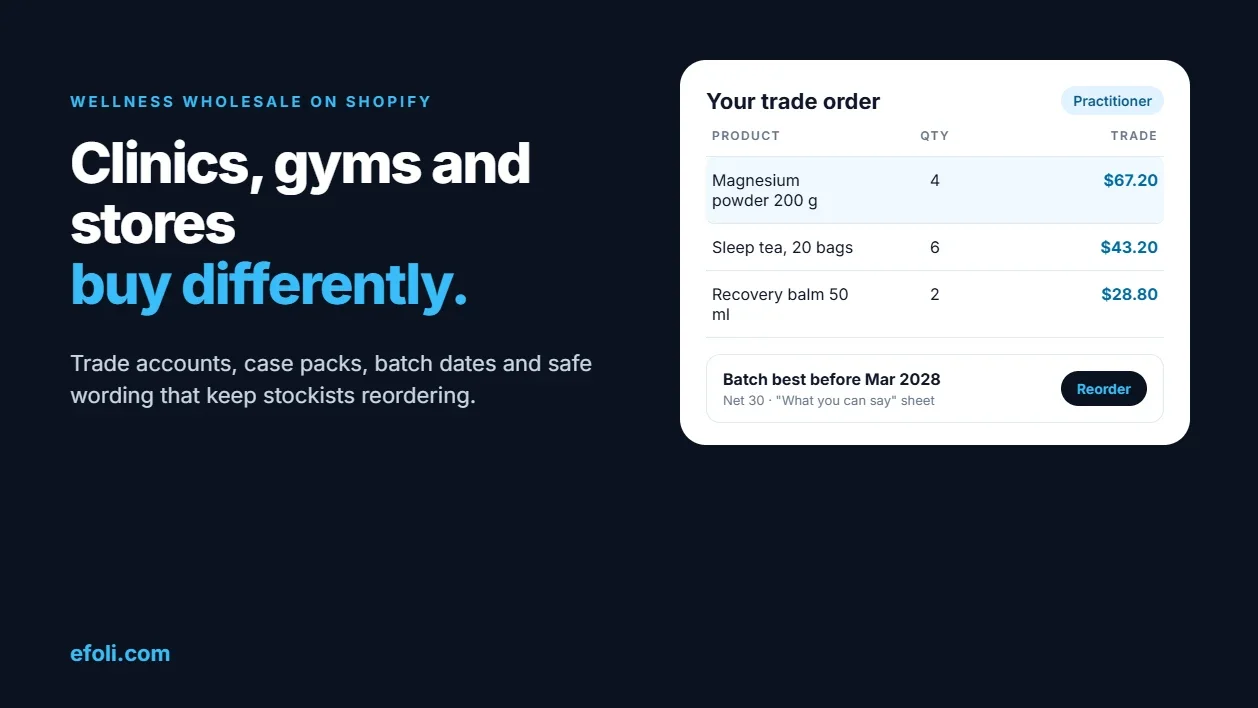
Fernleaf Botanicals is a fictional wellness brand. They make herbal teas, magnesium powders, a few capsule supplements and some topical balms. Their Shopify store sells well to the public. Over two years, wholesale crept in by word of mouth.
By this autumn, Fernleaf had about 60 trade accounts, and they fell into three groups:
Practitioners. A naturopath, two nutritionists, a chiropractor and a few massage therapists. They recommend products to clients and sell a small range from their clinic. They order little and often, a few units of six or seven products, maybe monthly.
Gyms and studios. Two yoga studios, a climbing gym and a boutique fitness chain with four sites. They sell magnesium powder and teas at the front desk. They want display-ready cases, care about margin, and order before busy seasons like January.
Independent health stores. Small shops with a supplement wall. They want the full range, compare price per unit carefully, and expect consistent stock and long dates.
All three ordered by email. Some used a PDF price list from last year. A few used a wholesale discount code on the public store, which meant they paid retail and then got 40% off, sometimes stacked with a sale.
The founder spent two mornings a week turning emails into orders. That's when Fernleaf decided to fix wholesale properly. This post walks through what was breaking. If you're a brand in a similar spot, most of it will sound familiar.
How the three buyers differ
Before fixing anything, Fernleaf wrote down how each group actually buys.

Three stockist types, three buying patterns.
Practitioners | Gyms and studios | Health stores | |
|---|---|---|---|
Typical order | 10 to 30 units, mixed | 1 to 3 cases of a few products | Several cases across the range |
How often | Monthly or as needed | Seasonal, plus top-ups | Every 2 to 4 weeks |
Main concern | Quality, client trust, practitioner-only range | Front-desk display and margin | Price per unit, dates, consistency |
Pack size | Single units or small packs | Display cases | Full cases |
Verification | Professional status | Business details | Business details, sometimes resale certificate |
Payment | Card, sometimes terms | Card or terms | Terms usually expected |
That table alone showed why one discount code and one price list couldn't work.
Where ordering breaks: the friction map
Here's what each buyer hit when they tried to order from Fernleaf's store.

Eight places where a retail-first store fails wellness stockists.
1. Signing up
There was no wholesale sign-up. Stockists emailed, and the founder replied with a code. Nobody checked whether a "practitioner" was actually a practitioner. That matters for Fernleaf's two higher-strength formulas, which they only want sold through professionals.
2. Finding wholesale products
Trade buyers saw the public store: gift sets, sample sizes, bundles. The case packs and practitioner-only products weren't visible. A health store owner looking for "magnesium, case of 12" scrolled past three gift boxes to find a single tub.
3. Ordering in the right quantities
Health stores wanted to order by the case. The store let them order any number of single tubs, so orders came in as 17 or 23 units. Fernleaf had to open cases, repack and sometimes send short.
Practitioners had the opposite problem. They wanted three of one tea, two of another and one balm. The store forced them through seven product pages and seven "add to cart" clicks.
4. Seeing the right price
With a 40% discount code, prices showed as retail until checkout. Stockists couldn't see trade prices while browsing, so they couldn't work out their margin per product. Several asked for a price list "just to be sure", which defeated the point of the website.
5. Checking dates
Health stores asked the same question on almost every order: "What's the best-before date on this batch?" Supplements and herbal products with short dates are hard to sell. A store that receives magnesium with four months left may not be able to sell through before it expires.
6. Knowing what they can say
A naturopath asked if she could say the sleep tea "treats insomnia" on her clinic's Instagram. A gym wanted to put "boosts recovery" on a shelf card. Fernleaf had no guidance for stockists, so everyone improvised.
7. Paying
Gyms and stores wanted to pay on 30-day terms. The store only took cards at checkout.
8. Reordering
Practitioners reorder the same small set of products every month. There was no reorder button or saved list. Every order started from scratch.
What this costs the brand
The costs crept up quietly.
Time. Two mornings a week of order entry, invoicing and chasing.
Mistakes. Opened cases, wrong quantities and mixed-up flavours.
Margin. Discount codes stacked with public sales, so some trade orders went out below cost.
Lost stockists. Two health stores stopped ordering. When asked, one said it was "easier to order from the distributor who stocks your competitor". The product wasn't the problem. Ordering was.
Brand risk. Stockists writing their own claims, some of which a regulator wouldn't accept.
Fixes that work
Here's what Fernleaf changed, roughly in order of impact.
Fix 1: Separate wholesale accounts by buyer type
Replace discount codes with proper trade accounts. Each account gets tagged or set up by type: practitioner, gym or studio, health store.
In Shopify, you can do this with Shopify B2B, available on the Basic, Grow, Advanced and Plus plans, which uses companies and company locations. Or you can use customer tags with a wholesale pricing app. Syeda's post on Shopify B2B by plan explains exactly what each plan includes. The key point is that one wholesale customer equals one account with the right prices and rules, not one shared code.
Add a short application form: business name, address, type of business, and for practitioners, their professional registration or membership number. Approve accounts by hand at first. It takes a minute each and stops the wrong people seeing practitioner-only products.
Fix 2: Show each buyer type the right range
Practitioner-only products should only be visible to practitioner accounts. Display cases should be front and centre for gyms. Health stores should see the full range in case packs.
With Shopify B2B, catalogs let you control which products and prices each group sees. Note that on plans below Plus, you're limited to three active catalog assignments across your B2B markets, so keep your buyer groups simple. With tags, many wholesale apps can hide or show products by tag.
Fix 3: Sell in cases where cases matter
For health stores and gyms, set case quantities. If magnesium comes 12 to a case, trade buyers can order 12, 24 or 36, not 17.
Shopify B2B includes quantity rules: a minimum, a maximum and an increment per variant. For practitioners, who buy single units, you might set a minimum of 3 per product rather than a case.
If you're not on Shopify B2B, or you want different rules for different buyers, a bulk order app can do this. MultiVariants, a Shopify bulk order form app, offers quantity increments and minimums per variant or on the total on its Professional plan ($29.99 a month), and order forms with B2B catalog pricing on its Standard plan ($12.99).

Quantity increments keep trade orders in full cases. Source: MultiVariants App Store listing.
Fix 4: Give practitioners a quick order form
Practitioners want a list, not seven product pages. A single page with every product they can buy, a quantity box next to each, and one "add to cart" button.
Shopify B2B's quick order list section (in recent free themes) does a version of this on product pages. A bulk order form app can put the whole range on one page. Either way, test it on a phone. Many practitioners order between clients.
Fix 5: Show trade prices while browsing, by account
Stockists should see their price on every product page and collection, not just at checkout. Show the trade price and the suggested retail price side by side, so they can see their margin.
Use Shopify B2B catalogs or a pricing app that sets prices by customer tag, group or company. DiscountRay, a Shopify wholesale pricing app, handles pricing by customer group or tag on its Growth plan ($14 a month) and by company or customer list on Pro ($29). Its quantity tiers and discount table are on the free plan, which is useful for "buy 3 cases, save another 5%".

Show trade price, suggested retail and margin per buyer type. Prices are illustrative.
Product | Retail price | Practitioner | Gym / studio | Health store (per case of 12) |
|---|---|---|---|---|
Magnesium powder 200 g | $28 | $16.80 | $16.80 | $15.40 per unit |
Sleep tea, 20 bags | $12 | $7.20 | $7.20 | $6.60 per unit |
Recovery balm 50 ml | $24 | $14.40 | n/a | $13.20 per unit |
Illustrative prices for a fictional brand.
Keep the number of price levels small. Three is plenty for most wellness brands.
Anika's post on Shopify apps for selling vitamins and supplements compares more apps if you're still choosing.
Fix 6: Put dates on the product page
This one is free and makes a big difference. For each wholesale product, show:
The best-before or expiry date of the current batch, or a minimum ("at least 12 months' life on delivery").
Pack and case size.
Storage instructions.
Even a line like "Current batch: best before March 2028" saves an email on every order. If you rotate batches, update it when you do. Health stores will notice, and they'll trust you more for it.
Shopify doesn't track batch dates natively. A metafield on the product, shown by your theme, is the simplest way. If you track lots and expiry in an inventory system, check whether it can push the date to Shopify.
Fix 7: Give stockists safe wording
Your stockists will talk about your products. Help them say the right things.
In the US, dietary supplements can carry structure/function claims, statements about how a nutrient affects normal body function, like "magnesium supports normal muscle function". These need the FDA disclaimer on the label: "This statement has not been evaluated by the Food and Drug Administration. This product is not intended to diagnose, treat, cure, or prevent any disease." The manufacturer also has to notify FDA within 30 days of first marketing a product with such a claim.
What supplements can't claim is to treat, cure or prevent a disease. "Treats insomnia" is a disease claim. "Supports restful sleep" is the kind of wording brands typically use instead.
For stockists, Fernleaf created a short "what you can say" sheet for each product, with approved shelf-card wording and social captions. They added it as a download on each wholesale product page. Practitioners, in particular, appreciated it.
This is general information, not legal advice. Rules differ for herbal teas sold as food, topical products and supplements, and they differ between countries. Check the rules where you and your stockists sell.
For brands that want to go further, Anika's post on supplement educational content covers how to write education that stays within the rules.
Fix 8: Offer payment terms to the right accounts
Shopify B2B supports payment terms such as net 30, plus PO numbers. Start new accounts on card payment, then move reliable ones to terms after a few orders. Fernleaf moved gyms and health stores to net 30 after three on-time orders.
If you're not on B2B, some wholesale apps and invoicing tools handle terms. Draft orders with invoices are another option for a small number of accounts.
Fix 9: Make reordering faster than an email
For wellness stockists, reordering is most of the relationship. Offer:
A reorder button from past orders. Shopify B2B customer accounts include one.
A saved list of "your usual products" for each account.
A short reminder email after the account's usual gap. If a practitioner orders every five weeks and it's been seven, a friendly nudge often brings them back.
Anika's post on Shopify wholesale replenishment goes deeper on reorder reminders and par levels.
One thing to watch: subscriptions
Some practitioners ask for automatic monthly deliveries. That sounds like a subscription, but Shopify's B2B features aren't compatible with subscriptions. If you use Shopify B2B, handle repeat orders with reorder buttons and reminders, or a standing draft order you send each month. If you use customer tags and a pricing app instead, check how your subscription app handles trade pricing before promising it.
Before and after
Here's one practitioner's order, before and after Fernleaf's changes.
Before. The nutritionist emails on a Sunday: "Can I get 4 sleep tea, 3 calm tea, 2 magnesium, 1 balm? Same as last time but more sleep tea." The founder reads it Monday, checks stock, looks up the practitioner price, types a draft order, sends an invoice, and asks about the best-before dates the nutritionist mentioned last time.
After. The nutritionist signs in with a one-time code, opens "your usual products", changes sleep tea from 3 to 4, and checks out. The practitioner price is already there. The product page says "Current batch: best before March 2028". The "what you can say" sheet is a click away. The order lands in Shopify, ready to pick.
Wellness wholesale checklist

Fifteen checks for brands selling to clinics, gyms and health stores.
Accounts
Trade accounts replace shared discount codes.
Each account is tagged by buyer type.
Practitioner accounts are verified.
Range and quantities
Practitioner-only products are visible only to practitioners.
Case quantities are enforced for stores and gyms.
Practitioners have a quick order form.
Prices
Trade prices show while browsing.
Suggested retail and margin are visible.
Price levels are few and clear.
Information
Each product shows batch date or minimum life.
Pack size, case size and storage are listed.
A "what you can say" sheet is downloadable.
Ordering and paying
Reliable accounts can pay on terms.
Reorder takes under two minutes.
Lapsed stockists get a reminder.
Onboarding a new stockist in the first week
Fixing the store is half the job. The other half is how a new stockist experiences their first week with you. Fernleaf wrote a simple onboarding sequence:
Day 0: Approval email. Their account is live, with a one-line explanation of how to sign in and what price level they're on.
Day 0: Starter guide. A one-page PDF: how to order, minimums, delivery times, payment terms, and where to find the "what you can say" sheets.
Day 1: Suggested opening order. For each buyer type, a short list of best-sellers. Practitioners get a mixed starter of their most recommended products. Gyms get a front-desk starter case. Stores get a range starter with the top ten products.
First order: shelf materials. Shelf cards or a counter display with the approved wording, so the first thing a customer sees is accurate.
Day 30: Check-in. A short email asking what's selling and what isn't, with a link to reorder.
This took Fernleaf a few hours to write and has run unchanged since. New stockists ask far fewer questions, and their first reorder comes sooner.
Samples and trial sizes
Practitioners, in particular, want to try a product before recommending it. A few ways brands handle this:
A practitioner sample pack at cost, available once per account.
Free samples on a first order above a certain value.
Trial sizes that practitioners can sell or give to clients, sold in small multiples.
Whatever you choose, make it a product in the trade catalogue with clear rules, not a favour arranged by email. That keeps stock and costs visible.
What to measure once stockists order online
After two or three months, check:
Share of trade orders placed online rather than by email. The goal is nearly all routine orders.
Average days between orders, per buyer type. It tells you when to send reminders.
Stockists who haven't ordered in twice their usual gap. These are the accounts drifting away.
Orders blocked by case rules. If many orders hit the rule, check the rule matches how buyers want to buy.
Questions about dates and claims. These should drop sharply once the information is on the page.
Pricing for multi-site gyms and studio chains
One of Fernleaf's gym customers has four sites. Each site's front desk orders its own stock, but the head office pays and negotiated a slightly better price for the group.
That's a common pattern, and Shopify B2B handles it well: one company, four locations. Each location has its own shipping address, and each front-desk manager can be set to order only for their site. The group price sits on the company's catalog or price rule. Head office sees all orders.
Keep the group price simple. A small extra saving for the group is easy to manage. A tier that depends on combined monthly volume across sites is much harder, because each order is priced on its own.
Suggested retail prices and resale
Stockists will ask what they should charge. A clear suggested retail price (shown on each wholesale product page) helps them price confidently and keeps your brand consistent across shops.
Some brands also set rules on advertised prices or on selling through marketplaces. If you do, write the policy down, share it with stockists before they order, and get advice on what's allowed where you sell, because the rules on resale pricing differ between countries. At minimum, make the suggested price visible and explain your policy on online resale, so a clinic doesn't discover it after listing your products on a marketplace.
Seasonal ordering for gyms and studios
Gyms and studios have strong seasons. January brings new members, and many studios run summer challenges. Help them order ahead: email gym accounts in early December with a suggested January order based on last year, and make sure display cases are in stock before the rush. A front desk that sells out in the second week of January usually doesn't reorder until February.
A note on international stockists
If you sell to stockists in other countries, the rules change. Claims, labelling and which ingredients are allowed differ between markets, and a product that's fine to sell in one country may need a different label in another. Before you approve an overseas account, check the rules in that market, and consider limiting your wholesale catalogue to the products you know are compliant there.
The bottom line
Wellness wholesale isn't one customer type. Practitioners, gyms and health stores buy differently, and the store needs to let each of them order the way they already work. Proper accounts, case rules, visible trade prices, dates on the page, safe wording and fast reordering fix most of the friction. The tools exist in Shopify and a few apps. The real work is deciding the rules.
If you also sell to consumers who build their own supplement routines, Anika's vitamin pack builder on Shopify post covers that side of the business.
Fernleaf Botanicals and its stockists are fictional, used to illustrate a common situation. Prices are illustrative. Claims guidance is general information, not legal advice.
FAQ
How do I sell wellness products wholesale on Shopify?
How can I limit some products to practitioners only?
Should I show expiry dates to wholesale buyers?
What can stockists say about supplements?
Can wholesale customers subscribe to monthly deliveries?
Do I need Shopify Plus for wellness wholesale?

Anika Anamta Mehnaz
This article is written by Anika Anamta Mehnaz, a Content Writer and Content Marketing Strategist specializing in Shopify, eCommerce, and SaaS. With over four years of content writing experience, she creates SEO and AI search-optimized content that helps Shopify merchants make better business decisions through practical, research-backed insights. Her work covers Shopify apps, product variants, bundles, discounts, B2B commerce, and conversion-focused strategies. Outside of work, Anika enjoys watching anime, reading John Grisham novels, and discovering new ideas in digital marketing and e-commerce. If you enjoy discussing Shopify, content marketing, or online growth, feel free to connect with her. Twitter: https://x.com/mehnaz2201 Medium: https://medium.com/@mehnaz_78932
Keep reading
View all articles →
Manufacturing RFQs on Shopify: How Far Native Tools Go, and Where a Quote App Takes Over
November 24, 2026 • 17 min read
One Buyer, Three Businesses, Three Price Lists: Where Shopify B2B Pricing Gets Stuck
November 24, 2026 • 17 min read
Pet Essentials Bundles on Shopify: When the Free Bundles App Is Enough, and When It Isn't
November 24, 2026 • 17 min read